

Join Our Newsletter To Be Informed When New Videos Are Posted
Hebrew Text
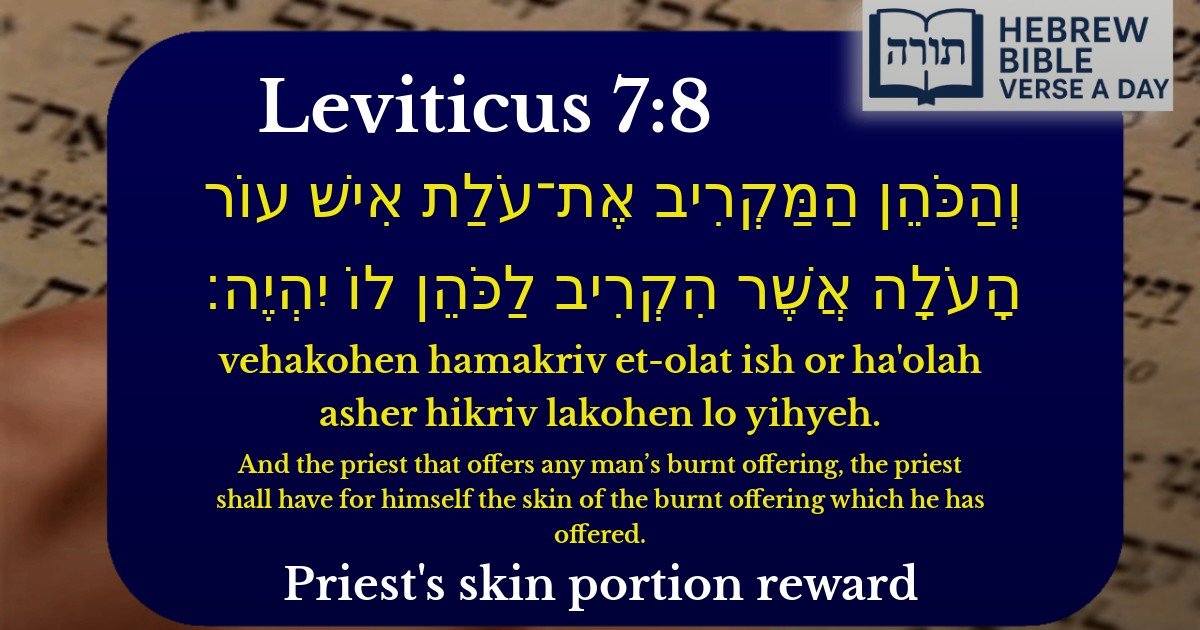
וְהַכֹּהֵן הַמַּקְרִיב אֶת־עֹלַת אִישׁ עוֹר הָעֹלָה אֲשֶׁר הִקְרִיב לַכֹּהֵן לוֹ יִהְיֶה׃
English Translation
And the priest that offers any man’s burnt offering, the priest shall have for himself the skin of the burnt offering which he has offered.
Transliteration
Vehakohen hamakriv et-olat ish or ha'olah asher hikriv lakohen lo yihyeh.
Hebrew Leining Text
וְהַ֨כֹּהֵ֔ן הַמַּקְרִ֖יב אֶת־עֹ֣לַת אִ֑ישׁ ע֤וֹר הָֽעֹלָה֙ אֲשֶׁ֣ר הִקְרִ֔יב לַכֹּהֵ֖ן ל֥וֹ יִהְיֶֽה׃
🎵 Listen to leining
Parasha Commentary
📚 Talmud Citations
This verse is quoted in the Talmud.
📖 Zevachim 12b
The verse is discussed in the context of the laws regarding the distribution of the skins of the burnt offerings to the priests.
📖 Menachot 7a
The verse is referenced in a discussion about the rights of priests to certain portions of the sacrifices.
Explanation of the Verse
The verse (Vayikra 7:8) discusses the distribution of the skin (or ha'olah) from a burnt offering (olah) to the priest who performed the sacrificial service. This is part of the broader Torah laws detailing the rights and portions allocated to the Kohanim (priests) in the Mishkan (Tabernacle) and later the Beit HaMikdash (Temple).
Rashi's Commentary
Rashi (Vayikra 7:8) explains that the skin of the burnt offering is given to the priest who actually performed the sacrificial service (ha'kohen hamakriv), not necessarily the priest who owns the altar or oversees the procedure. This emphasizes the principle that the one who performs the labor receives the reward.
Halachic Implications (Rambam)
Rambam (Hilchot Ma'aseh HaKorbanot 10:4) codifies this law, stating that the skin of a burnt offering is a perquisite (matnot kehunah) reserved exclusively for the officiating priest. This applies even if multiple priests participated in the service—only the one who completed the final steps (e.g., sprinkling the blood) receives the skin.
Midrashic Insight
The Midrash (Torat Kohanim 7:8) connects this law to the broader theme of schar mitzvah (reward for performing a mitzvah). Just as the priest is rewarded with the skin for his service, so too does Hashem reward those who fulfill His commandments, whether in the physical or spiritual realm.
Practical Considerations (Talmud)