
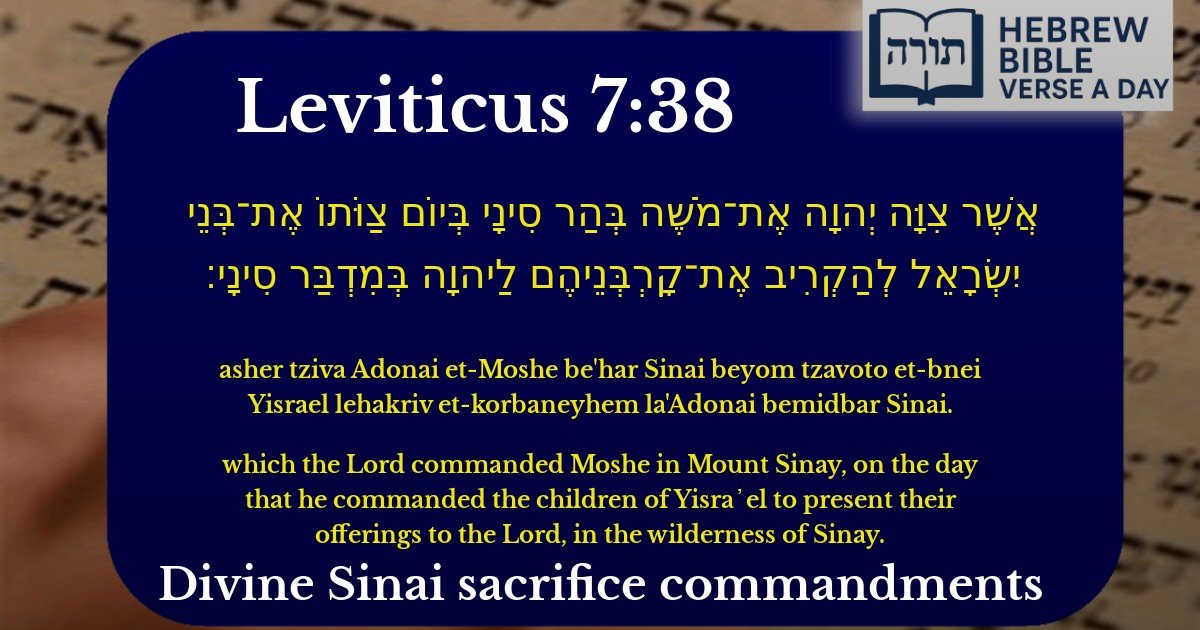

Leviticus 7:38 - Divine Sinai sacrifice commandments

Leviticus 7:38 - ויקרא 7:38

Hebrew Text

אֲשֶׁר צִוָּה יְהוָה אֶת־מֹשֶׁה בְּהַר סִינָי בְּיוֹם צַוֺּתוֹ אֶת־בְּנֵי יִשְׂרָאֵל לְהַקְרִיב אֶת־קָרְבְּנֵיהֶם לַיהוָה בְּמִדְבַּר סִינָי׃

English Translation

which the Lord commanded Moshe in Mount Sinay, on the day that he commanded the children of Yisra᾽el to present their offerings to the Lord, in the wilderness of Sinay.

Transliteration

Asher tziva Adonai et-Moshe be'har Sinai beyom tzavoto et-bnei Yisrael lehakriv et-korbaneyhem la'Adonai bemidbar Sinai.

Hebrew Leining Text

אֲשֶׁ֨ר צִוָּ֧ה יְהֹוָ֛ה אֶת־מֹשֶׁ֖ה בְּהַ֣ר סִינָ֑י בְּי֨וֹם צַוֺּת֜וֹ אֶת־בְּנֵ֣י יִשְׂרָאֵ֗ל לְהַקְרִ֧יב אֶת־קׇרְבְּנֵיהֶ֛ם לַיהֹוָ֖ה בְּמִדְבַּ֥ר סִינָֽי׃ {פ}

🎵 Listen to leining

Parasha Commentary

Context in the Torah

The verse (Vayikra 7:38) appears in the section detailing the laws of sacrifices (korbanot), emphasizing that these commandments were given at Har Sinai. This reinforces the divine origin of the sacrificial system and its eternal significance in Jewish worship.

Rashi's Explanation

Rashi comments that the phrase "בְּיוֹם צַוֺּתוֹ" ("on the day that He commanded") refers specifically to the first day of Nisan, when the Mishkan was erected and the korbanot began to be offered. He notes that despite the Torah's narrative structure, the laws of sacrifices were given earlier at Sinai, but their practical implementation began later.

Rambam's Perspective

In Moreh Nevuchim (3:32), Rambam explains that the korbanot were a concession to the spiritual level of Bnei Yisrael at the time, guiding them away from idolatrous practices toward divine service. The emphasis on Sinai underscores that even these seemingly transitional laws carry eternal divine wisdom.

Midrashic Insights

  • Torat Kohanim: Teaches that the phrase "בְּהַר סִינַי" connects all mitzvot—even those seemingly given later—to the revelation at Sinai, demonstrating their unified divine source.
  • Sifra: Highlights that the wilderness setting ("בְּמִדְבַּר סִינַי") symbolizes humility, a prerequisite for receiving Torah and bringing korbanot.

Theological Significance

The verse underscores that korbanot are not merely ritual acts but divine commandments rooted in the covenant at Sinai. The repetition of "Sinai" (both the mountain and wilderness) emphasizes that even in transient circumstances, the Torah's laws remain eternal and binding.

📚 Talmud Citations

This verse is quoted in the Talmud.

📖 Menachot 45a
The verse is referenced in a discussion about the commandments given at Mount Sinai and their applicability to offerings.
📖 Chullin 28a
Cited in a debate regarding the timing and location of the commandments related to sacrifices.

Frequently Asked Questions

Q: What does Leviticus 7:38 teach us about the origin of the sacrificial laws?
A: Leviticus 7:38 emphasizes that the laws of sacrifices (korbanot) were given by Hashem to Moshe at Mount Sinai. This teaches us that these commandments are divine in origin, not man-made, as Rashi explains that all mitzvot—whether general principles or details—were transmitted at Sinai.
Q: Why does the verse mention both 'Mount Sinai' and 'the wilderness of Sinai'?
A: The dual mention highlights that the commandments were given in a specific time and place—Mount Sinai (the mountain where the Torah was given) and the wilderness (where Bnei Yisrael journeyed). The Midrash notes that this teaches us the mitzvot apply everywhere, not just at Sinai, as the Jewish people carried these laws with them through the desert and beyond.
Q: What is the significance of the phrase 'on the day that He commanded' in this verse?
A: The Ramban explains that this phrase connects the sacrificial laws to the broader moment of Revelation at Sinai. It teaches that just as the Ten Commandments were given with awe and reverence, so too must the korbanot (offerings) be approached with seriousness, as they are part of the same divine covenant.
Q: How does this verse relate to the Jewish people today without the Temple?
A: Although we cannot bring sacrifices today, the Talmud (Berachot 26b) teaches that prayer (tefillah) serves in place of korbanot. This verse reminds us that our worship—whether through sacrifices in the past or prayer now—must be performed with the same devotion as 'the day He commanded' at Sinai.
Q: Why does the Torah specify that these laws were for 'the children of Israel'?
A: The Sforno explains that this emphasizes the unique relationship between Hashem and Bnei Yisrael. The korbanot were not universal laws for all nations but a special system of service given to the Jewish people to elevate their connection to Hashem, as established at Sinai through the covenant.