

Join Our Newsletter To Be Informed When New Videos Are Posted
Hebrew Text
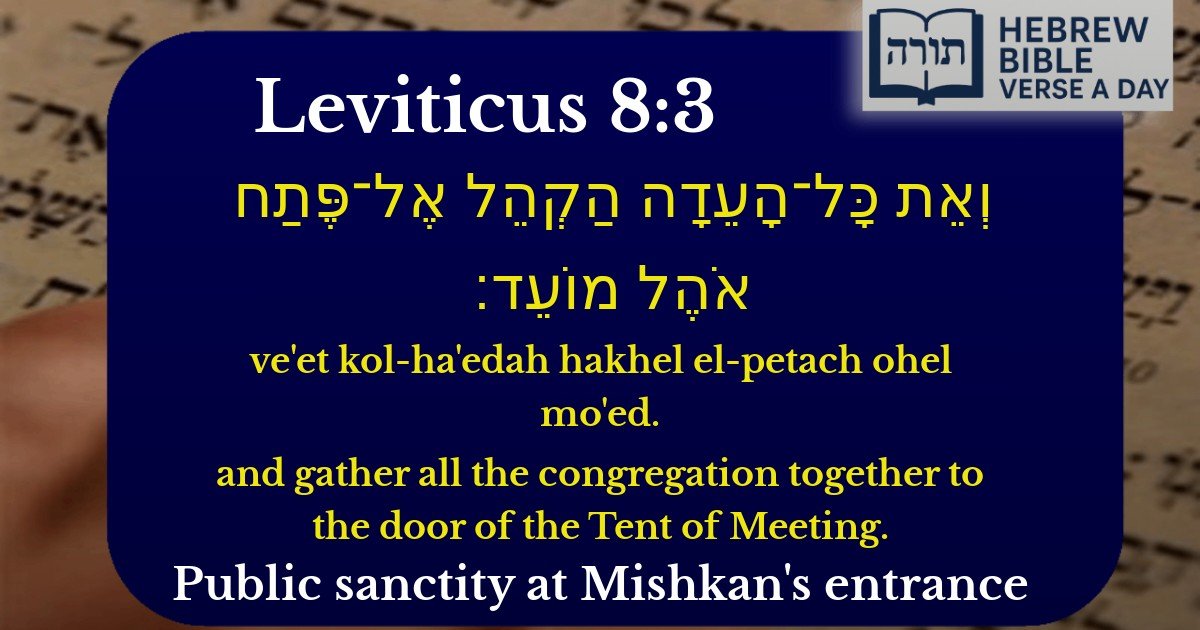
וְאֵת כָּל־הָעֵדָה הַקְהֵל אֶל־פֶּתַח אֹהֶל מוֹעֵד׃
English Translation
and gather all the congregation together to the door of the Tent of Meeting.
Transliteration
Ve'et kol-ha'edah hakhel el-petach ohel mo'ed.
Hebrew Leining Text
וְאֵ֥ת כׇּל־הָעֵדָ֖ה הַקְהֵ֑ל אֶל־פֶּ֖תַח אֹ֥הֶל מוֹעֵֽד׃
🎵 Listen to leining
Parasha Commentary
📚 Talmud Citations
This verse is quoted in the Talmud.
📖 Megillah 23b
The verse is referenced in the discussion about the minimum number of people required for a public reading of the Torah, connecting it to the concept of gathering the congregation.
📖 Sanhedrin 16b
The verse is cited in the context of discussing the proper procedures for assembling the community for important matters, emphasizing the importance of gathering at a designated holy place.
Context in the Torah
The verse appears in Vayikra (Leviticus) 8:3, where Moshe is commanded to assemble the entire congregation of Israel at the entrance of the Ohel Moed (Tent of Meeting) for the inauguration of the Mishkan and the consecration of Aharon and his sons as Kohanim (priests).
Rashi's Explanation
Rashi (Rabbi Shlomo Yitzchaki) comments that the phrase "וְאֵת כָּל־הָעֵדָה הַקְהֵל" ("and gather all the congregation") emphasizes the importance of public participation in this sacred event. He explains that the presence of the entire nation was necessary to witness the sanctification of the Mishkan and the Kohanim, thereby affirming their legitimacy and the divine nature of their service.
Rambam's Perspective
Rambam (Maimonides) in Hilchot Klei HaMikdash (Laws of the Temple Vessels) underscores the principle that major communal mitzvot, such as the inauguration of the Mishkan, require the participation and acknowledgment of the entire nation. This public gathering reinforced the unity of Israel in accepting the divine commandments.
Midrashic Insights
Symbolism of the "Ohel Moed"
The Ohel Moed (Tent of Meeting) represents the dwelling place of the Shechinah (Divine Presence) among Israel. The Kli Yakar (Rabbi Shlomo Ephraim Luntschitz) explains that gathering at its entrance signified the people's approach to holiness and their commitment to serving Hashem collectively.
Halachic Significance
The Mishneh LaMelech (Rabbi Yehoshua Falk) notes that this verse establishes a precedent for public ceremonies involving the entire community, particularly in matters of national religious importance, such as the dedication of the Beit HaMikdash or the appointment of leaders.