
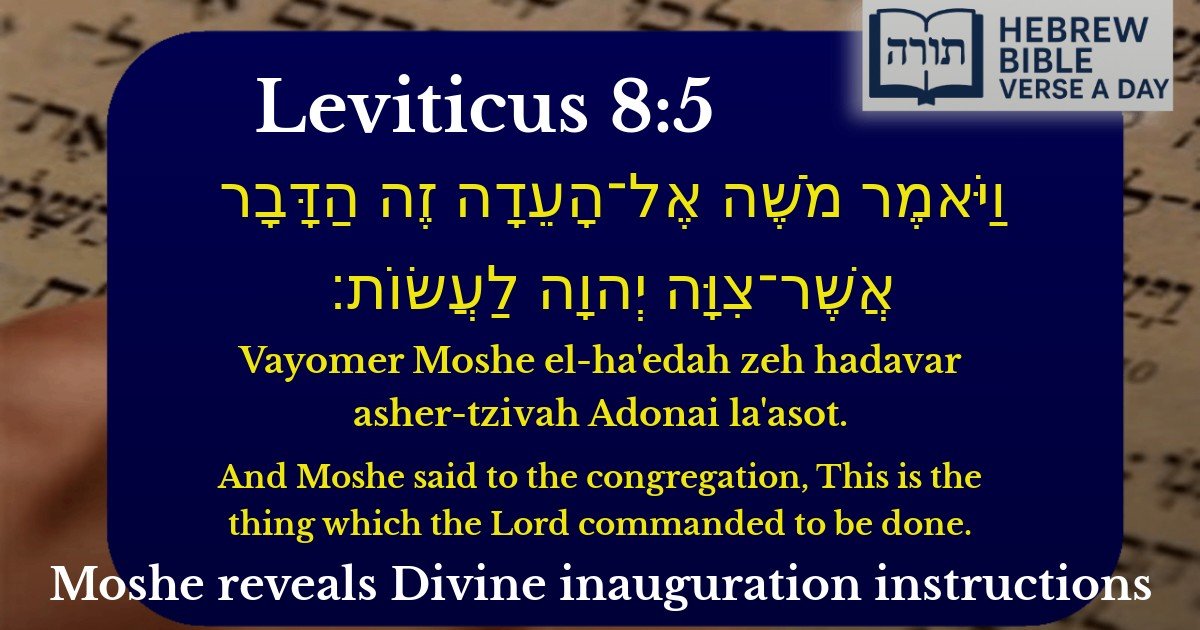

Leviticus 8:5 - Moshe reveals Divine inauguration instructions

Leviticus 8:5 - ויקרא 8:5

Hebrew Text

וַיֹּאמֶר מֹשֶׁה אֶל־הָעֵדָה זֶה הַדָּבָר אֲשֶׁר־צִוָּה יְהוָה לַעֲשׂוֹת׃

English Translation

And Moshe said to the congregation, This is the thing which the Lord commanded to be done.

Transliteration

Vayomer Moshe el-ha'edah zeh hadavar asher-tzivah Adonai la'asot.

Hebrew Leining Text

וַיֹּ֥אמֶר מֹשֶׁ֖ה אֶל־הָעֵדָ֑ה זֶ֣ה הַדָּבָ֔ר אֲשֶׁר־צִוָּ֥ה יְהֹוָ֖ה לַעֲשֽׂוֹת׃

🎵 Listen to leining

Parasha Commentary

Context of the Verse

The verse (Vayikra 8:5) appears in the context of the inauguration of the Mishkan (Tabernacle) and the consecration of Aharon and his sons as Kohanim (priests). Moshe is addressing the entire congregation of Israel, emphasizing that the instructions he is about to convey come directly from Hashem.

Rashi's Explanation

Rashi comments on the phrase "זֶה הַדָּבָר" ("This is the thing"), explaining that Moshe was showing the people the exact details of the mitzvah with clarity and precision. Unlike other instances where Moshe might say "כֹּה אָמַר ה'" ("Thus says Hashem"), here he uses "זֶה הַדָּבָר" to indicate that he was transmitting the commandment exactly as he received it, without any alteration or omission.

Rambam's Perspective

In Moreh Nevuchim (Guide for the Perplexed 3:32), Rambam explains that Moshe's declaration underscores the divine origin of the commandments. The phrase "אֲשֶׁר־צִוָּה יְהוָה" ("which the Lord commanded") reinforces that these laws are not of human origin but are direct instructions from Hashem, binding upon the Jewish people.

Midrashic Insights

  • The Sifra (a halachic Midrash on Vayikra) notes that Moshe's address to the "עֵדָה" (congregation) teaches that major communal mitzvos must be performed in the presence of the entire nation, emphasizing unity and collective responsibility.
  • The Midrash Tanchuma (Tzav 14) highlights that Moshe's words were meant to inspire reverence, as the sanctity of the Mishkan and the priesthood required the people's full attention and commitment to fulfill Hashem's will.

Halachic Implications

The Sefer HaChinuch (Mitzvah 132) derives from this verse the importance of precision in fulfilling mitzvos. Just as Moshe conveyed the details exactly as commanded, so too must every Jew strive to perform mitzvos with meticulous care, adhering to the halachic requirements as transmitted through the Mesorah (tradition).

📚 Talmud Citations

This verse is quoted in the Talmud.

📖 Yoma 73b
The verse is referenced in the discussion about the rituals performed by the High Priest on Yom Kippur, emphasizing the importance of following divine commandments precisely as instructed.
📖 Sanhedrin 17a
The verse is cited in the context of discussing communal obligations and the authority of Moses in conveying God's commandments to the people.

Frequently Asked Questions

Q: What is the context of Leviticus 8:5?
A: Leviticus 8:5 describes Moshe (Moses) speaking to the congregation of Israel at the inauguration of the Mishkan (Tabernacle). He is conveying Hashem's commandments regarding the consecration of Aharon (Aaron) and his sons as Kohanim (priests). Rashi explains that this verse emphasizes that Moshe followed Hashem's instructions precisely, teaching us the importance of exactness in fulfilling mitzvos.
Q: Why does the verse say 'this is the thing' instead of just 'this is what'?
A: The phrase 'זֶה הַדָּבָר' (this is the thing) is used to stress that Moshe was transmitting Hashem's command with absolute accuracy, without adding or omitting anything. The Midrash teaches that this wording underscores the principle of precise transmission of Torah teachings, a foundation of our mesorah (tradition).
Q: What lesson can we learn from Moshe saying 'this is the thing which the Lord commanded'?
A: The Rambam teaches that this verse demonstrates the proper way to transmit Torah - with clarity and faithfulness to the original command. Just as Moshe didn't add his own interpretations when conveying Hashem's word, we learn the importance of preserving Torah teachings exactly as we receive them from reliable sources.
Q: How does this verse relate to leadership in Judaism?
A: This verse shows Moshe's model of Jewish leadership - humbly conveying Hashem's word without personal alteration. The Talmud (Yoma 4b) derives from here that a true leader must faithfully represent the Torah's teachings, not his own agenda. This principle applies to all Torah teachers and community leaders today.
Q: Why is it important that Moshe spoke to the entire congregation?
A: The Ohr HaChaim explains that addressing the entire congregation teaches that the sanctity of the Mishkan and Kehuna (priesthood) concerned all of Israel. This reflects the principle that every Jew has a share in the holiness of mitzvos, even those performed by the Kohanim on behalf of the nation.