Frequently Asked Questions
Q: What does it mean to anoint someone with oil in the Torah?
A: In the Torah, anointing with special oil (shemen hamishchah) signifies setting someone apart for a holy role. Here, Aharon is anointed as Kohen Gadol (High Priest), showing his unique status in serving Hashem in the Mishkan (Tabernacle). Rashi explains this anointing was done by pouring oil on his head, marking his sanctification for this sacred duty.
Q: Why was only Aharon anointed as High Priest and not others?
A: Aharon was chosen by Hashem for this role, as stated earlier in the Torah (Exodus 28:1). The Midrash teaches that this anointing showed his unique position of leadership in avodah (service in the Mishkan). His descendants would later inherit this role, but he was the first to be sanctified in this special way.
Q: What can we learn from the anointing of Aharon today?
A: The Rambam teaches that while we no longer have the anointing oil today, we learn the importance of treating leadership roles with respect and sanctity. Just as Aharon was set apart for holy service, we should approach mitzvot and leadership positions with seriousness and dedication.
Q: What was the special anointing oil made of?
A: The anointing oil (shemen hamishchah) was made from a unique blend of spices and olive oil as described in Exodus 30:22-25. The Talmud (Keritot 5a) explains it was prepared with great care and was never to be replicated for personal use, showing its sacred nature.
Q: Why was the oil poured on Aharon's head specifically?
A: Rashi explains that pouring oil on the head symbolizes the flow of wisdom and divine spirit needed for leadership. The head represents the seat of thought and decision-making, showing that a leader must be guided by Torah wisdom in all matters.

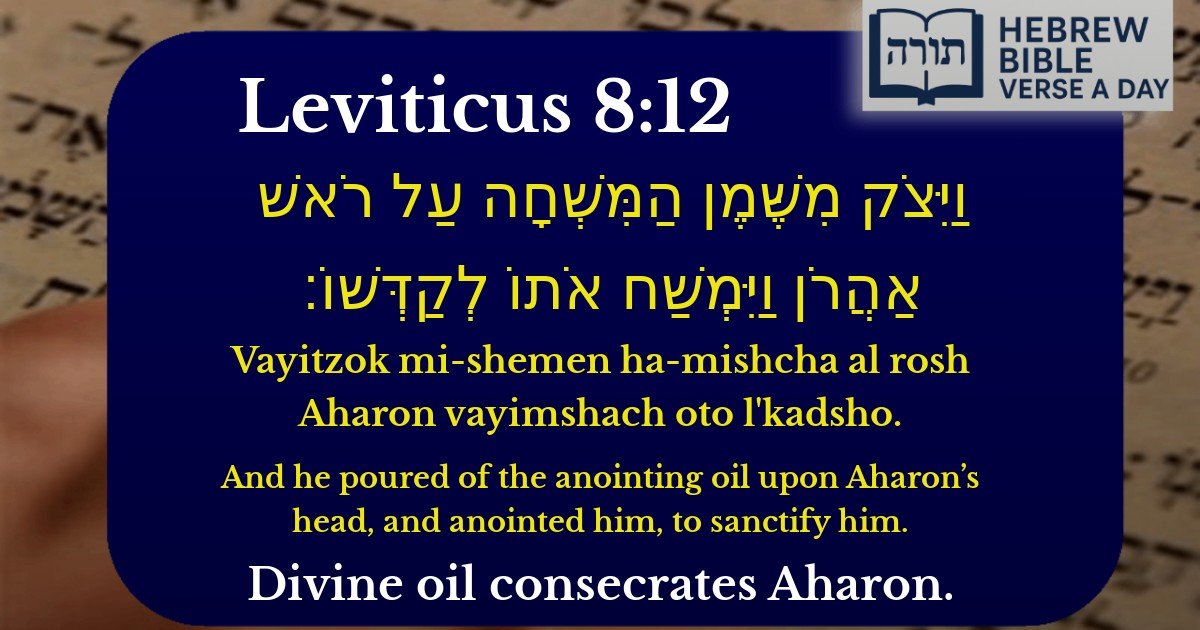

The Significance of Anointing Aharon
The verse (Vayikra 8:12) describes Moshe anointing Aharon with the sacred anointing oil (shemen hamishchah) to sanctify him for the priesthood. Rashi explains that the anointing was performed by pouring the oil on Aharon's head in the shape of the Greek letter chi (Χ), symbolizing the Divine Name (Shem Havayah) being bestowed upon him. This act set Aharon apart for his sacred role as Kohen Gadol.
The Purpose of the Anointing Oil
Rambam (Hilchos Klei HaMikdash 1:7) teaches that the anointing oil was used exclusively for:
The Sforno adds that the oil represented wisdom and Divine inspiration, as oil illuminates - just as the Kohen Gadol must illuminate the people with Torah and service of Hashem.
The Symbolism of Pouring on the Head
The Midrash (Tanchuma Tetzaveh 10) explains that the head was anointed specifically because:
The Act of Sanctification
The Kli Yakar emphasizes that the phrase "lekadsho" (to sanctify him) teaches that the anointing wasn't merely ceremonial. It effected an actual metaphysical change in Aharon's status, elevating him to a state of holiness fit for the Temple service. This parallels how objects consecrated for Temple use become forbidden for mundane purposes.