Frequently Asked Questions
Q: What does Leviticus 9:19 mean?
A: Leviticus 9:19 describes the specific fats and organs from sacrificial animals (a bull and a ram) that were to be offered on the altar during the inauguration of the Mishkan (Tabernacle). According to Rashi and traditional Jewish sources, these fats (chelev) and organs were considered the choicest parts and were exclusively designated for Hashem as part of the korbanot (offerings).
Q: Why is the 'fat tail' mentioned in Leviticus 9:19?
A: The 'fat tail' (alyah) refers to a special fatty portion found in certain sheep breeds in the ancient Near East. The Talmud (Chullin 117a) explains that this was a prized part of the animal, and its inclusion in the sacrifice emphasized giving the best to Hashem. Rambam (Hilchot Ma'aseh HaKorbanot 7:5) notes that only certain fats were permitted for the altar, and the alyah was one of them.
Q: Why are the kidneys and liver mentioned in sacrifices?
A: The kidneys and the 'appendage of the liver' (yoteret hakaver) were considered spiritually significant in Jewish tradition. The Midrash (Vayikra Rabbah 3:4) teaches that these organs symbolize thought (kidneys) and emotion (liver), representing the donor's complete devotion in serving Hashem. By offering them, the person demonstrated that their inner faculties were dedicated to divine service.
Q: Do these sacrificial laws apply today?
A: While the Temple stands in Jerusalem is not currently standing, these laws remain important in Torah study. Rambam (Hilchot Beit HaBechirah) explains that all the details of korbanot will be reinstated in the future Third Temple. Today, we remember these mitzvot through prayer and learning, as taught in the Talmud (Megillah 31b), which states that studying the laws of sacrifices is considered like offering them.
Q: What can we learn from Leviticus 9:19 today?
A: This verse teaches the principle of giving our best to Hashem, even when we cannot bring physical sacrifices. The Kli Yakar (Rabbi Shlomo Ephraim Luntschitz) explains that just as the choicest fats were offered, we should dedicate our finest efforts—whether in prayer, charity, or mitzvot—with sincerity and excellence. This idea is echoed in Proverbs (3:9): 'Honor Hashem with your wealth and with the first of all your produce.'

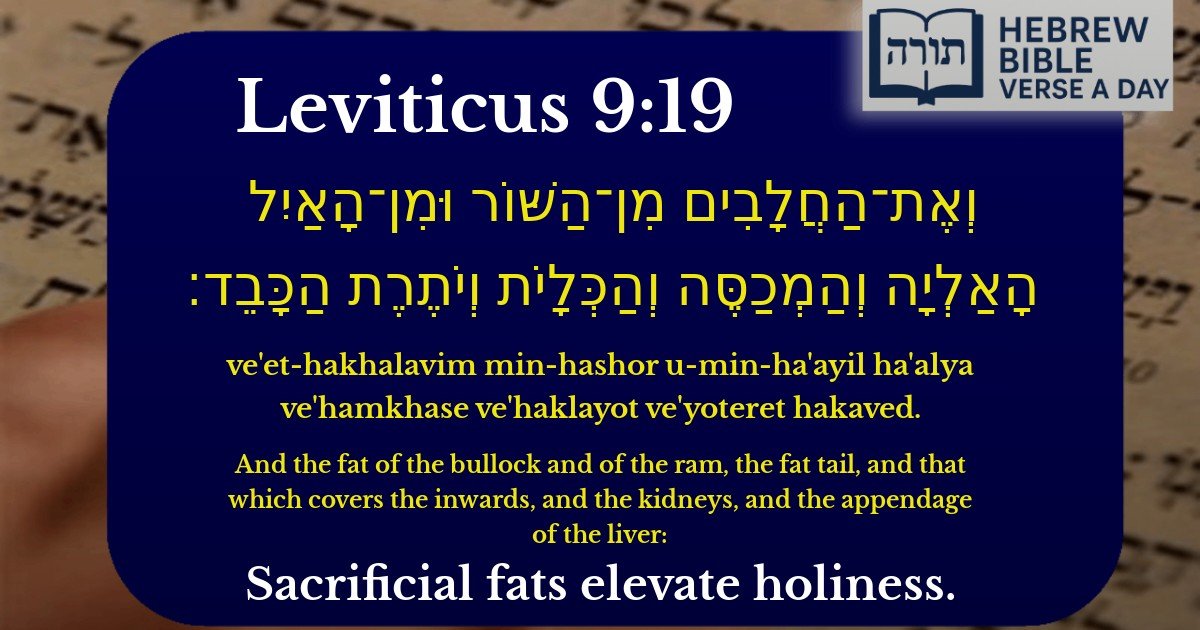

Explanation of the Verse from Vayikra (Leviticus) 3:9
The verse discusses the portions of animal sacrifices that were offered on the mizbe'ach (altar) in the Beit HaMikdash (Holy Temple). These fats and organs were designated as cheilev (forbidden fats) and emurim (offerings burned on the altar).
Key Components of the Offering
Spiritual Significance
The Sforno (Vayikra 3:9) teaches that these parts were chosen because they represent indulgence and vitality (fat being a symbol of richness and pleasure). By offering them on the altar, a person demonstrates that even their physical desires are sanctified to Hashem. The removal and burning of these fats also serve as a reminder to distance oneself from materialism and focus on spiritual elevation.
Halachic Implications
The Rambam (Hilchot Ma'achalot Asurot 7:5) rules that consuming these forbidden fats (חֵלֶב) is a severe Torah prohibition. The Gemara (Chullin 49b) elaborates on the precise definitions of these fats to ensure proper observance of the mitzvah.