Frequently Asked Questions
Q: What does Leviticus 11:22 teach about kosher insects?
A: Leviticus 11:22 lists four types of kosher locusts/grasshoppers that are permitted to eat according to Jewish law: arbeh, solam, chargol, and chagav. The Torah specifies that only these species (and their kinds) may be consumed, while all other insects are forbidden. This is part of the kashrut laws given in the Torah.
Q: Why does the Torah specify different kinds of locusts that can be eaten?
A: The Torah specifies exact species to teach us that not all insects are the same in Jewish law. According to Rashi and the Talmud (Chullin 59a, 65b), only locusts with specific identifying signs are permitted. The detailed listing prevents confusion and establishes clear boundaries for what is kosher, which is a fundamental principle in halacha (Jewish law).
Q: Do Jews still eat kosher locusts today?
A: While the Torah permits certain locusts, most Ashkenazi Jewish communities lost the tradition of which exact species are permitted and therefore avoid all insects. Some Yemenite and North African Jewish communities maintain traditions about identifying kosher locusts and may consume them on rare occasions. The Rambam (Hilchos Maachalos Asuros 1:21-22) discusses the laws but notes the importance of having a clear tradition.
Q: What lesson can we learn from the laws about kosher locusts?
A: This teaches us that G-d's commandments have precise details that matter. Just as the Torah distinguishes between permitted and forbidden species, we learn to pay attention to distinctions in all areas of Jewish life. The Midrash (Vayikra Rabbah 22:10) connects this to making proper distinctions between good and evil in our behavior.
Q: How do we identify the kosher locusts mentioned in Leviticus 11:22?
A: The Talmud (Chullin 59a) gives identifying signs: kosher locusts have four legs, four wings, and jumping legs. Rashi explains they must also have a certain body structure. However, since proper identification requires a living tradition, most communities today avoid eating any locusts unless they have an unbroken tradition passed down from earlier generations about specific permitted species.

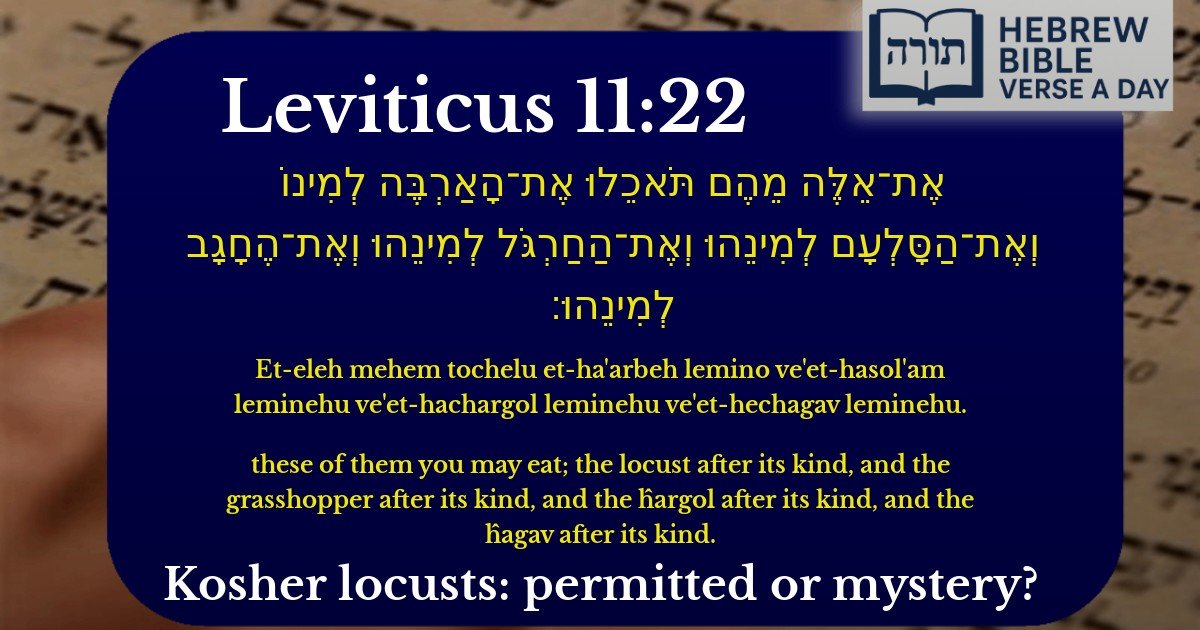

Permitted Species of Locusts
The verse (Vayikra 11:22) lists four types of locusts that are permitted for consumption, each specified "after its kind." The Torah permits these insects despite the general prohibition against eating most creeping creatures. The Gemara (Chullin 59a) discusses the identifying signs of kosher locusts, which include having four legs, four wings, and jointed legs for hopping.
Identification of the Four Species
Halachic Considerations
The Shulchan Aruch (Yoreh De'ah 85:1) rules that only locusts with a known mesorah (tradition) of being eaten by Jewish communities may be consumed. The Rambam (ibid.) emphasizes that one must be certain of the species before eating, as misidentification could lead to transgression.
Symbolic Meaning
The Kli Yakar suggests that the permitted locusts symbolize humility and repentance—traits associated with their swarming nature and sudden appearance. Their inclusion among kosher creatures teaches that even seemingly lowly beings can be elevated through proper intention and adherence to halacha.