Frequently Asked Questions
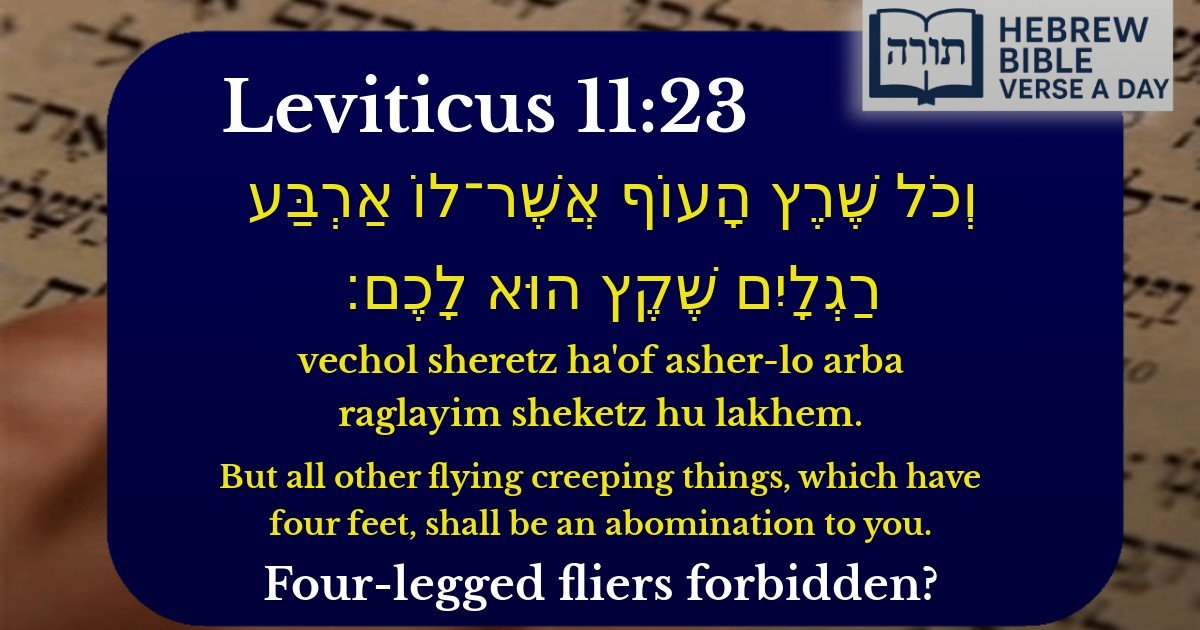
Q: What does Leviticus 11:23 mean when it says flying creeping things with four feet are an abomination?
A: This verse refers to certain insects or flying creatures that crawl and have four legs. According to Jewish law (based on the Torah), these creatures are considered 'sheketz' (an abomination) and are not kosher for consumption. Rashi explains that this refers to certain winged insects that walk on four legs, distinguishing them from permitted insects like locusts, which have jointed legs for hopping (see Leviticus 11:21).
Q: Why does the Torah prohibit eating flying insects with four legs?
A: The Torah establishes kosher dietary laws to sanctify Jewish life and separate the Jewish people in their conduct. Rambam (Hilchot Ma'achalot Asurot) explains that these laws teach discipline and elevate a person's spiritual state by avoiding certain creatures. The prohibition against four-legged flying insects falls under these divine commandments, even if the reason isn't always fully understood.
Q: Are there any flying insects that are kosher to eat according to Jewish law?
A: Yes, the Torah permits certain insects. Leviticus 11:21-22 specifies that locusts, grasshoppers, and crickets with jointed hind legs for hopping are kosher. The Talmud (Chullin 59a) lists the permitted species, and Jewish tradition identifies specific types based on mesorah (received tradition). However, most flying insects with four legs (like flies or beetles) are forbidden as stated in our verse.
Q: How do we apply Leviticus 11:23 today in keeping kosher?
A: Today, Orthodox Jews strictly avoid eating any insects unless they are from the explicitly permitted types (like certain locusts in communities with that tradition). Processed foods are carefully checked for insect infestation, and vegetables are inspected or specially washed to remove tiny insects. The Shulchan Aruch (Yoreh De'ah) details these practical applications to maintain kosher standards.
Q: What is the spiritual lesson behind not eating these creatures?
A: The Midrash (Vayikra Rabbah 13:2) teaches that kosher laws refine a person's character by cultivating discipline and sensitivity to holiness. Avoiding 'sheketz' (abominable creatures) symbolizes distancing oneself from spiritually degrading influences. Ramban (Nachmanides) adds that non-kosher species negatively affect the soul's purity, while permitted foods elevate one's connection to Hashem.


Understanding the Prohibition
The verse (Leviticus 11:20) states: "But all other flying creeping things, which have four feet, shall be an abomination to you." This is part of the Torah's detailed laws of kashrut, specifically addressing forbidden creatures. The term sheketz (abomination) underscores the severity of consuming these insects, as they are spiritually impure and unfit for Jewish consumption.
Rashi's Explanation
Rashi clarifies that this verse refers to certain flying insects that crawl on four legs, in addition to having wings. He notes that these creatures are distinct from the permitted locusts mentioned earlier in the passage (Leviticus 11:21-22), which have jointed legs for hopping. Rashi emphasizes that the Torah prohibits insects that primarily crawl rather than fly, as their mode of movement renders them impure.
Rambam's Classification
In Mishneh Torah (Hilchot Ma'achalot Asurot 2:13-14), Rambam elaborates on the criteria for forbidden insects. He explains that any flying insect with four legs—beyond the two wings—is prohibited. This aligns with the Talmudic discussion in Chullin 65b, which distinguishes between permitted and forbidden insects based on their physical characteristics.
Midrashic Insight
The Midrash Tanchuma (Shemini 12) connects this prohibition to the broader theme of holiness. It teaches that avoiding sheketz (abominable creatures) elevates the Jewish people, separating them from impurity and aligning them with divine sanctity. The Midrash emphasizes that dietary laws are not arbitrary but serve to refine the soul.
Practical Halachic Implications