Frequently Asked Questions
Q: What does Leviticus 11:29 teach us about kosher animals?
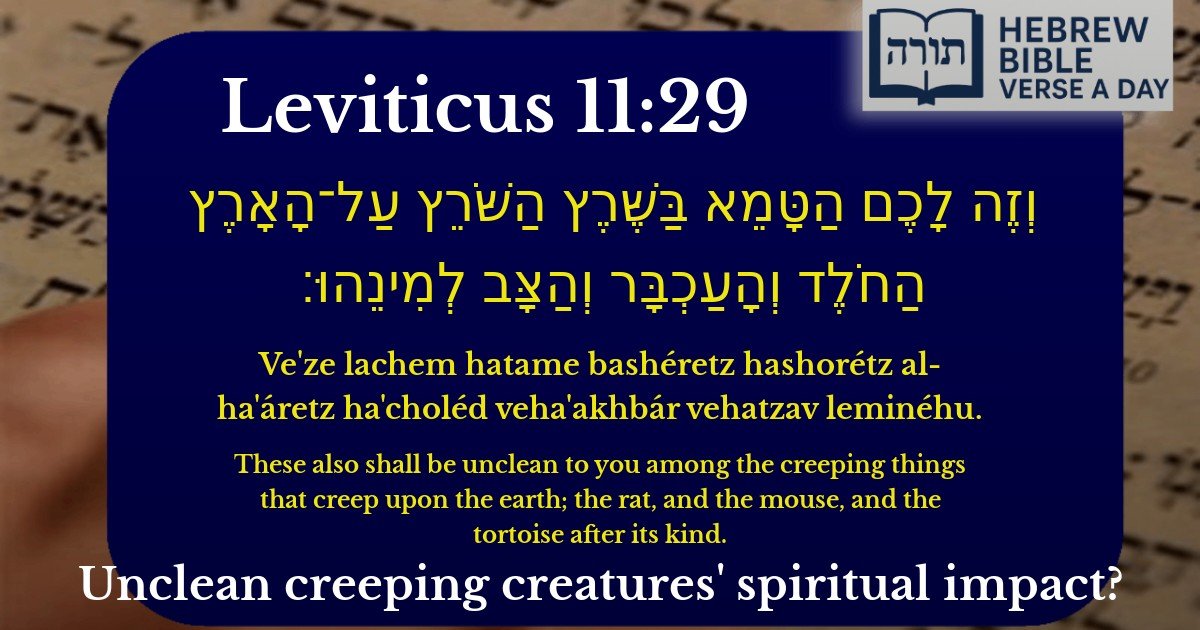
A: Leviticus 11:29 lists specific creeping animals (the rat, mouse, and tortoise) that are considered unclean (non-kosher) according to Jewish law. The Torah teaches that these creatures are forbidden to eat or derive benefit from, as they fall under the category of 'sheretz' (creeping things) that make a person ritually impure (tamei).
Q: Why does the Torah specify certain animals as unclean?
A: The Torah designates certain animals as unclean to teach us holiness (kedushah) in our daily lives. Rashi explains that these laws help refine our character by exercising self-control and following Hashem's commandments, even in matters that may seem mundane like food choices. The Rambam (Hilchot Ma'achalot Asurot) further explains that these creatures are spiritually harmful or naturally repulsive.
Q: How do we identify the animals mentioned in Leviticus 11:29 today?
A: Traditional Jewish sources identify 'the rat' (חולד) as the mole, 'the mouse' (עכבר) as common mice, and 'the tortoise' (צב) as various turtle or tortoise species. The Talmud (Chullin 122b) discusses their characteristics. For practical halacha, one must consult a reliable kosher authority, as some identifications may differ slightly in modern times.
Q: What practical lesson can we learn from these laws today?
A: The Sages teach that the kosher laws remind us to be mindful in all aspects of life. Just as we carefully distinguish between pure and impure foods, we should cultivate discernment in our actions, speech, and thoughts. The Sefer HaChinuch (Mitzvah 163) explains that these laws train us to avoid negative influences and pursue holiness.
Q: Do these laws apply to touching these animals or just eating them?
A: According to halacha, while eating these creatures is strictly forbidden, merely touching their dead bodies makes one ritually impure (tamei) as explained in Leviticus 11:31-32. The Talmud (Chullin 122a) discusses the details of this impurity. However, live animals generally don't convey impurity through touch unless they die in one's hand (Rambam, Hilchot Avot HaTumah 4:1).


Verse Context in Vayikra (Leviticus)
The verse appears in Vayikra 11:29, within the broader discussion of tum'ah (ritual impurity) caused by certain creeping creatures. The Torah enumerates specific animals that transmit impurity when they die, emphasizing the need for kedushah (holiness) in daily life by avoiding contact with them.
Identification of the Animals
Halachic Implications
The Mishnah (Keilim 1:1) teaches that these creatures transmit impurity not only through direct contact but also if they are found in food or vessels. The Sefer HaChinuch (Mitzvah 162) explains that this prohibition trains us to distance ourselves from lowly, creeping creatures—symbolizing base desires—and instead pursue spiritual refinement.
Symbolic Interpretation
The Midrash (Vayikra Rabbah 13:5) suggests these animals represent negative traits: the rat symbolizes stealth and theft, the mouse signifies destruction (as it gnaws through possessions), and the tortoise reflects sluggishness in mitzvot. Avoiding them teaches us to reject such behaviors in our spiritual lives.
Practical Application
The Shulchan Aruch (Yoreh De'ah 84:1) rules that any of these creatures, whether alive or dead, impart impurity if touched or carried. The Rema adds that contemporary practice requires vigilance in checking food storage areas to prevent contamination, reflecting the Torah’s enduring relevance in maintaining taharah (ritual purity).