
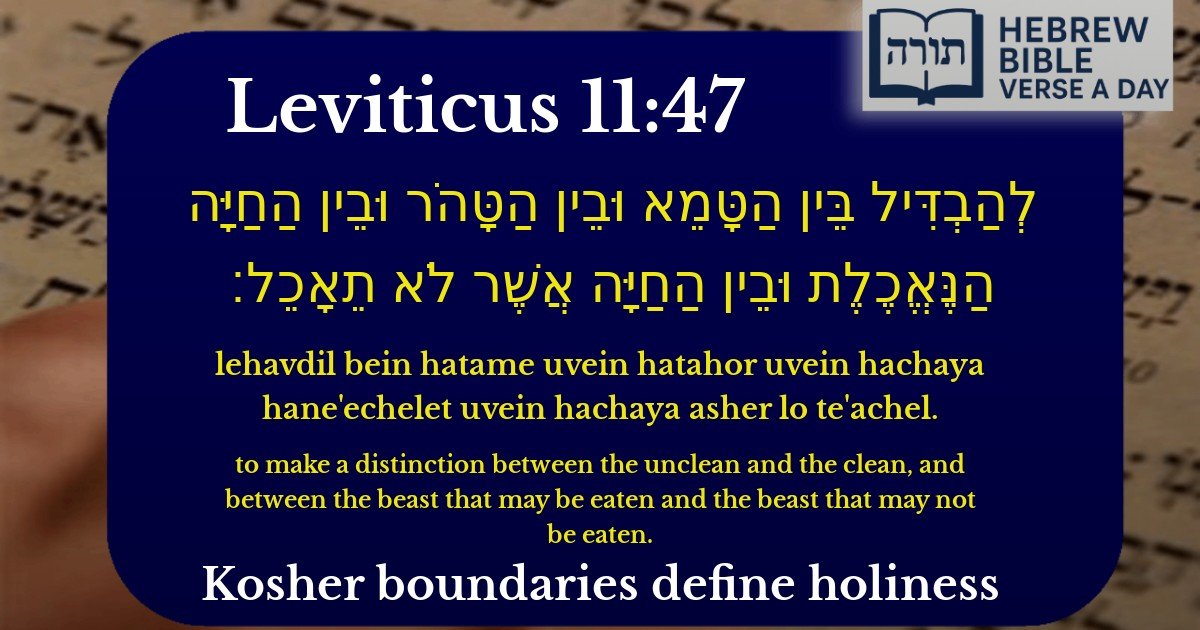

Leviticus 11:47 - Kosher boundaries define holiness

Leviticus 11:47 - ויקרא 11:47

Hebrew Text

לְהַבְדִּיל בֵּין הַטָּמֵא וּבֵין הַטָּהֹר וּבֵין הַחַיָּה הַנֶּאֱכֶלֶת וּבֵין הַחַיָּה אֲשֶׁר לֹא תֵאָכֵל׃

English Translation

to make a distinction between the unclean and the clean, and between the beast that may be eaten and the beast that may not be eaten.

Transliteration

Lehavdil bein hatame uvein hatahor uvein hachaya hane'echelet uvein hachaya asher lo te'achel.

Hebrew Leining Text

לְהַבְדִּ֕יל בֵּ֥ין הַטָּמֵ֖א וּבֵ֣ין הַטָּהֹ֑ר וּבֵ֤ין הַֽחַיָּה֙ הַֽנֶּאֱכֶ֔לֶת וּבֵין֙ הַֽחַיָּ֔ה אֲשֶׁ֖ר לֹ֥א תֵאָכֵֽל׃ {פ}

🎵 Listen to leining

Parasha Commentary

Distinction Between Pure and Impure

The verse (Vayikra 11:47) emphasizes the mitzvah of distinguishing between tamei (impure) and tahor (pure), as well as between permitted and forbidden animals for consumption. Rashi explains that this verse serves as a summary of the preceding laws of kashrut, highlighting the importance of discernment in adhering to Hashem's commandments. The ability to differentiate reflects the Jewish people's unique role as a holy nation.

Purpose of Kashrut Laws

Rambam (Hilchot Ma'achalot Asurot 17:26) teaches that the dietary laws are not merely about physical health but are primarily spiritual disciplines. By abstaining from forbidden animals, a Jew refines their character and elevates their soul. The Midrash (Vayikra Rabbah 13:2) further states that these distinctions serve to sanctify Bnei Yisrael, separating them from other nations in their devotion to Hashem.

Symbolism of Permitted and Forbidden Animals

  • Permitted Animals: The Talmud (Chullin 59a) notes that kosher animals possess specific signs (split hooves and chewing cud for land animals; fins and scales for fish). These physical traits symbolize moral virtues—split hooves represent discernment in one's path, while chewing cud signifies thoughtful reflection.
  • Forbidden Animals: Carnivorous or predatory animals, which are non-kosher, embody traits of cruelty and aggression. Avoiding them reinforces ethical conduct (Sefer HaChinuch, Mitzvah 73).

Spiritual Implications

The Sforno comments that the mitzvah of distinguishing between pure and impure extends beyond food—it trains a Jew to differentiate between holy and profane in all aspects of life. The Vilna Gaon adds that mastering this discernment prepares one for higher levels of kedushah (holiness), as the physical act of eating influences the soul's purity.

📚 Talmud Citations

This verse is quoted in the Talmud.

📖 Chullin 42a
The verse is referenced in the discussion about the laws of kosher and non-kosher animals, emphasizing the distinction between clean and unclean beasts.
📖 Niddah 51b
The verse is cited in the context of discussing purity laws, particularly the differentiation between what is ritually pure and impure.

Frequently Asked Questions

Q: What does Leviticus 11:47 mean?
A: Leviticus 11:47 teaches the commandment to distinguish between what is ritually pure (tahor) and impure (tamei), as well as between animals that are permitted (kosher) and forbidden (non-kosher) to eat according to Jewish law. This verse summarizes the laws of kashrut (dietary laws) given in the Torah.
Q: Why is distinguishing between pure and impure important in Judaism?
A: Distinguishing between pure and impure is central to Jewish life because it reflects holiness (kedushah). The Rambam (Hilchot Ma'achalot Asurot) explains that these laws elevate a Jew's spiritual state by instilling discipline and mindfulness in daily actions, connecting physical sustenance with divine service.
Q: What animals are considered clean (tahor) and unclean (tamei) in Leviticus 11?
A: Leviticus 11 details the signs of kosher animals: land animals must have split hooves and chew their cud (e.g., cows, sheep), fish need fins and scales, and birds must not be among the forbidden species listed (e.g., eagles, owls). Rashi clarifies that insects and certain creatures like pigs are inherently non-kosher.
Q: How do the laws of kosher animals apply today?
A: The laws remain binding today as part of halacha (Jewish law). The Shulchan Aruch (Yoreh De'ah) codifies detailed rules for slaughter (shechita), checking for defects, and separating meat and dairy. Observance preserves Jewish identity and spiritual discipline, as taught in the Talmud (Chullin 109a).
Q: What spiritual lesson can we learn from this verse?
A: The Midrash (Vayikra Rabbah 13:3) teaches that these laws train us to exercise self-control and mindfulness, refining our character. By distinguishing between permitted and forbidden, we emulate Hashem’s holiness, as the verse concludes (Leviticus 11:44): 'You shall be holy, for I am holy.'