

Join Our Newsletter To Be Informed When New Videos Are Posted
Hebrew Text
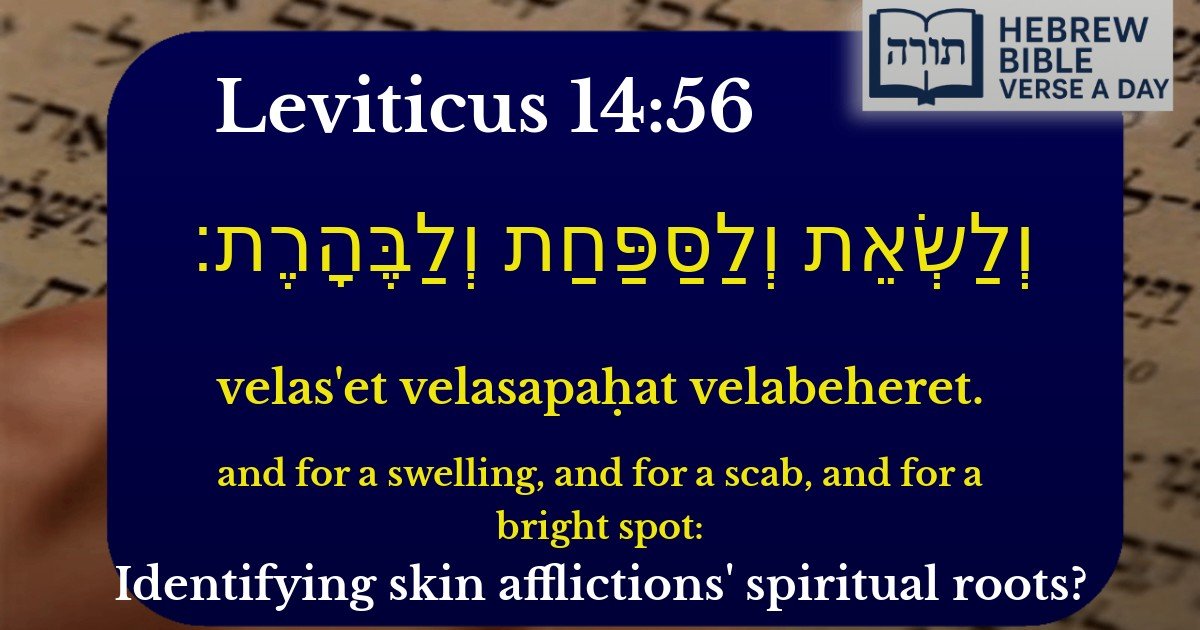
וְלַשְׂאֵת וְלַסַּפַּחַת וְלַבֶּהָרֶת׃
English Translation
and for a swelling, and for a scab, and for a bright spot:
Transliteration
Velas'et velasapaḥat velabeheret.
Hebrew Leining Text
וְלַשְׂאֵ֥ת וְלַסַּפַּ֖חַת וְלַבֶּהָֽרֶת׃
🎵 Listen to leining
Parasha Commentary
📚 Talmud Citations
This verse is quoted in the Talmud.
📖 Nega'im 1:1
The verse is referenced in the Mishnah as part of the discussion on the laws of skin afflictions (tzara'at), where it lists the types of afflictions that require examination by a priest.
📖 Arakhin 3b
The verse is cited in a discussion about the different types of skin afflictions and their implications for ritual purity.
Context in Torah
The verse (Vayikra 14:56) appears in the context of the laws of tzara'at (often mistranslated as "leprosy"), detailing the various skin afflictions that require examination by a Kohen. The terms שְׂאֵת (swelling), סַּפַּחַת (scab), and בֶּהָרֶת (bright spot) are three of the primary categories of tzara'at blemishes discussed in the Torah.
Explanation of Terms
Spiritual Significance
The Sages (Arachin 16a) teach that tzara'at is not merely a physical ailment but a spiritual affliction, often brought about by sins such as lashon hara (evil speech), arrogance, or stinginess. The different types of blemishes symbolize varying degrees or manifestations of these spiritual flaws:
Halachic Implications
Rambam (Hilchot Tuma'at Tzara'at 9:1-2) emphasizes that the determination of impurity or purity is solely the domain of a Kohen, not a physician. The Kohen examines the affliction based on the Torah's criteria, and his declaration is binding. This underscores the idea that tzara'at is a spiritual matter requiring divine wisdom, not merely a medical condition.