Frequently Asked Questions
Q: What does Leviticus 15:17 mean?
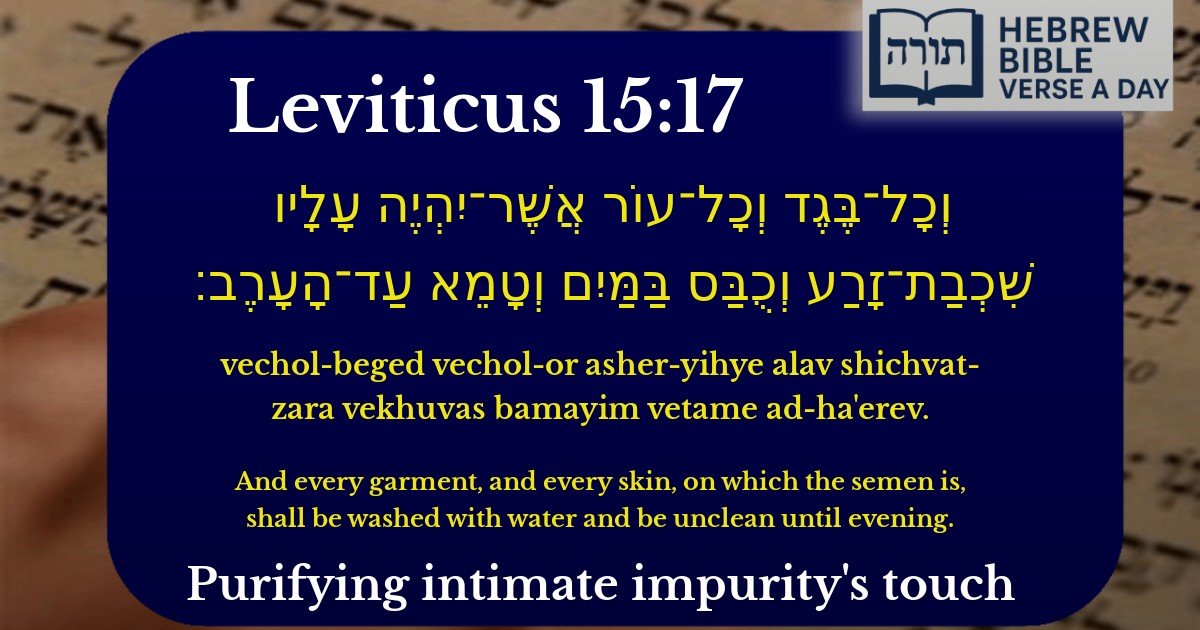
A: Leviticus 15:17 discusses the laws of ritual impurity (tum'ah) related to bodily emissions. According to Orthodox Jewish interpretation, this verse teaches that any garment or leather item that comes into contact with semen becomes ritually impure and must be washed in water. The impurity lasts until evening (after sunset). This is part of the Torah's detailed laws about purity and impurity, which were especially relevant when the Holy Temple stood.
Q: Why is washing required for impurity from semen?
A: The Torah requires washing to restore ritual purity because certain bodily emissions create a state of tum'ah (impurity). Rashi explains that this teaches discipline and holiness, reminding us to elevate physical acts. The Rambam (Hilchot Mechusrei Kapparah) notes that these laws emphasize the importance of spiritual cleanliness alongside physical cleanliness in Jewish life.
Q: Does this law still apply today without the Temple?
A: While the full laws of ritual purity cannot be observed today without the Holy Temple, the principle of maintaining holiness in physical matters remains important. The Talmud (Berachot 22a) discusses aspects that still apply, such as the requirement for immersion in a mikveh after certain emissions. However, the specific garment purification is currently not practiced in the same way without the Temple.
Q: What can we learn from this verse about Judaism's view of the body?
A: This verse shows Judaism's balanced view of the human body - it's not sinful, but requires sanctification. The Midrash (Vayikra Rabbah) teaches that these laws elevate physicality by giving us mindful ways to engage with our bodies. Impurity doesn't mean sin; it's a temporary spiritual state requiring purification, showing that holiness can be regained through proper actions.
Q: Why does the impurity last until evening?
A: The 'until evening' timeframe appears in many purification laws. Rashi explains that this period represents a complete cycle (from day to night), symbolizing renewal. The Talmud (Chulin 31a) notes that most temporary impurities last until evening because nightfall marks a natural transition point, after which a person can return to their regular holy activities in a state of purity.


Context in Torah and Halacha
This verse appears in Vayikra (Leviticus) 15:17, within the broader discussion of tum'ah (ritual impurity) related to bodily emissions. The Torah outlines various states of impurity and their purification processes, emphasizing the importance of maintaining ritual purity, especially in relation to the Mishkan (Tabernacle) and later the Beit HaMikdash (Temple).
Rashi's Explanation
Rashi (Vayikra 15:17) clarifies that the verse refers to a garment or leather item that comes into contact with shichvas zera (seminal emission). He notes that the impurity applies whether the emission was deliberate or accidental, and the item must be immersed in a mikveh (ritual bath) to regain purity. The phrase "ve'tamei ad ha'arev" ("unclean until evening") indicates that the impurity lasts until nightfall after immersion.
Rambam's Halachic Analysis
In Mishneh Torah (Hilchot Metamei Mishkav u'Moshav 5:1), Rambam codifies this law, stating that any garment or leather item contaminated by shichvas zera becomes a primary source of impurity (av hatum'ah). He emphasizes that immersion alone is insufficient; the item must also be washed in water before immersion to remove the physical residue.
Talmudic Discussion
Midrashic Insight
Torat Kohanim (Sifra, Metzora 9:5) connects this law to the broader theme of kedushah (holiness), teaching that even natural bodily functions require mindfulness and purification to elevate physical acts into spiritual ones. The temporary impurity serves as a reminder to sanctify intimate aspects of life.
Practical Implications
In contemporary Orthodox practice, while the laws of tum'ah and taharah are largely dormant without the Beit HaMikdash, this verse underscores the Torah's holistic approach to purity, influencing modern discussions on tzeniut (modesty) and the sanctity of marital relations.