
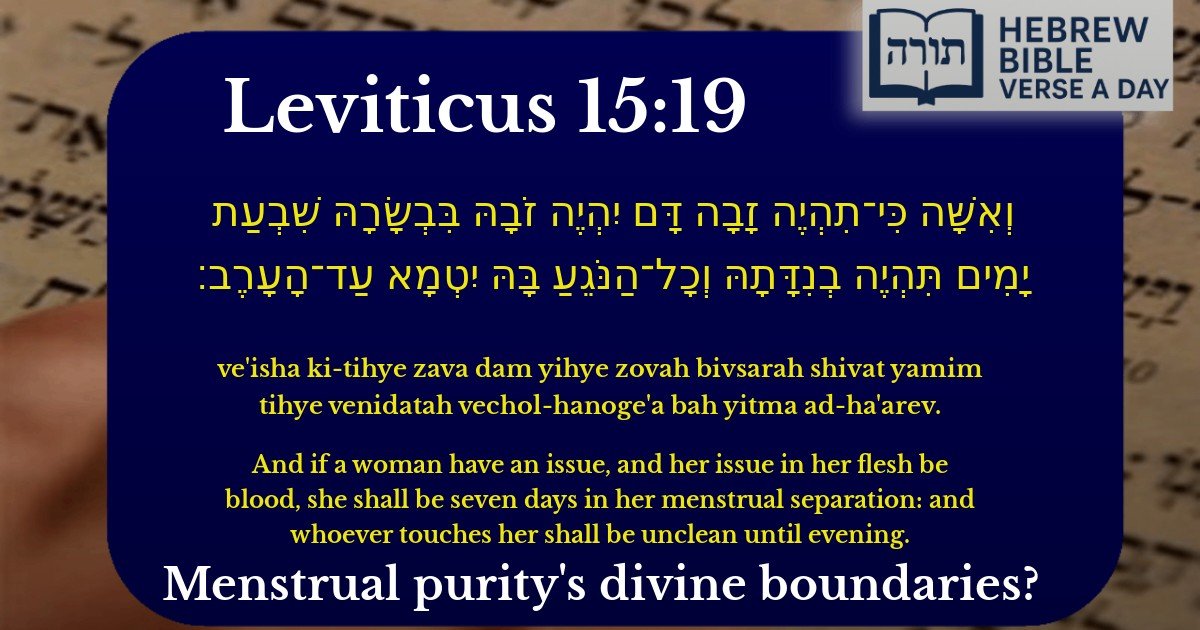

Leviticus 15:19 - Menstrual purity's divine boundaries?

Leviticus 15:19 - ויקרא 15:19

Hebrew Text

וְאִשָּׁה כִּי־תִהְיֶה זָבָה דָּם יִהְיֶה זֹבָהּ בִּבְשָׂרָהּ שִׁבְעַת יָמִים תִּהְיֶה בְנִדָּתָהּ וְכָל־הַנֹּגֵעַ בָּהּ יִטְמָא עַד־הָעָרֶב׃

English Translation

And if a woman have an issue, and her issue in her flesh be blood, she shall be seven days in her menstrual separation: and whoever touches her shall be unclean until evening.

Transliteration

Ve'isha ki-tihye zava dam yihye zovah bivsarah shivat yamim tihye venidatah vechol-hanoge'a bah yitma ad-ha'arev.

Hebrew Leining Text

וְאִשָּׁה֙ כִּֽי־תִהְיֶ֣ה זָבָ֔ה דָּ֛ם יִהְיֶ֥ה זֹבָ֖הּ בִּבְשָׂרָ֑הּ שִׁבְעַ֤ת יָמִים֙ תִּהְיֶ֣ה בְנִדָּתָ֔הּ וְכׇל־הַנֹּגֵ֥עַ בָּ֖הּ יִטְמָ֥א עַד־הָעָֽרֶב׃

🎵 Listen to leining

Parasha Commentary

Overview of the Verse

The verse (Vayikra 15:19) discusses the laws of niddah, a woman's state of ritual impurity during menstruation. It establishes that a woman with a menstrual flow remains in a state of tum'ah (impurity) for seven days, and anyone who touches her becomes impure until evening.

Explanation of Key Terms

  • זָבָה דָּם (zavah dam) – Rashi explains that this refers to a regular menstrual flow, as opposed to irregular bleeding (zivah), which has different halachic implications.
  • בִּבְשָׂרָהּ (bivsarah) – The blood must originate from her flesh (i.e., the uterus), excluding external wounds or other sources (Talmud, Niddah 36a).
  • נִדָּתָהּ (niddatah) – The term niddah denotes separation, as the woman must abstain from marital relations and avoid objects that can become ritually impure (Rambam, Hilchot Issurei Bi'ah 4:6).

Duration of Impurity

The verse specifies that a menstruating woman remains impure for seven days, regardless of whether her bleeding stops earlier. The Talmud (Niddah 66a) derives from this that even if she sees blood for only one day, she must still observe seven "clean days" after the bleeding ceases before immersion in a mikveh.

Impurity Through Contact

The verse states that anyone who touches her becomes impure until evening. Rashi clarifies that this applies only to direct physical contact, not indirect contact (such as carrying an object she sits on). The Rambam (Hilchot Metamei Mishkav uMoshav 1:1) elaborates that this impurity extends to objects she lies or sits upon (mishkav u'moshav).

Halachic Implications

  • A menstruating woman must separate from her husband until she completes the seven-day period and immerses in a mikveh (Shulchan Aruch, Yoreh De'ah 183).
  • Items she touches or sits on may transmit impurity, affecting those who handle them (Talmud, Zavim 2:3).
  • The concept of niddah underscores the sanctity of marital relations, requiring periods of separation and reunion to maintain holiness (Sefer HaChinuch, Mitzvah 166).

📚 Talmud Citations

This verse is quoted in the Talmud.

📖 Niddah 2a
The verse is discussed in the context of defining the laws of menstrual impurity (niddah) and the duration of impurity.
📖 Niddah 35b
The verse is referenced in discussions about the timing and nature of menstrual impurity and its implications for ritual purity.
📖 Shabbat 64b
The verse is mentioned in a broader discussion about the laws of purity and impurity, particularly in relation to women's menstrual cycles.

Frequently Asked Questions

Q: What does Leviticus 15:19 mean?
A: Leviticus 15:19 discusses the laws of niddah (menstrual separation) in Jewish tradition. It states that when a woman has a menstrual flow, she is in a state of ritual impurity (tumah) for seven days. Anyone who touches her during this time also becomes ritually impure until evening. This is part of the Torah's laws regarding purity and family sanctity.
Q: Why is the concept of niddah important in Judaism?
A: The laws of niddah are central to Jewish family life and marital sanctity. They create periods of separation and reunion between spouses, fostering holiness and appreciation in marriage. The Rambam (Hilchot Issurei Bi'ah) explains that these laws help maintain purity and spiritual discipline within the Jewish home.
Q: How do Jewish women observe niddah today?
A: Today, observant Jewish women follow the laws of niddah by separating from physical contact with their husbands during menstruation and for seven clean days afterward. They then immerse in a mikveh (ritual bath) before resuming marital relations. These practices are based on Torah law as interpreted by the Talmud and codified in halachic works like the Shulchan Aruch.
Q: What does 'unclean until evening' mean in this verse?
A: The phrase 'unclean until evening' refers to a temporary state of ritual impurity (tumah) that lasts until nightfall. Rashi explains that this level of impurity prevents one from entering the Temple area or eating sacred foods. Today, without the Temple, the practical effects are minimal, but the concepts remain important for understanding Torah law.
Q: Are there any spiritual benefits to the niddah laws?
A: Yes, Jewish tradition teaches that the niddah laws bring spiritual benefits. The Talmud (Niddah 31b) states that observing these laws brings holiness to marital life. The periodic separation and reunion help maintain freshness in marriage and create opportunities for emotional and spiritual connection beyond the physical.