Frequently Asked Questions
Q: What does 'a sabbath of solemn rest' mean in Leviticus 16:31?
A: The phrase 'a sabbath of solemn rest' (שַׁבַּת שַׁבָּתוֹן) refers to Yom Kippur, the Day of Atonement. Unlike the weekly Shabbat, this is a day of complete cessation from work and intense spiritual focus. Rashi explains that it is called a 'Shabbat Shabbaton' to emphasize its supreme holiness and the requirement to abstain from all labor, just as on Shabbat.
Q: Why does the verse say 'you shall afflict your souls' on Yom Kippur?
A: The term 'afflict your souls' (וְעִנִּיתֶם אֶת־נַפְשֹׁתֵיכֶם) refers to the five afflictions required on Yom Kippur: fasting (no eating or drinking), refraining from washing, anointing with oils, wearing leather shoes, and marital relations (Yoma 73b). Rambam (Hilchot Shevitat Asor 1:4-5) explains that these practices help a person focus on repentance and humility before Hashem.
Q: What does 'by a statute forever' mean in this verse?
A: The phrase 'by a statute forever' (חֻקַּת עוֹלָם) teaches that the observance of Yom Kippur is an eternal commandment for all generations. The Talmud (Yoma 81a) emphasizes that even if the Temple is not standing, the mitzvah of fasting and repentance on Yom Kippur remains binding for all Jews.
Q: How does Yom Kippur apply to us today?
A: Today, Yom Kippur remains the holiest day of the Jewish year, dedicated to repentance, prayer, and fasting. The Mishnah (Yoma 8:9) teaches that Yom Kippur atones for sins between a person and Hashem, provided one sincerely repents. It is a time for introspection, seeking forgiveness, and committing to spiritual growth.
Q: Why is Yom Kippur called a 'Shabbat Shabbaton'?
A: Yom Kippur is called a 'Shabbat Shabbaton' (שַׁבַּת שַׁבָּתוֹן) because it is a day of complete rest, even stricter than the weekly Shabbat. The Midrash (Vayikra Rabbah 29:7) explains that this term highlights its unique sanctity—while regular Shabbat has some leniencies (like preparing food), Yom Kippur requires absolute cessation from all work and physical pleasures to focus entirely on spiritual purification.

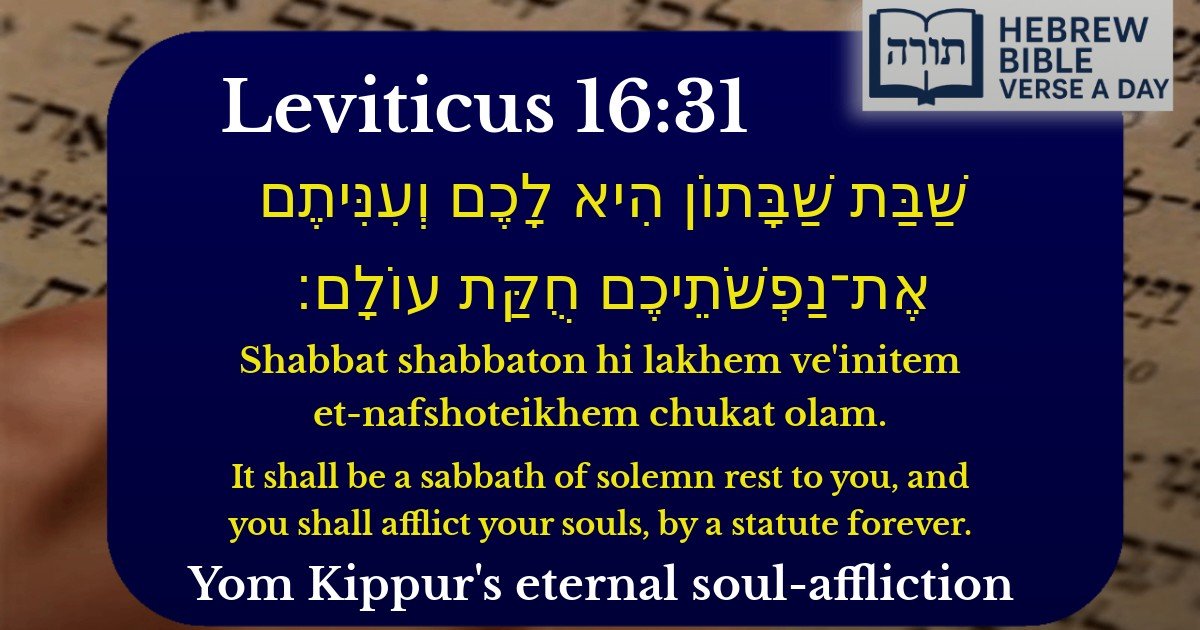

Shabbat Shabbaton and Inui Nefesh
The verse (Vayikra 16:31) describes Yom Kippur as a "Shabbat Shabbaton" and commands "ve'initem et nafshoteichem" (afflicting your souls). Rashi explains that "Shabbat Shabbaton" means a complete cessation from labor, even more stringent than a regular Shabbat. The term "Shabbaton" intensifies the prohibition of melacha (work), emphasizing Yom Kippur's unique sanctity.
The Five Inuyim (Afflictions)
The Talmud (Yoma 73b) enumerates five forms of inui nefesh required on Yom Kippur:
Eternal Statute (Chukat Olam)
The phrase "chukat olam" teaches that these laws apply in all generations. The Sifra (Acharei Mot 9) emphasizes that even when the Beit HaMikdash is not standing, Yom Kippur's obligations remain. Ramban adds that this eternal statute connects to the day's power to atone, as stated in Vayikra 16:30.
Spiritual Purpose of Affliction
The Sefer HaChinuch (Mitzvah 313) explains that afflicting the body helps focus the soul on teshuvah (repentance). By temporarily neglecting physical needs, one elevates spiritual awareness. The Chatam Sofer notes that "nafshoteichem" refers to the soul's dominance over the body on this sacred day.