

Join Our Newsletter To Be Informed When New Videos Are Posted
Hebrew Text
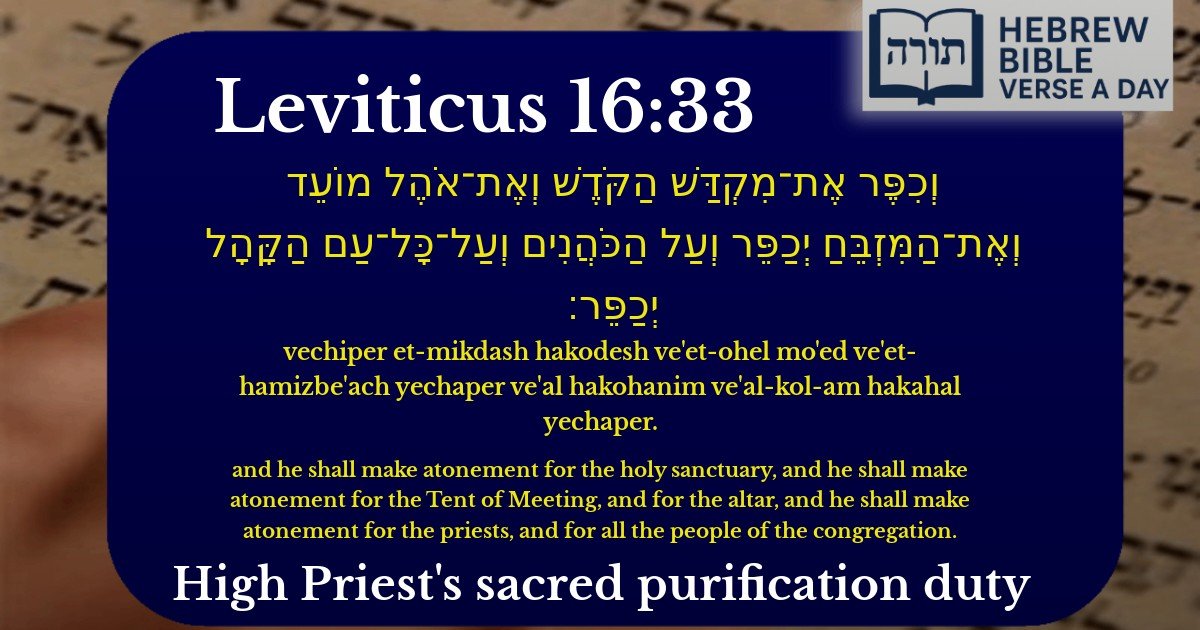
וְכִפֶּר אֶת־מִקְדַּשׁ הַקֹּדֶשׁ וְאֶת־אֹהֶל מוֹעֵד וְאֶת־הַמִּזְבֵּחַ יְכַפֵּר וְעַל הַכֹּהֲנִים וְעַל־כָּל־עַם הַקָּהָל יְכַפֵּר׃
English Translation
and he shall make atonement for the holy sanctuary, and he shall make atonement for the Tent of Meeting, and for the altar, and he shall make atonement for the priests, and for all the people of the congregation.
Transliteration
Vechiper et-mikdash hakodesh ve'et-ohel mo'ed ve'et-hamizbe'ach yechaper ve'al hakohanim ve'al-kol-am hakahal yechaper.
Hebrew Leining Text
וְכִפֶּר֙ אֶת־מִקְדַּ֣שׁ הַקֹּ֔דֶשׁ וְאֶת־אֹ֧הֶל מוֹעֵ֛ד וְאֶת־הַמִּזְבֵּ֖חַ יְכַפֵּ֑ר וְעַ֧ל הַכֹּהֲנִ֛ים וְעַל־כׇּל־עַ֥ם הַקָּהָ֖ל יְכַפֵּֽר׃
🎵 Listen to leining
Parasha Commentary
📚 Talmud Citations
This verse is quoted in the Talmud.
📖 Yoma 57a
The verse is discussed in the context of the High Priest's atonement service on Yom Kippur, particularly regarding the order of atonement for different parts of the sanctuary.
📖 Shevuot 14a
Cited in a discussion about the atonement process and the different elements that require atonement according to the Torah.
Context in Vayikra (Leviticus)
This verse (Vayikra 16:33) appears in the Torah portion of Acharei Mot, which details the Yom Kippur service performed by the Kohen Gadol (High Priest). The verse summarizes the comprehensive atonement achieved through the Avodah (Temple service) on this holy day, covering the Mishkan (Tabernacle), the altar, the Kohanim (priests), and all of Klal Yisrael (the Jewish people).
Rashi's Explanation
Rashi explains that the repetition of the verb "וְכִפֶּר" ("and he shall make atonement") emphasizes that each component requires its own distinct kaparah (atonement). The Kohen Gadol must atone separately for:
Rambam's Perspective
In Hilchot Avodat Yom HaKippurim (Laws of the Yom Kippur Service 1:2), the Rambam elaborates that this verse establishes the Kohen Gadol's obligation to perform kaparah for all these elements in a specific order. The sequence reflects descending levels of holiness - beginning with the most sacred space (Kodesh HaKodashim) and concluding with the people.
Talmudic Insights (Yoma 57b-58a)
The Talmud discusses how the atonement process functions differently for each component:
Midrashic Interpretation (Torat Kohanim 16:33)
The Midrash teaches that this all-encompassing atonement demonstrates how Yom Kippur serves as a "reset" for the entire Jewish people and their relationship with the Divine. The inclusion of both the physical sanctuary and the people shows that spiritual purity requires both proper worship spaces and proper conduct among the nation.
Chassidic Perspective (Sefat Emet)
The Sefat Emet notes that the verse's structure hints at the interconnectedness of all elements - when the holiest space is purified, it elevates the entire system down to the people. This reflects the concept that the Jewish people are a "mamlechet kohanim" (kingdom of priests), intrinsically connected to the Mishkan's sanctity.