

Join Our Newsletter To Be Informed When New Videos Are Posted
Hebrew Text
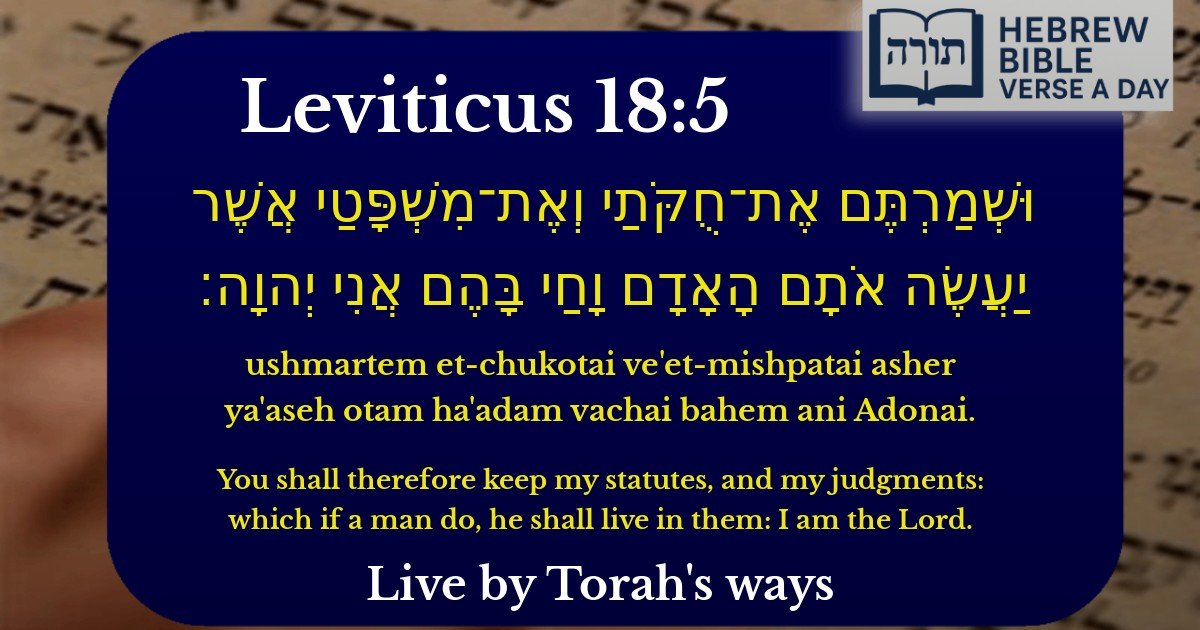
וּשְׁמַרְתֶּם אֶת־חֻקֹּתַי וְאֶת־מִשְׁפָּטַי אֲשֶׁר יַעֲשֶׂה אֹתָם הָאָדָם וָחַי בָּהֶם אֲנִי יְהוָה׃
English Translation
You shall therefore keep my statutes, and my judgments: which if a man do, he shall live in them: I am the Lord.
Transliteration
Ushmartem et-chukotai ve'et-mishpatai asher ya'aseh otam ha'adam vachai bahem ani Adonai.
Hebrew Leining Text
וּשְׁמַרְתֶּ֤ם אֶת־חֻקֹּתַי֙ וְאֶת־מִשְׁפָּטַ֔י אֲשֶׁ֨ר יַעֲשֶׂ֥ה אֹתָ֛ם הָאָדָ֖ם וָחַ֣י בָּהֶ֑ם אֲנִ֖י יְהֹוָֽה׃ {ס}
🎵 Listen to leining
Parasha Commentary
📚 Talmud Citations
This verse is quoted in the Talmud.
📖 Yoma 85b
The verse is cited in the discussion about the principle that saving a life overrides the Sabbath laws, emphasizing 'and live by them' (וָחַי בָּהֶם) rather than die by them.
📖 Sanhedrin 74a
The verse is referenced in the context of the laws of martyrdom, where the principle 'and live by them' is interpreted to mean that one should live by the commandments, not die by them, except in cases of idolatry, incest, and murder.
Verse Context and Meaning
The verse (Vayikra 18:5) appears in the context of a section warning against following the immoral practices of Egypt and Canaan, emphasizing adherence to Hashem's commandments. The phrase "וָחַי בָּהֶם" ("and live by them") is central to understanding the Torah's approach to mitzvot.
Rashi's Explanation
Rashi comments that "וָחַי בָּהֶם" means that the mitzvot are given for life, not to bring death. He derives from this that if a mitzvah conflicts with preserving life (e.g., in a life-threatening situation), one must prioritize life over the mitzvah, except for the three cardinal sins (idolatry, murder, and forbidden relations). This principle is foundational in halachah (Sanhedrin 74a).
Rambam's Perspective
In Mishneh Torah (Hilchot Yesodei HaTorah 5:1), Rambam elaborates that the mitzvot are meant to enhance life, not diminish it. He emphasizes that the Torah's laws are rational and life-affirming, guiding a person toward spiritual and physical well-being.
Talmudic Interpretation
The Talmud (Yoma 85b) discusses this verse in the context of Shabbat laws, stating that saving a life overrides Shabbat observance. The Sages derive from "וָחַי בָּהֶם" that mitzvot should lead to life, not the opposite. This principle is extended to all mitzvot (except the three cardinal sins).
Midrashic Insight
The Midrash (Sifra Acharei Mot 13:14) teaches that the phrase "אֲנִי יְהוָה" ("I am the Lord") at the end of the verse underscores that Hashem, as the giver of the Torah, is trustworthy in His commandments. Observing them brings life, both in this world and the World to Come.
Key Takeaways