

Join Our Newsletter To Be Informed When New Videos Are Posted
Hebrew Text
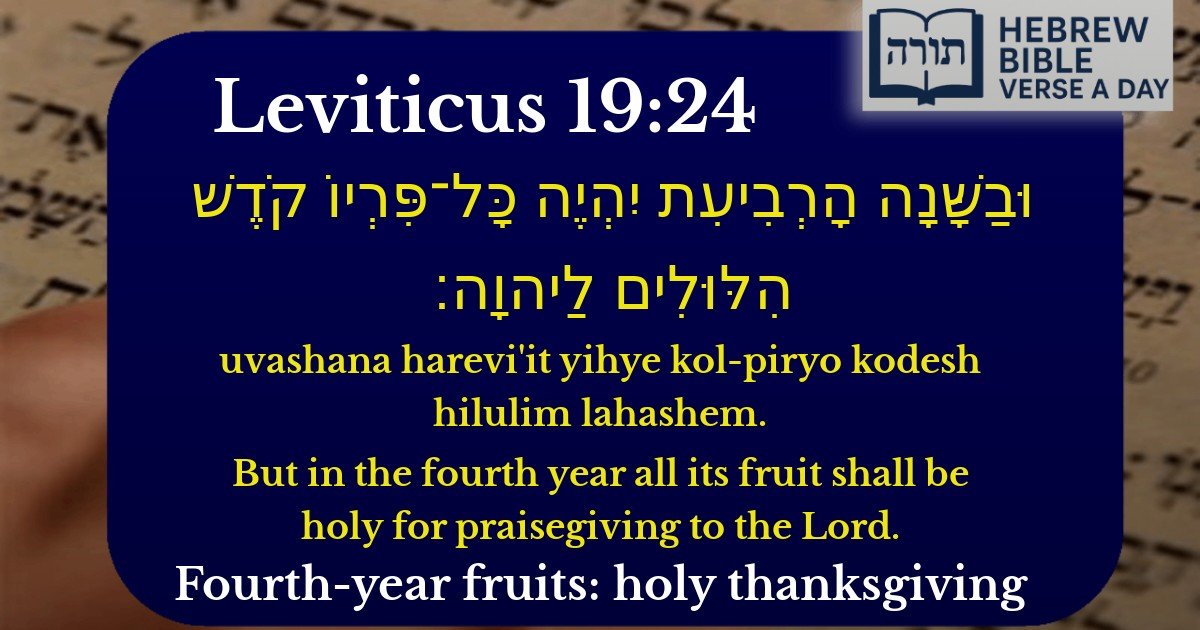
וּבַשָּׁנָה הָרְבִיעִת יִהְיֶה כָּל־פִּרְיוֹ קֹדֶשׁ הִלּוּלִים לַיהוָה׃
English Translation
But in the fourth year all its fruit shall be holy for praisegiving to the Lord.
Transliteration
Uvashana harevi'it yihye kol-piryo kodesh hilulim lahashem.
Hebrew Leining Text
וּבַשָּׁנָה֙ הָרְבִיעִ֔ת יִהְיֶ֖ה כׇּל־פִּרְי֑וֹ קֹ֥דֶשׁ הִלּוּלִ֖ים לַיהֹוָֽה׃
🎵 Listen to leining
Parasha Commentary
📚 Talmud Citations
This verse is quoted in the Talmud.
📖 Berakhot 35a
The verse is discussed in the context of the laws regarding the fruits of the fourth year (Neta Reva'i) and their sanctity.
📖 Rosh Hashanah 9b
The verse is referenced in a discussion about the counting of years for trees and the sanctity of their fruits in the fourth year.
Context in the Torah
The verse (Vayikra 19:24) discusses the laws of orlah (forbidden fruit of a tree's first three years) and the sanctity of fruit in its fourth year. This mitzvah is part of the agricultural laws given to Bnei Yisrael upon entering Eretz Yisrael.
Rashi's Explanation
Rashi explains that the fourth-year fruits are designated as "holy for praisegiving to the Lord" (hilulim laHashem), meaning they must be eaten in Yerushalayim with purity, similar to ma'aser sheni (second tithe). The term "hilulim" refers to praising Hashem through joyful consumption in the holy city.
Rambam's Halachic Perspective
In Hilchos Ma'aser Sheni (2:1-3), the Rambam rules that fourth-year fruits must be brought to Yerushalayim and eaten there by their owner in a state of ritual purity. If bringing them is impractical, they may be redeemed (with added 1/5 value), and the money used to purchase food in Yerushalayim.
Midrashic Insight
The Midrash (Vayikra Rabbah 25:4) connects this mitzvah to the concept of gratitude: Just as a child matures by year four, these fruits represent our acknowledgment of Hashem's bounty after the tree's initial growth period.
Symbolic Meaning
Practical Halachic Considerations
The Shulchan Aruch (Yoreh De'ah 294) discusses details of this mitzvah, including: