Frequently Asked Questions
Q: What does Leviticus 19:28 mean when it says not to make cuttings in the flesh or marks on the body?
A: Leviticus 19:28 prohibits two practices common among ancient pagan cultures: making cuts or gashes in the skin as a sign of mourning for the dead (שריטה לנפש), and tattooing the body (כתבת קעקע). The Torah forbids these practices to distinguish Jewish behavior from idolatrous customs. Rashi explains that these were pagan mourning rituals, and the Torah wants us to mourn in sanctified ways instead.
Q: Does Leviticus 19:28 mean all tattoos are forbidden according to Jewish law?
A: Yes, traditional Jewish law (Halacha) interprets this verse as prohibiting permanent tattoos, based on the phrase 'וכתבת קעקע לא תתנו בכם' (you shall not place a tattoo marking upon yourselves). The Rambam (Hilchot Avodat Kochavim 12:11) states this prohibition applies even if the tattoo does not contain idolatrous imagery. However, temporary markings like henna are permitted.
Q: Why does the verse end with 'I am the Lord'?
A: The concluding phrase 'אני ה'' (I am the Lord) emphasizes that these commandments come from Hashem and should be observed as part of our covenant with Him. The Sforno explains that this reminds us these laws are not arbitrary, but are divine decrees meant to sanctify us and separate us from pagan practices.
Q: How does the prohibition against cuttings for the dead apply today?
A: Today, this prohibition means we may not engage in extreme mourning practices that involve self-harm, like cutting or wounding oneself. Jewish mourning practices (like kriah - tearing garments) provide structured, sanctified ways to express grief. The Talmud (Makkot 20b) discusses the seriousness of this prohibition, showing its continued relevance.
Q: Are there any exceptions to the tattoo prohibition in Jewish law?
A: Halacha generally considers all intentional, permanent tattoos as prohibited. However, some contemporary poskim discuss cases where tattoos were made under duress or for medical purposes (like radiation markings). The Minchat Chinuch (253) notes the prohibition applies specifically to tattooing done willingly as decoration or idolatry. Nevertheless, getting a tattoo remains strongly discouraged under Jewish law.

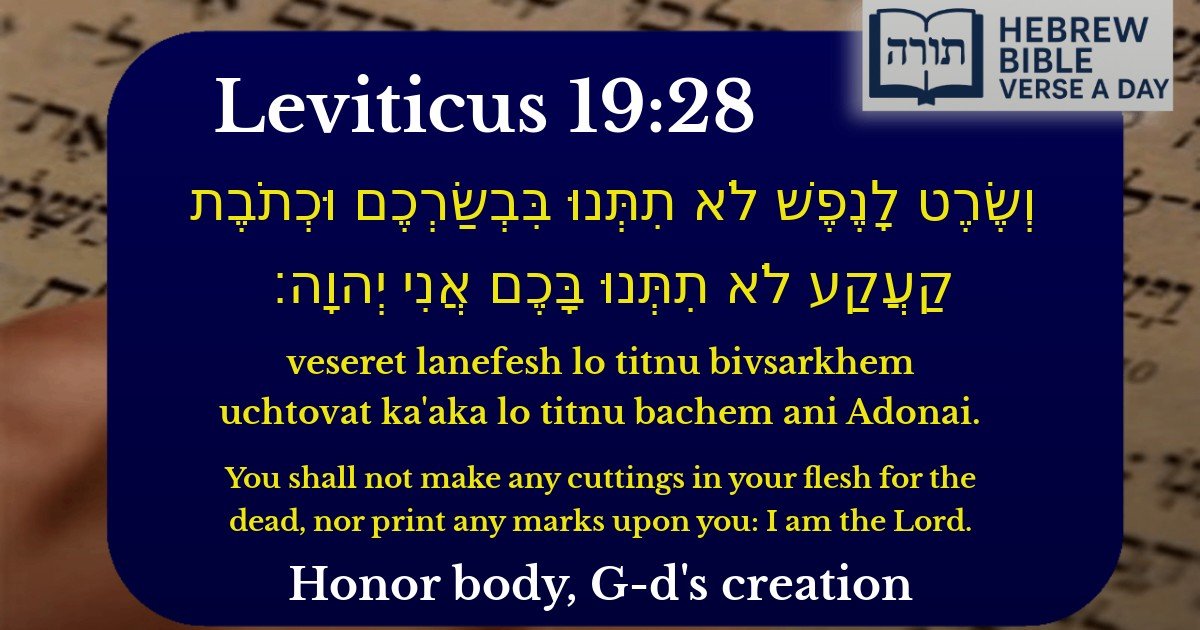

Prohibition of Self-Mutilation and Tattoos
The verse (Vayikra 19:28) contains two prohibitions:
Prohibition of Cutting for the Dead
Rashi explains that שֶׂרֶט לָנֶפֶשׁ refers to the ancient pagan practice of making gashes in one's flesh as an expression of mourning for the dead. The Rambam (Hilchos Avodas Kochavim 12:11) states this was a custom of idol worshippers, and the Torah forbids imitating their practices.
The Talmud (Makos 20b) discusses how this prohibition applies specifically to making cuts as a mourning rite, deriving from the words "for the dead" in the verse.
Prohibition of Tattoos
The second half of the verse prohibits כְּתֹבֶת קַעֲקַע - permanent tattooing. Rashi explains this as writing permanently on the skin by making incisions and filling them with ink or dye.
The Mishnah (Makkos 3:6) states that one is liable for tattooing only if it includes both writing and pigment. The Rambam (Hilchos Avodas Kochavim 12:11) clarifies that this prohibition applies whether the tattoo contains idolatrous symbols or any other writing or design.
The Concluding Phrase: "I am the Lord"
The verse concludes with אֲנִי יְהוָה - "I am the Lord." The Kli Yakar explains this emphasizes that our bodies belong to Hashem, and we have no right to mutilate or mark them. The Sforno adds that this reminds us we are servants of Hashem alone, not to follow pagan customs.
Contemporary Applications
Poskim discuss several modern applications of these prohibitions: