Frequently Asked Questions
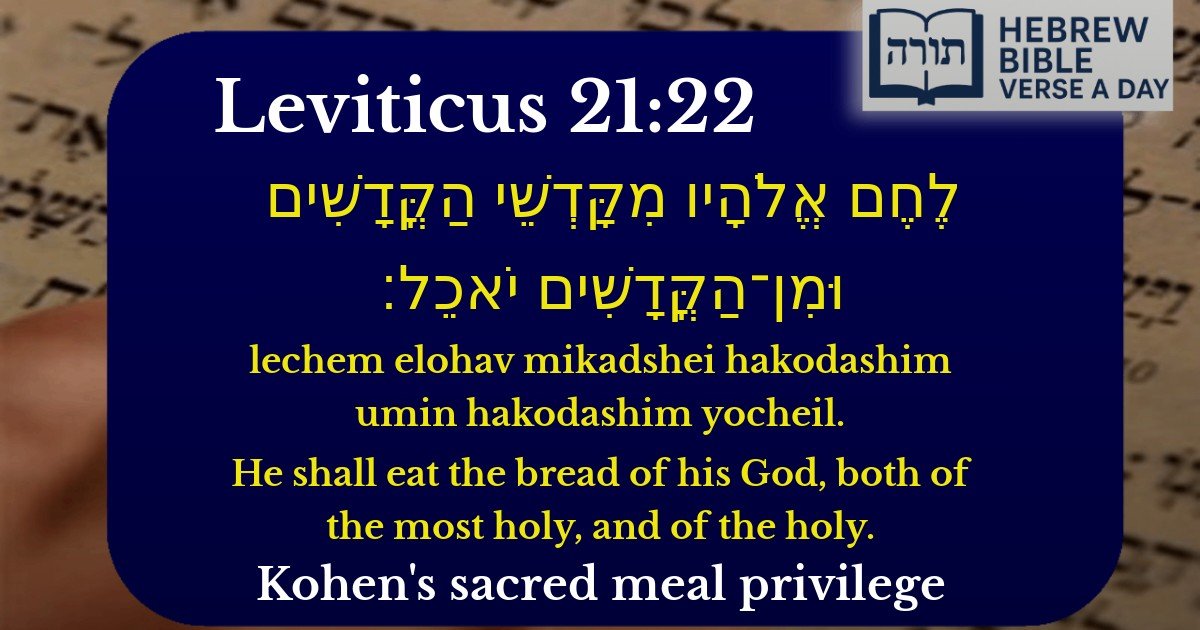
Q: What does 'the bread of his God' refer to in Leviticus 21:22?
A: In Leviticus 21:22, 'the bread of his God' refers to the sacrificial offerings brought in the Temple, particularly the grain offerings (minchah) and other holy foods that were designated for the kohanim (priests) to eat. Rashi explains that this includes both the 'most holy' offerings (kodshei kodashim), which could only be eaten within the Temple courtyard, and the 'holy' offerings (kodashim kalim), which could be eaten anywhere in Jerusalem.
Q: Why is this verse specifically about a kohen with a physical blemish?
A: This verse is part of a section discussing kohanim with physical blemishes (mumim). While such kohanim are restricted from performing certain Temple services (as stated in Leviticus 21:17-21), the Torah here clarifies that they are still permitted to eat from the holy offerings. The Rambam (Hilchot Bi'at HaMikdash 6:9) explains that this shows their sanctity remains intact despite their physical limitations.
Q: What is the difference between 'most holy' and 'holy' offerings mentioned in this verse?
A: The 'most holy' offerings (kodshei kodashim) include sacrifices like the sin offering (chatat) and guilt offering (asham), which could only be eaten by male kohanim within the Temple courtyard. The 'holy' offerings (kodashim kalim) include offerings like the peace offering (shelamim) and thanksgiving offering (todah), which could be eaten by the kohen's family anywhere in Jerusalem, as explained in the Talmud (Zevachim 56b).
Q: How does this verse apply today without the Temple?
A: While we no longer have the Temple or sacrificial offerings today, this verse teaches us about the sanctity of the kohanim and the importance of including all members of the community—even those with limitations—in spiritual matters. The Midrash (Sifra) emphasizes that this law shows God's compassion, ensuring that kohanim with physical imperfections still retain their holy status and connection to Divine service.
Q: Why does the Torah specify that the kohen 'shall eat' these offerings?
A: The Torah specifies that the kohen 'shall eat' these offerings to emphasize that consuming the sacred food is not just a privilege but also part of their sacred duty. The Talmud (Pesachim 59b) teaches that eating the offerings helps bring atonement and completes the sacrificial process. This mitzvah also provides sustenance for the kohanim, allowing them to dedicate themselves fully to serving in the Temple.


Context of the Verse
The verse (Vayikra 21:22) discusses the privileges of a Kohen (priest) who has a physical blemish (mum). While such a Kohen is restricted from performing certain Temple services, he is still permitted to partake of the sacred offerings, both the "most holy" (kodshei kodashim) and the "holy" (kodashim kalim).
Explanation of "Bread of His God"
The term "lechem Elohav" (bread of his God) refers to the sacrificial offerings given to the Kohanim as their portion. Rashi explains that this phrase emphasizes that these offerings are designated for Divine service, even though they are consumed by the Kohanim. The Rambam (Hilchos Maaseh HaKorbanos 10:1) elaborates that this includes both offerings that are eaten within the Temple courtyard (kodshei kodashim) and those eaten anywhere in Jerusalem (kodashim kalim).
Distinction Between Kodshei Kodashim and Kodashim Kalim
Halachic Implications
The Sifra (Emor 3:5) derives from this verse that even a Kohen with a blemish retains his right to eat from the sacrifices, despite being disqualified from service. The Rambam (Hilchos Bi'as HaMikdash 6:6) rules that this applies to all Kohanim with blemishes, except for those who are disqualified for other reasons (e.g., a Kohen who served idolatry).
Spiritual Significance
The Kli Yakar notes that the term "bread of his God" teaches that the Kohen's consumption of sacrifices is not merely for sustenance but is an act of Divine service. Even a Kohen with a physical imperfection maintains a sacred connection to the Temple offerings, reflecting the principle that all Kohanim are inherently holy (kedushat kehunah).