Frequently Asked Questions
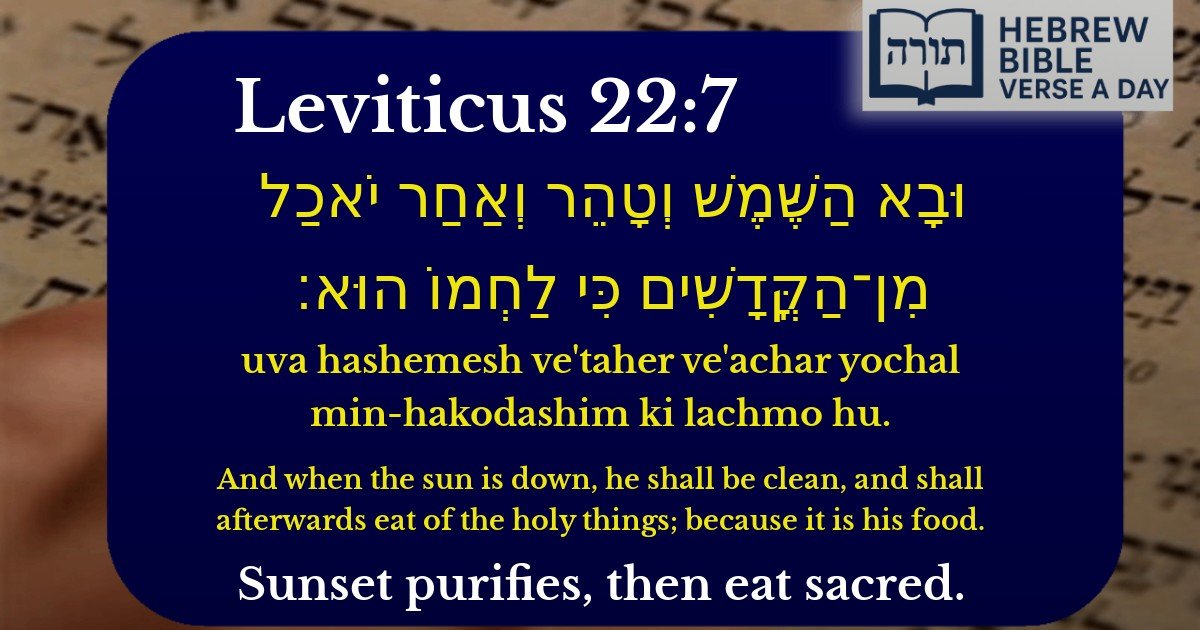
Q: What does Leviticus 22:7 mean?
A: Leviticus 22:7 discusses the laws of ritual purity (tumah and taharah) for Kohanim (priests). It states that a Kohen who became impure must wait until sunset to become ritually clean again, after which he may eat from the holy offerings (terumah or sacrifices). Rashi explains that this teaches us that purification from certain impurities (like contact with a dead body) requires waiting until nightfall.
Q: Why is this verse important in Judaism?
A: This verse is important because it establishes the laws of purity required for Kohanim when handling sacred items or eating holy food (like terumah or sacrifices). The Rambam (Hilchot Bi'at Mikdash 3:12) explains that these laws emphasize the sanctity of the Temple service and the need for spiritual readiness when engaging with holy matters.
Q: What can we learn from Leviticus 22:7 today?
A: While the Temple is not standing today, this verse teaches us the importance of spiritual preparation before engaging in holy acts. Just as a Kohen had to wait until nightfall to regain purity, we learn (based on Talmudic and Midrashic teachings) the value of patience, self-reflection, and proper readiness before performing mitzvot or approaching sacred matters.
Q: Why does the verse say 'because it is his food'?
A: Rashi explains that the phrase 'because it is his food' refers to the fact that the holy offerings (terumah and sacrifices) were the primary sustenance of the Kohanim, who served in the Temple. Since this was their livelihood, the Torah emphasizes the strict purity requirements to teach that even essential needs must be approached with holiness when connected to divine service.
Q: Does this law apply to non-Kohanim?
A: No, according to traditional Jewish law (based on Talmud Yevamot 74a), the restrictions in this verse apply only to Kohanim regarding their consumption of holy offerings. However, the Sages derive broader lessons about spiritual purity and mindfulness that apply to all Jews in their relationship with mitzvot and sanctity.


Context in Leviticus
The verse (Vayikra 22:7) discusses the laws of tum'ah (ritual impurity) and taharah (ritual purity) pertaining to a kohen (priest) who is temporarily disqualified from partaking of terumah or sacrificial offerings due to impurity. The Torah states that after sunset, the kohen becomes ritually pure and may once again eat from the holy offerings.
Rashi's Explanation
Rashi (Vayikra 22:7) clarifies that the phrase "and when the sun is down, he shall be clean" refers to the completion of the purification process, which includes immersion in a mikveh and waiting until nightfall. Only then is the kohen fully permitted to eat kodshim (holy foods). Rashi emphasizes that the verse concludes with "because it is his food" to teach that the priestly portions are considered their rightful sustenance, not merely a privilege.
Rambam's Halachic Perspective
In Hilchos Terumos (6:6), the Rambam codifies this law, stating that a kohen who was tamei (impure) must wait until nightfall after immersion before partaking of terumah. He further explains in Moreh Nevuchim (3:47) that these laws reinforce the sanctity of the priesthood and the sacred service, ensuring that those who handle holy matters maintain a heightened state of purity.
Midrashic Insight
The Sifra (a halachic midrash on Vayikra) comments on this verse, noting that the phrase "because it is his food" underscores the mutual responsibility between the Jewish people and the kohanim. Just as the nation provides for the priests through gifts like terumah, the priests must uphold their sanctity to be worthy of receiving them.
Symbolism of Sunset
The Kli Yakar (Vayikra 22:7) offers a deeper interpretation: the setting of the sun symbolizes the completion of a spiritual process. Just as physical darkness precedes a new day, the transition from impurity to purity requires patience and the passage of time. This teaches that spiritual renewal is not instantaneous but follows a divinely ordained process.