

Join Our Newsletter To Be Informed When New Videos Are Posted
Hebrew Text
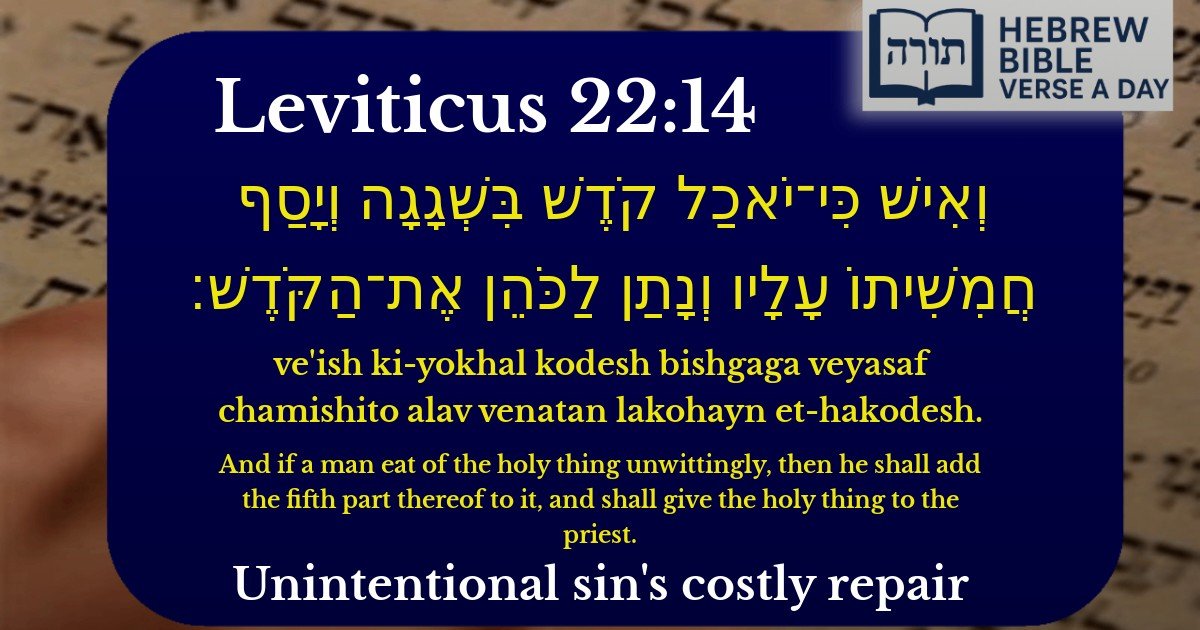
וְאִישׁ כִּי־יֹאכַל קֹדֶשׁ בִּשְׁגָגָה וְיָסַף חֲמִשִׁיתוֹ עָלָיו וְנָתַן לַכֹּהֵן אֶת־הַקֹּדֶשׁ׃
English Translation
And if a man eat of the holy thing unwittingly, then he shall add the fifth part thereof to it, and shall give the holy thing to the priest.
Transliteration
Ve'ish ki-yokhal kodesh bishgaga veyasaf chamishito alav venatan lakohayn et-hakodesh.
Hebrew Leining Text
וְאִ֕ישׁ כִּֽי־יֹאכַ֥ל קֹ֖דֶשׁ בִּשְׁגָגָ֑ה וְיָסַ֤ף חֲמִֽשִׁיתוֹ֙ עָלָ֔יו וְנָתַ֥ן לַכֹּהֵ֖ן אֶת־הַקֹּֽדֶשׁ׃
🎵 Listen to leining
Parasha Commentary
📚 Talmud Citations
This verse is quoted in the Talmud.
📖 Kritot 6b
The verse is cited in a discussion about the laws of unintentional consumption of sacred offerings and the requirement to add a fifth when making restitution.
📖 Shevuot 8a
Referenced in the context of oaths and the penalties for misusing sacred property, highlighting the principle of adding a fifth for restitution.
Context in the Torah
The verse (Vayikra 22:14) discusses the case of someone who unintentionally consumes terumah (sacred food designated for kohanim) or other sanctified items. According to Torah law, such items are reserved exclusively for kohanim and their households, and their consumption by a non-kohen—even accidentally—requires restitution.
Obligation to Restore and Add a Fifth
Rashi explains that the violator must repay the principal amount of the sanctified item (et hakodesh) and add an additional fifth (chamishito), making the total repayment 125% of the original value. The Mishnah (Terumot 6:1) clarifies that this additional fifth is calculated based on the principal, meaning one adds a quarter of the principal's value (e.g., for 100 units, the repayment is 125).
Reason for the Additional Fifth
Rambam (Hilchot Terumot 7:1-2) teaches that the extra fifth serves as both restitution and a deterrent, ensuring people are vigilant about respecting sanctified property. The Talmud (Kritut 4b) further notes that this penalty applies only to unintentional consumption; deliberate misuse of sanctified items incurs stricter punishments.
Giving the Repayment to the Kohen
The verse concludes by instructing the violator to give the repaid sanctified item (et hakodesh) to the kohen. The Sifra (Emor 12:6) emphasizes that this must be given to a kohen in a state of ritual purity, as the sanctity of the item must be preserved. The Ramban adds that this reinforces the principle that kohanim are entrusted with maintaining the sanctity of the Beit HaMikdash and its associated offerings.
Practical Halachic Implications