Frequently Asked Questions
Q: What does the verse 'you shall not kill it and its young both in one day' mean?
A: This verse from Leviticus 22:28 prohibits slaughtering a mother animal and its offspring on the same day. According to Rashi, this law teaches compassion and prevents cruelty, as killing both on the same day would be emotionally distressing. The Rambam (Hilchos Shechita 12:1) explains that this applies to both domesticated and wild animals, whether for sacrifice or regular consumption.
Q: Why is this commandment important in Judaism?
A: This commandment is important because it instills the value of mercy (rachamim) in human behavior. The Talmud (Chullin 78b) discusses this mitzvah as part of the broader Torah principle of avoiding unnecessary suffering to animals (tza'ar ba'alei chayim). By not slaughtering a mother and offspring on the same day, we learn sensitivity to the natural bonds in creation.
Q: Does this law apply only to sacrifices or also to regular meat?
A: This law applies to all slaughter, whether for sacrificial purposes (in Temple times) or for regular consumption (today). The Rambam (Guide for the Perplexed 3:48) explains that the Torah extends this prohibition to all cases to universally teach compassion, not just in the sacred context of sacrifices.
Q: How does this verse apply today if we don't have the Temple?
A: Even without the Temple, this law remains fully applicable to regular kosher slaughter (shechita). The Shulchan Aruch (Yoreh De'ah 16:1) rules that it's forbidden to slaughter a mother and child on the same day, and kosher slaughterhouses must carefully track animal relationships to avoid violation. This teaches us that ethical treatment of animals is timeless.
Q: What's the punishment for violating this commandment?
A: While this prohibition carries no formal court-imposed punishment (it's a 'lav she'ein bo ma'aseh'), the Sefer HaChinuch (mitzvah 294) explains that violating it constitutes a serious Torah transgression. The spiritual consequences are significant, as one disregards both a clear commandment and the ethical foundation it represents.

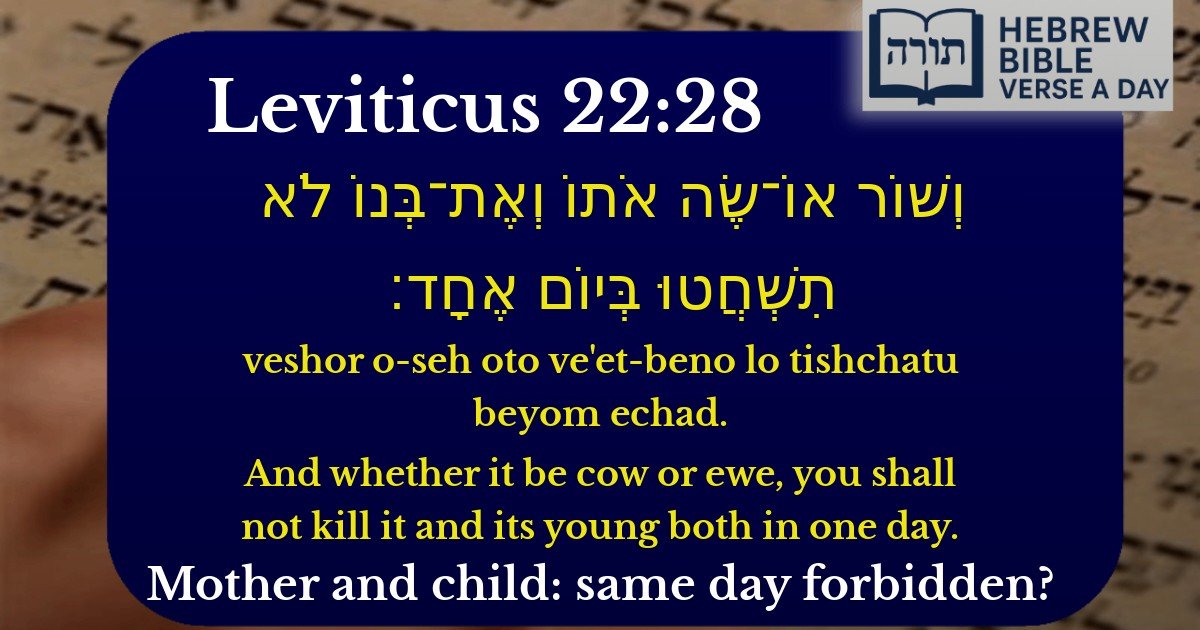

Prohibition of Slaughtering a Mother and Offspring on the Same Day
The verse (Vayikra 22:28) states: "And whether it be cow or ewe, you shall not kill it and its young both in one day." This commandment prohibits slaughtering a mother animal and its offspring on the same day, whether for sacrificial purposes or for ordinary consumption.
Rashi's Explanation
Rashi (Vayikra 22:28) explains that this prohibition applies regardless of whether the slaughter is performed for sacred purposes (korbanot) or for mundane use (chullin). He emphasizes that the Torah uses the term "תִשְׁחֲטוּ" (you shall slaughter) rather than "תִּזְבְּחוּ" (you shall sacrifice), indicating that the law applies even outside the Temple context.
Rambam's Classification
Rambam (Hilchos Shechitah 12:1) categorizes this prohibition as one of the 365 negative commandments in the Torah. He clarifies that the prohibition applies to both domesticated animals (behemah) and wild animals (chayah), as derived from the inclusive language of the verse.
Reason for the Prohibition
Several explanations are offered by our Sages for this mitzvah:
Halachic Details
The Talmud (Chullin 78b-83a) elaborates on several important applications of this law:
Contemporary Application
Poskim (halachic authorities) discuss modern applications including: