Frequently Asked Questions
Q: What does Leviticus 23:5 mean?
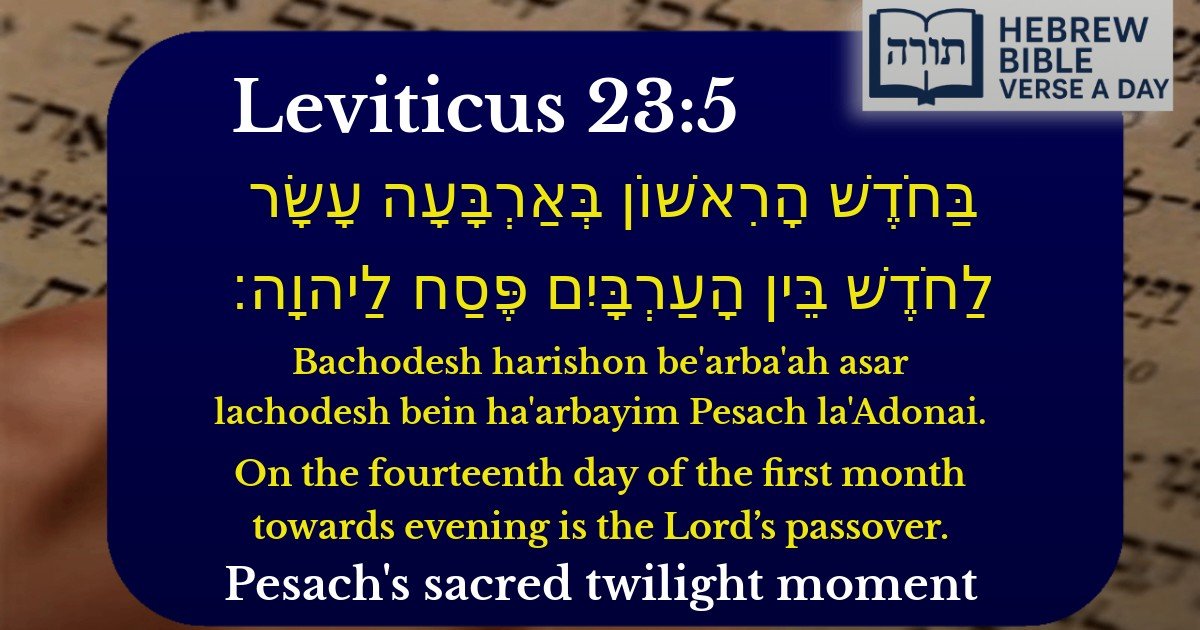
A: Leviticus 23:5 establishes the date and time for observing Passover (Pesach). It states that Passover begins on the 14th day of the first month (Nisan) 'toward evening' (bein ha'arbayim). According to Rashi, 'bein ha'arbayim' refers to the afternoon hours when the sun begins to descend, specifically the time when the Passover offering (Korban Pesach) was brought in the Temple.
Q: Why is the 14th of Nisan important?
A: The 14th of Nisan is significant because it marks the eve of Passover, commemorating the Exodus from Egypt. On this day, the Passover sacrifice was offered in the Temple (as commanded in Exodus 12). The Rambam (Mishneh Torah, Hilchot Korban Pesach) explains that this mitzvah was central to the redemption from Egypt and remains a foundational event in Jewish history.
Q: What does 'toward evening' (bein ha'arbayim) mean in this verse?
A: The phrase 'bein ha'arbayim' (toward evening) is traditionally understood as the afternoon hours, specifically from midday until nightfall. The Talmud (Pesachim 58a) explains that the Passover offering was brought after midday (from approximately 12:30 PM onward) and had to be completed before sunset. This timing connects to the original Exodus, when the lamb was slaughtered in the afternoon before being eaten at night.
Q: How do we observe the 14th of Nisan today without the Temple?
A: Since the destruction of the Temple, we no longer bring the Passover sacrifice. However, the 14th of Nisan remains significant as the day before Passover begins at nightfall. Jewish tradition (Shulchan Aruch, Orach Chaim 431-452) prescribes thorough preparation—removing chametz (leaven), reciting special prayers, and preparing the Seder plate with symbolic foods like matzah and maror to retell the story of the Exodus.
Q: Why is Passover called 'Pesach LaHashem' (the Lord’s Passover)?
A: The term 'Pesach LaHashem' emphasizes that Passover is dedicated to G-d, commemorating His miraculous intervention during the tenth plague in Egypt (Exodus 12). The Midrash (Mechilta Bo) explains that 'Pesach' refers to G-d 'passing over' Jewish homes while striking the Egyptians. The holiday thus reflects divine protection and the covenant between G-d and the Jewish people.


Overview of the Verse
The verse (Shemot 12:6) establishes the precise timing for the Korban Pesach (Passover sacrifice), which is central to the observance of Pesach. The Torah specifies that it must be brought on the 14th of Nisan, "בֵּין הָעַרְבָּיִם" (between the evenings). This mitzvah marks the beginning of the Exodus narrative and serves as a foundational commandment for Bnei Yisrael.
Explanation of "בַּחֹדֶשׁ הָרִאשׁוֹן" (The First Month)
Rashi (Shemot 12:2) explains that this refers to the month of Nisan, which is called the "first month" because it marks the beginning of the national identity of the Jewish people, as it was the month of their redemption from Egypt. The Ramban adds that Nisan is also significant because it is the first of the months regarding the festivals, as the Torah later designates it as the start of the year for the Jewish calendar in matters of holiness.
The Meaning of "בֵּין הָעַרְבָּיִם" (Between the Evenings)
There is a dispute among the Sages regarding the exact time denoted by this phrase:
The Gemara (Berachot 9a) further explains that this time period is called "between the evenings" because it is between the decline of the sun (afternoon) and the actual evening (nightfall).
The Significance of the 14th of Nisan
The Midrash (Mechilta Bo 5) teaches that the 14th of Nisan was chosen for the Korban Pesach because it was the day before the actual Exodus, allowing Bnei Yisrael to demonstrate their faith in Hashem by preparing the sacrifice while still in Egypt. The Sefer HaChinuch (Mitzvah 7) explains that this act of devotion was a rejection of Egyptian idolatry, as the lamb was considered sacred in Egypt.
"פֶּסַח לַיהוָה" (A Passover to Hashem)
The term "Pesach" is interpreted in multiple ways:
The phrase "לַיהוָה" emphasizes that the Korban Pesach is dedicated solely to Hashem, distinguishing it from pagan sacrifices and reinforcing the monotheistic foundation of the Jewish people.