Frequently Asked Questions
Q: What does 'And the Lord spoke to Moshe, saying' mean in Leviticus 23:9?
A: This phrase introduces a new communication from Hashem to Moshe Rabbeinu (Moses our teacher). In Torah, this wording indicates a direct and important transmission of divine commandments. Rashi explains that this formula emphasizes the precision with which Moshe transmitted Hashem's words to the Jewish people.
Q: Why does the Torah keep repeating 'And the Lord spoke to Moshe'?
A: The repetition teaches us that each communication was a separate, distinct event. The Rambam (Maimonides) explains in his introduction to Mishneh Torah that this shows prophecy didn't come to Moshe in one continuous flow, but as individual revelations at different times, each with its own importance.
Q: What important laws follow this introduction in Leviticus 23?
A: After this introduction, the Torah presents the laws of the Jewish holidays, beginning with Pesach (Passover). This teaches us the importance of the mo'adim (appointed times) in Jewish life. The Talmud (Chagigah 10b) explains that properly observing the holidays connects us to our history and to Hashem.
Q: Why does the Torah specify 'saying' after 'spoke to Moshe'?
A: The word 'saying' (לֵּאמֹר) teaches that Moshe was commanded to repeat these words to the Jewish people. The Midrash (Sifra) explains this emphasizes the transmission of Torah from generation to generation, a fundamental principle in Judaism known as Mesorah.
Q: How does this verse apply to us today?
A: This verse reminds us that Torah comes directly from Hashem through Moshe. As the Rambam states in his 13 Principles of Faith, we believe the entire Torah was given to Moshe. This forms the basis for our observance of mitzvot today exactly as they were commanded at Sinai.

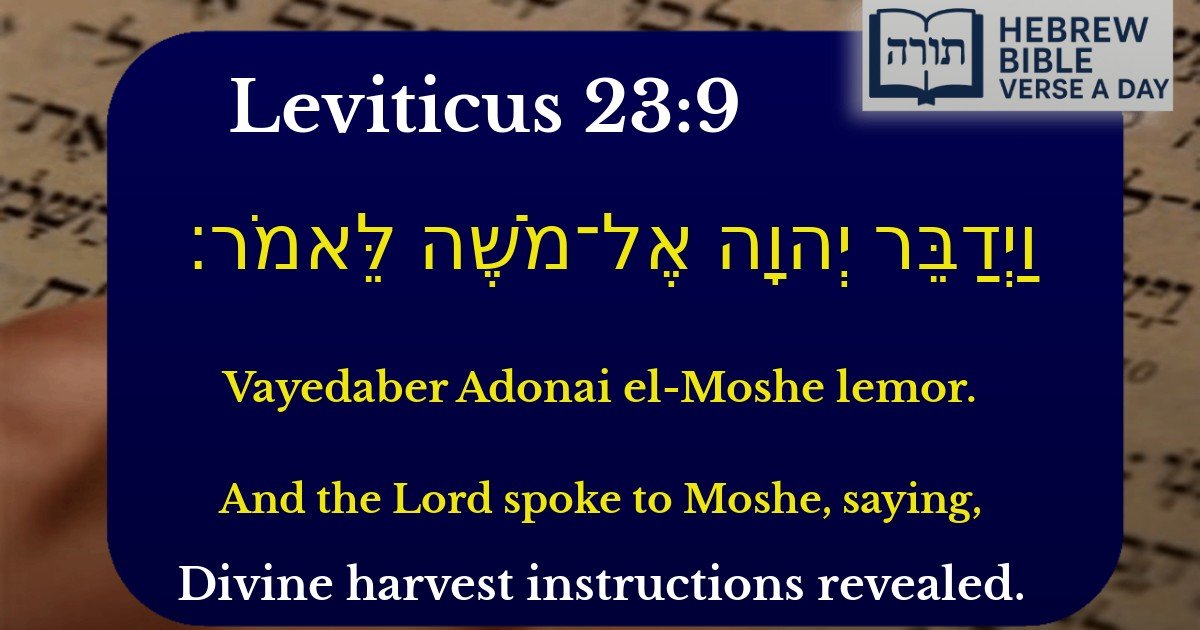

The Divine Communication to Moshe
The phrase "וַיְדַבֵּר יְהוָה אֶל־מֹשֶׁה לֵּאמֹר" ("And the Lord spoke to Moshe, saying") appears frequently in the Torah, marking the transmission of divine commandments and teachings. Rashi (Shemot 6:2) notes that this expression signifies a direct and clear communication from Hashem to Moshe, emphasizing Moshe's unique prophetic stature. Unlike other prophets who received messages through visions or allegories, Moshe heard Hashem's words with unparalleled clarity, as stated in Bamidbar 12:8: "Peh el Peh adaber bo" ("Mouth to mouth I will speak with him").
The Significance of "Leimor"
The term "לֵּאמֹר" ("saying") is interpreted by the Midrash (Sifrei Bamidbar 7:1) as an instruction for Moshe to relay the message to Bnei Yisrael. Rambam (Hilchos Yesodei HaTorah 7:6) explains that this underscores the role of Moshe as the intermediary between Hashem and the people, ensuring the accurate transmission of Torah. The Mechilta (Shemot 19:3) adds that "leimor" implies an obligation to teach these words to future generations, reinforcing the eternal nature of Torah.
Contextual Nuances