

Join Our Newsletter To Be Informed When New Videos Are Posted
Hebrew Text
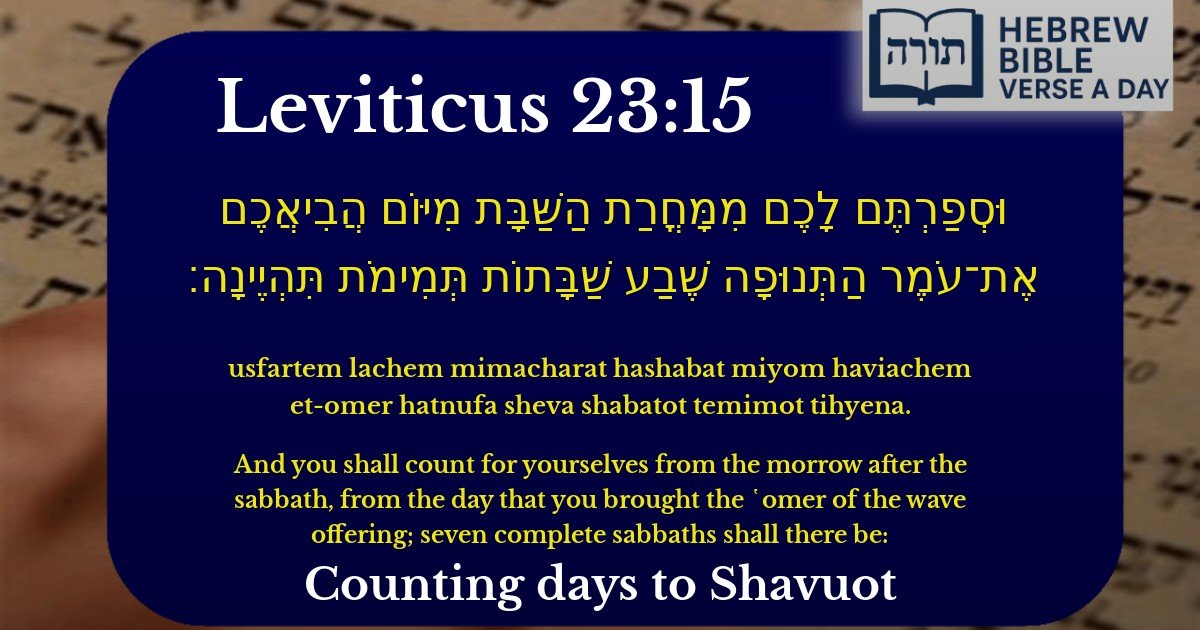
וּסְפַרְתֶּם לָכֶם מִמָּחֳרַת הַשַּׁבָּת מִיּוֹם הֲבִיאֲכֶם אֶת־עֹמֶר הַתְּנוּפָה שֶׁבַע שַׁבָּתוֹת תְּמִימֹת תִּהְיֶינָה׃
English Translation
And you shall count for yourselves from the morrow after the sabbath, from the day that you brought the ῾omer of the wave offering; seven complete sabbaths shall there be:
Transliteration
Usfartem lachem mimacharat hashabat miyom haviachem et-omer hatnufa sheva shabatot temimot tihyena.
Hebrew Leining Text
וּסְפַרְתֶּ֤ם לָכֶם֙ מִמׇּחֳרַ֣ת הַשַּׁבָּ֔ת מִיּוֹם֙ הֲבִ֣יאֲכֶ֔ם אֶת־עֹ֖מֶר הַתְּנוּפָ֑ה שֶׁ֥בַע שַׁבָּת֖וֹת תְּמִימֹ֥ת תִּהְיֶֽינָה׃
🎵 Listen to leining
Parasha Commentary
📚 Talmud Citations
This verse is quoted in the Talmud.
📖 Menachot 65b
The verse is discussed in the context of the counting of the Omer, particularly regarding the interpretation of 'the morrow after the sabbath' and whether it refers to the day after Passover or the day after the weekly Sabbath.
📖 Chagigah 17b
Mentioned in relation to the proper time for bringing the Omer offering and the subsequent counting of the days until Shavuot.
The Commandment of Sefirat HaOmer
The verse (Vayikra 23:15) commands the counting of the Omer, beginning from the day after the first day of Pesach (referred to here as "the morrow after the Shabbat") and continuing for seven complete weeks until Shavuot. This mitzvah, known as Sefirat HaOmer, bridges Pesach and Shavuot, connecting the physical redemption from Egypt with the spiritual redemption of receiving the Torah at Har Sinai.
Interpretation of "Morrow After the Shabbat"
Rashi explains that the term "the morrow after the Shabbat" does not refer to the weekly Shabbat but rather to the first day of Pesach (Yom Tov), which is called "Shabbat" in this context because it is a day of rest. This interpretation follows the Oral Torah tradition (Menachot 65b) and is universally accepted in Halacha. The count begins on the 16th of Nisan, the day the Omer offering was brought in the Beit HaMikdash.
The Omer Offering
The "Omer of the wave offering" refers to the barley offering brought on the second day of Pesach. The Rambam (Hilchot Temidin uMusafin 7:6) details that this offering was a measure of an omer (approximately 2.2 liters) of barley flour, waved before Hashem by the Kohen. This act sanctified the new grain harvest and permitted its consumption.
Seven Complete Weeks
The phrase "seven complete sabbaths" (שֶׁבַע שַׁבָּתוֹת תְּמִימֹת) teaches that the counting must encompass seven full weeks (49 days) without interruption. The Talmud (Menachot 66a) derives from the word "תְּמִימֹת" (complete) that one must count both days and weeks, leading to the practice of reciting both counts (e.g., "Today is 32 days, which is four weeks and four days of the Omer").
Spiritual Preparation for Shavuot
The Seforno explains that this counting period is a time of spiritual refinement, preparing us to receive the Torah on Shavuot. Just as Bnei Yisrael underwent a 49-day process from leaving Egypt to standing at Har Sinai, we too use these days to work on our middot (character traits) and Torah study, elevating ourselves for Matan Torah.
Halachic Details