Frequently Asked Questions
Q: What does Leviticus 23:30 mean?
A: Leviticus 23:30 is part of the Torah's laws regarding Yom Kippur (the Day of Atonement). It strictly forbids doing any work on this holy day and warns that those who violate this commandment will be spiritually cut off from the Jewish people. Rashi explains that this severe consequence emphasizes the sanctity of Yom Kippur as a day dedicated entirely to repentance and connection with Hashem.
Q: Why is this verse about Yom Kippur so strict?
A: The Torah is particularly strict about Yom Kippur because it is the holiest day of the year, when we focus entirely on repentance and spiritual renewal. The Rambam teaches that Yom Kippur is our annual opportunity to cleanse ourselves from sins and reconnect with Hashem. The severe warning in this verse underscores how seriously we must take this sacred day's restrictions and spiritual purpose.
Q: What kind of work is forbidden on Yom Kippur according to this verse?
A: This verse prohibits all forms of melacha (creative work) on Yom Kippur, just as on Shabbat. The Talmud (Yoma 73b) explains that this includes the 39 categories of work used in building the Mishkan (Tabernacle). Examples include cooking, writing, using electricity, or any activity that involves creating or altering the physical world. The restriction helps us focus entirely on prayer and repentance.
Q: How do we observe this commandment today?
A: Today, Orthodox Jews observe this commandment by completely refraining from work on Yom Kippur, just as on Shabbat. We spend the day in synagogue praying, fasting, and repenting. The Shulchan Aruch (Orach Chaim 611) details the specific prohibitions. Even those who aren't normally Shabbat observant often refrain from work on Yom Kippur due to its unique sanctity and the serious warning in this verse.
Q: What does 'cut off from his people' mean in this verse?
A: The phrase 'cut off from his people' (karet in Hebrew) is understood by our sages in multiple ways. Rashi explains it can mean premature death or being spiritually severed from one's roots. The Talmud (Moed Katan 28a) discusses that karet affects both this world and the afterlife. This severe consequence shows how seriously the Torah views violating Yom Kippur's sanctity.

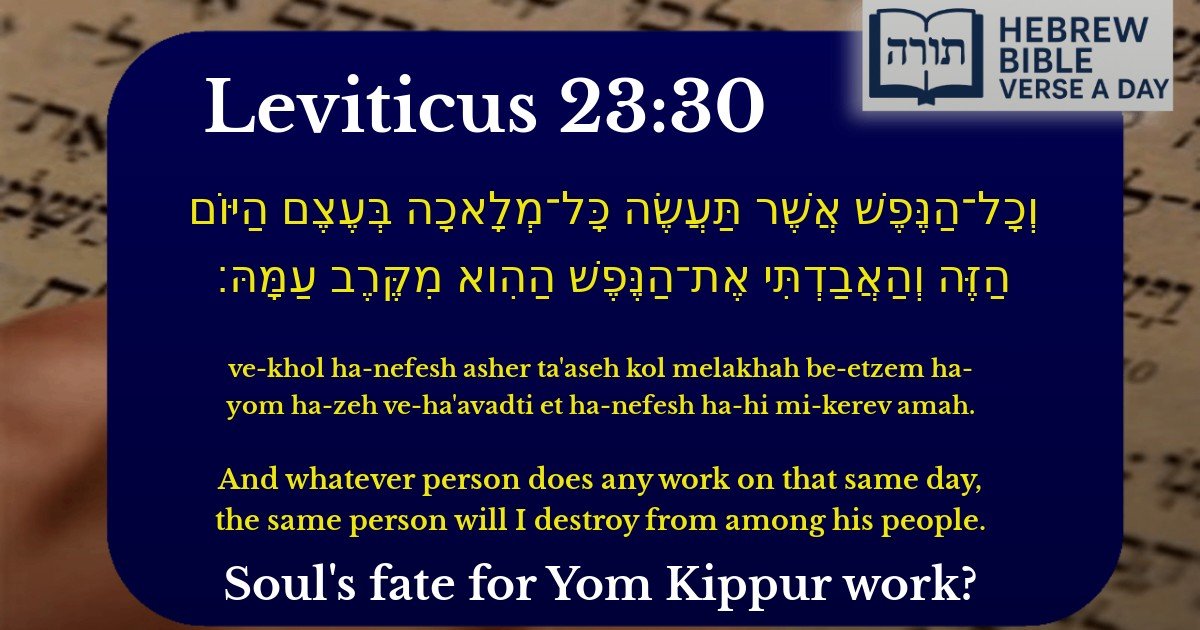

Context and Source
The verse (Vayikra 23:30) appears in the Torah's discussion of Yom Kippur, emphasizing the severe prohibition against performing labor on this holy day. The phrase "וְהַאֲבַדְתִּי אֶת־הַנֶּפֶשׁ הַהִוא" ("I will destroy that soul") underscores the gravity of violating this commandment.
Rashi's Explanation
Rashi (Vayikra 23:30) comments that the term "מְלָאכָה" (work) here refers specifically to the 39 categories of labor (Avot Melachah) prohibited on Shabbat, which also apply to Yom Kippur. He explains that the phrase "I will destroy" implies karet (spiritual excision), a severe Divine punishment for intentional violation.
Rambam's Perspective
In Mishneh Torah (Hilchot Shevitat Asor 1:6), Rambam elaborates that this prohibition applies even if the work is not for personal benefit but for the sake of a mitzvah, highlighting Yom Kippur's unique sanctity. He also notes that the punishment applies only to intentional violations (meizid), not accidental ones (shogeg).
Talmudic and Midrashic Insights
Spiritual Significance
The severity of the prohibition reflects Yom Kippur's role as a day of complete devotion to repentance and connection with Hashem. The karet punishment underscores the idea that violating this day severs one's spiritual bond with the Jewish people and the Divine.