Frequently Asked Questions
Q: What does 'no manner of work' mean in Leviticus 23:31?
A: The phrase 'no manner of work' refers to the prohibition of performing any melacha (creative labor) on Yom Kippur, as defined by Jewish law. This includes 39 categories of work derived from the activities involved in building the Mishkan (Tabernacle), such as cooking, writing, or lighting fires. Rashi explains that this commandment applies even in the Land of Israel and outside of it, emphasizing its eternal nature.
Q: Why is Yom Kippur called a 'statute forever' in this verse?
A: The Torah calls Yom Kippur a 'statute forever' (חֻקַּת עוֹלָם) to teach that its observance is binding for all future generations, regardless of time or place. The Rambam (Hilchot Shevitat Asor 1:1) emphasizes that this mitzvah remains in effect even when the Temple is not standing, showing its everlasting importance in Jewish life.
Q: Does this verse apply only in Israel or everywhere?
A: The verse explicitly states that the prohibition of work on Yom Kippur applies 'in all your dwellings' (בְּכֹל מֹשְׁבֹתֵיכֶם), meaning it is observed both in the Land of Israel and in the Diaspora. The Talmud (Moed Katan 19a) derives from this that Yom Kippur's restrictions apply universally, unlike some agricultural mitzvot that are land-dependent.
Q: What is the spiritual purpose of refraining from work on Yom Kippur?
A: The prohibition of work on Yom Kippur allows us to focus entirely on repentance, prayer, and spiritual renewal. The Midrash (Vayikra Rabbah 30:7) compares this to angels who serve Hashem without physical needs. By temporarily setting aside our physical labors, we emulate this angelic state and devote ourselves fully to teshuvah (repentance) and connection with Hashem.
Q: How do we observe this verse's commandment today?
A: Today, we observe this commandment by strictly refraining from all 39 categories of melacha (creative work) on Yom Kippur, just as on Shabbat. Additionally, we observe five afflictions (fasting, no washing, no anointing, no leather shoes, and no marital relations) as prescribed by the Talmud (Yoma 73b). The Shulchan Aruch (Orach Chaim 611) details these observances, showing how this eternal statute remains central to Jewish practice.

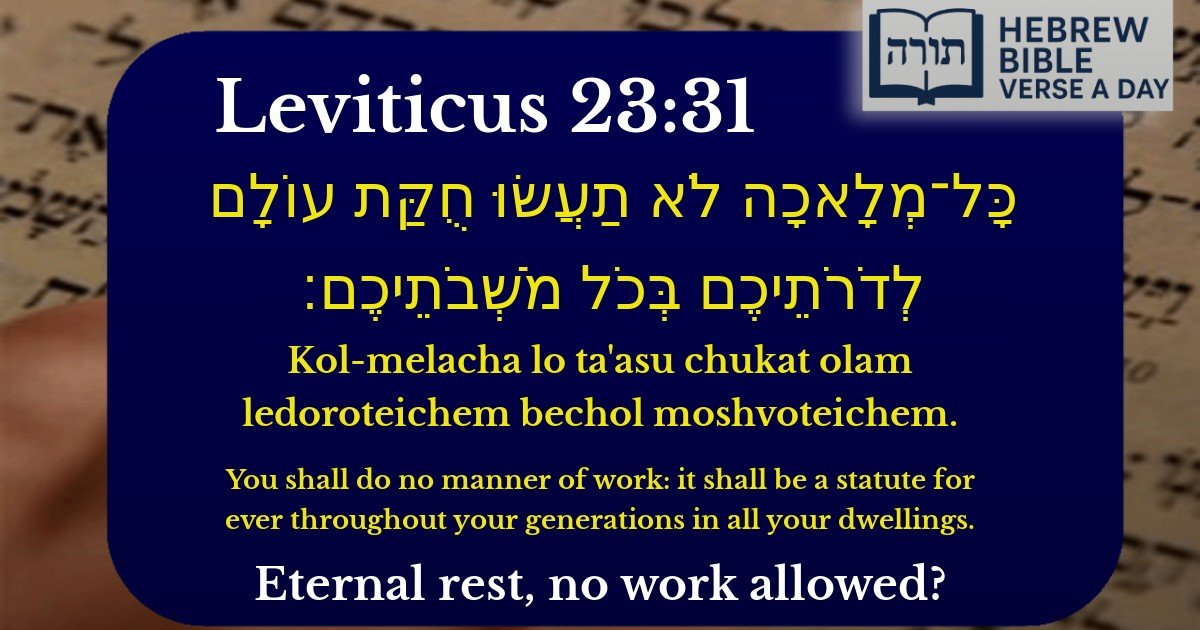

Source and Context
The verse כָּל־מְלָאכָה לֹא תַעֲשׂוּ חֻקַּת עוֹלָם לְדֹרֹתֵיכֶם בְּכֹל מֹשְׁבֹתֵיכֶם appears in Vayikra (Leviticus) 23:31 as part of the Torah's commandments regarding Yom Kippur. This verse emphasizes the absolute prohibition of performing any labor on Yom Kippur, framing it as an eternal statute for all generations, regardless of location.
Prohibition of Labor (מְלָאכָה)
Rashi (Vayikra 23:31) explains that the term מְלָאכָה refers to any form of creative labor, similar to the prohibitions of Shabbat. The Talmud (Yoma 74b) elaborates that this includes the 39 categories of labor (אֲבוֹת מְלָאכוֹת) derived from the construction of the Mishkan, as well as their derivatives (תּוֹלָדוֹת). The Rambam (Hilchot Shevitat Asor 1:5-6) codifies this prohibition, emphasizing its severity as a חֻקַּת עוֹלָם (eternal statute).
Eternal Statute (חֻקַּת עוֹלָם)
The phrase חֻקַּת עוֹלָם underscores the immutable nature of this commandment. The Sifra (a halachic Midrash on Vayikra) teaches that this term signifies that the prohibition applies לְדֹרֹתֵיכֶם (for all generations), even in times of exile or dispersion. The Kli Yakar (Vayikra 23:31) adds that the inclusion of בְּכֹל מֹשְׁבֹתֵיכֶם (in all your dwellings) reinforces that this mitzvah is binding both in Eretz Yisrael and outside of it, unlike certain agricultural laws tied to the Land.
Spiritual Significance
The Sefer HaChinuch (Mitzvah 313) explains that abstaining from labor on Yom Kippur facilitates complete focus on תְּשׁוּבָה (repentance) and spiritual elevation. The Meshech Chochmah (Vayikra 23:31) highlights that the prohibition serves as a reminder of human dependence on Hashem, as refraining from creative work acknowledges His sovereignty over all aspects of life.
Practical Halachic Implications