

Join Our Newsletter To Be Informed When New Videos Are Posted
Hebrew Text
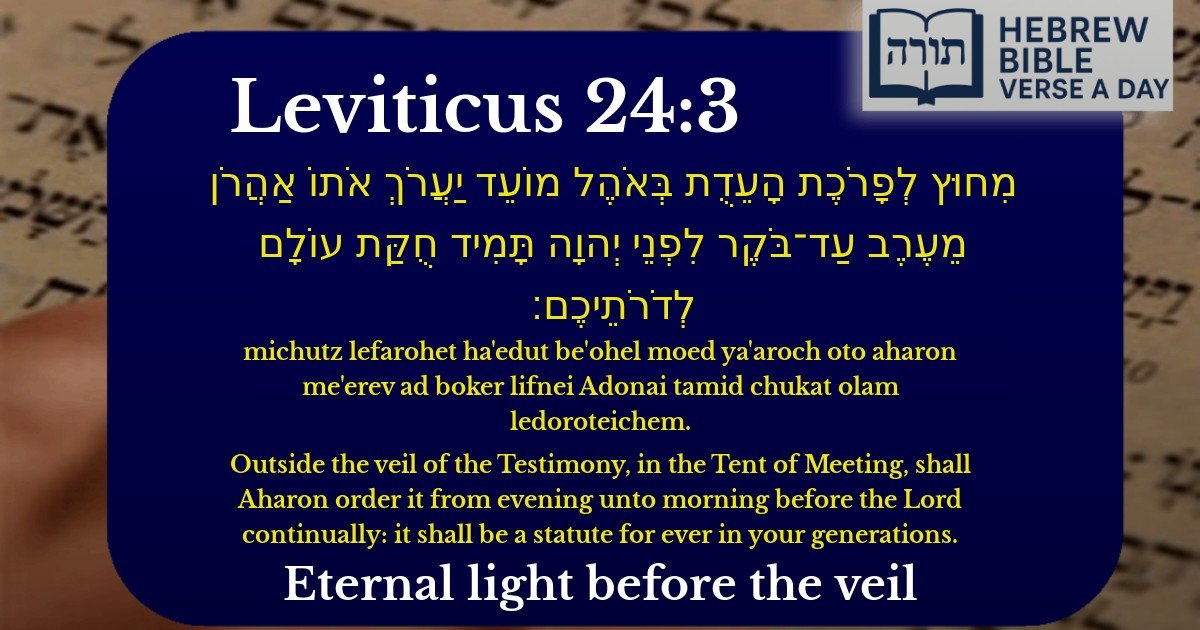
מִחוּץ לְפָרֹכֶת הָעֵדֻת בְּאֹהֶל מוֹעֵד יַעֲרֹךְ אֹתוֹ אַהֲרֹן מֵעֶרֶב עַד־בֹּקֶר לִפְנֵי יְהוָה תָּמִיד חֻקַּת עוֹלָם לְדֹרֹתֵיכֶם׃
English Translation
Outside the veil of the Testimony, in the Tent of Meeting, shall Aharon order it from evening unto morning before the Lord continually: it shall be a statute for ever in your generations.
Transliteration
Michutz lefarohet ha'edut be'ohel moed ya'aroch oto aharon me'erev ad boker lifnei Adonai tamid chukat olam ledoroteichem.
Hebrew Leining Text
מִחוּץ֩ לְפָרֹ֨כֶת הָעֵדֻ֜ת בְּאֹ֣הֶל מוֹעֵ֗ד יַעֲרֹךְ֩ אֹת֨וֹ אַהֲרֹ֜ן מֵעֶ֧רֶב עַד־בֹּ֛קֶר לִפְנֵ֥י יְהֹוָ֖ה תָּמִ֑יד חֻקַּ֥ת עוֹלָ֖ם לְדֹרֹֽתֵיכֶֽם׃
🎵 Listen to leining
Parasha Commentary
📚 Talmud Citations
This verse is quoted in the Talmud.
📖 Yoma 33a
The verse is referenced in the discussion about the arrangement of the menorah and the continual lighting of the lamp in the Tent of Meeting, emphasizing the perpetual nature of this commandment.
📖 Menachot 98b
The verse is cited in the context of discussing the laws of the menorah and the perpetual light, highlighting the duties of the priests in maintaining the lamp from evening until morning.
Context and Location of the Verse
This verse (Vayikra 24:3) describes the mitzvah of the ner tamid (eternal light) in the Mishkan (Tabernacle). The Torah commands Aharon to arrange the menorah's lamps outside the parochet (veil) separating the Holy of Holies from the rest of the Mishkan, ensuring they burn continuously from evening until morning.
Rashi's Explanation
Rashi (Vayikra 24:3) clarifies that "outside the veil of the Testimony" refers to the menorah's placement in the Ohel Moed (Tent of Meeting), specifically opposite the parochet but not inside the Holy of Holies. He emphasizes that Aharon must arrange the lamps so that they face the center of the menorah, symbolizing unity and divine presence.
Rambam's Halachic Perspective
In Hilchot Temidin u'Musafin (3:10), the Rambam codifies this mitzvah, stating that the menorah must be lit every evening and remain burning until morning. He notes that even if the flame extinguishes prematurely, it does not invalidate the mitzvah, provided it was initially lit properly.
Symbolism of the Eternal Light
The Midrash (Shemot Rabbah 36:3) teaches that the ner tamid represents the eternal light of Torah and the Jewish people's spiritual mission. Just as the menorah's light shines continuously, so too must our commitment to Torah and mitzvot endure through all generations.
Practical Halachic Implications
Eternal Statute for Future Generations
The verse concludes by calling this mitzvah a "statute forever," emphasizing its timeless relevance. The Talmud (Menachot 86b) derives from here that even after the destruction of the Temple, the concept of ner tamid continues in synagogues, where an eternal light is kept burning as a remembrance of the menorah in the Mishkan.