

Join Our Newsletter To Be Informed When New Videos Are Posted
Hebrew Text
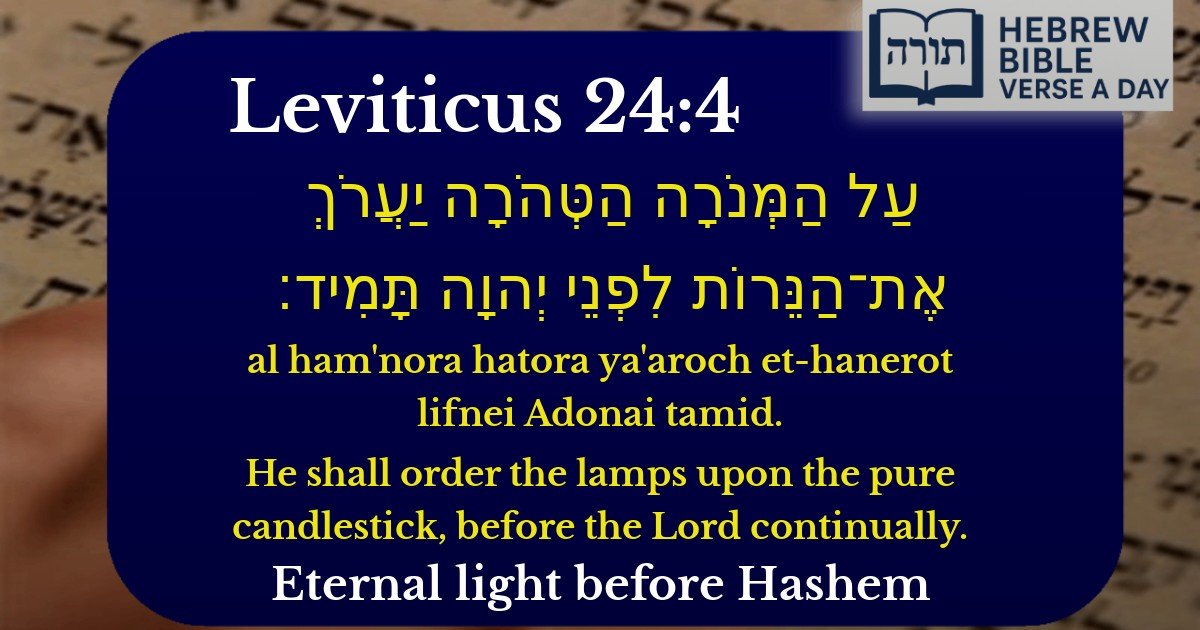
עַל הַמְּנֹרָה הַטְּהֹרָה יַעֲרֹךְ אֶת־הַנֵּרוֹת לִפְנֵי יְהוָה תָּמִיד׃
English Translation
He shall order the lamps upon the pure candlestick, before the Lord continually.
Transliteration
Al ham'nora hatora ya'aroch et-hanerot lifnei Adonai tamid.
Hebrew Leining Text
עַ֚ל הַמְּנֹרָ֣ה הַטְּהֹרָ֔ה יַעֲרֹ֖ךְ אֶת־הַנֵּר֑וֹת לִפְנֵ֥י יְהֹוָ֖ה תָּמִֽיד׃ {פ}
🎵 Listen to leining
Parasha Commentary
📚 Talmud Citations
This verse is quoted in the Talmud.
📖 Menachot 88b
The verse is discussed in the context of the proper arrangement of the lamps on the menorah in the Temple.
📖 Shabbat 22b
The verse is referenced in a discussion about the mitzvah of lighting the menorah and its perpetual nature.
Context of the Verse
The verse (Vayikra 24:4) describes the mitzvah of lighting the Menorah in the Mishkan (Tabernacle) and later in the Beit HaMikdash (Holy Temple). The Kohen is commanded to arrange the lamps on the pure Menorah so that they burn continually before Hashem.
Rashi's Explanation
Rashi explains that "עַל הַמְּנֹרָה הַטְּהֹרָה" ("upon the pure candlestick") means that the Kohen must ensure the Menorah itself remains pure and clean. He notes that the word "טְּהֹרָה" (pure) teaches that the Kohen must regularly clean the Menorah's lamps and remove any ashes or impurities to maintain its sanctity.
Rambam's Perspective
In Hilchot Temidin u'Musafin (3:10-12), the Rambam elaborates on the practical details of this mitzvah. He states that the Kohen must arrange the lamps each evening so that they face the center lamp (the Ner HaMa'aravi), symbolizing the unity of the Jewish people in their service to Hashem.
Symbolism of the Menorah
The Eternal Flame
The phrase "לִפְנֵי יְהוָה תָּמִיד" ("before the Lord continually") is interpreted by the Sifra to mean that even if the flame goes out, the mitzvah is still fulfilled as long as the Kohen properly prepared the wicks and oil each day. The Kli Yakar adds that this teaches the importance of consistency in divine service—just as the Menorah's light must be perpetual, so too must our commitment to Torah and mitzvot remain unwavering.
Practical Halachic Implications
The Shulchan Aruch (Orach Chaim 154:5) derives from this verse the importance of maintaining cleanliness and order in the synagogue's ner tamid (eternal light), as it reflects the sanctity of the original Menorah in the Beit HaMikdash.