Frequently Asked Questions
Q: What does Leviticus 24:19 mean when it says 'as he has done, so shall it be done to him'?
A: This verse teaches the principle of proportionate justice, known as 'middah k'neged middah' (measure for measure). According to Rashi and the Talmud (Sanhedrin 1:1), this refers to monetary compensation for injuries, not literal physical retaliation. The Torah is establishing that punishment or restitution should match the severity of the wrongdoing.
Q: Why is the law of 'an eye for an eye' important in Judaism?
A: Contrary to popular misunderstanding, Jewish tradition (as explained in Bava Kamma 83b) interprets 'an eye for an eye' as requiring monetary compensation, not physical retaliation. Rambam (Hilchot Chovel U'Mazik 1:3) explains this is fundamental to creating a just society where damages are fairly compensated. The Torah's approach emphasizes responsibility and the value of each person's physical wellbeing.
Q: How does Leviticus 24:19 apply to modern situations?
A: The principle continues to guide Jewish law today in cases of personal injury or damages. The Talmud (Bava Kamma 83b-84a) details how courts calculate compensation for medical expenses, pain, lost wages, and embarrassment. This teaches us that causing harm to others carries serious consequences and requires making proper amends.
Q: What's the difference between this verse and simple revenge?
A: As explained in the Midrash (Sifra on this verse), this law is about justice administered through proper courts, not personal vengeance. The Talmud (Sanhedrin 1:1) emphasizes that only qualified judges may assess damages after careful investigation. This prevents vigilante justice and ensures fair, measured responses to wrongdoing.
Q: Does Judaism really believe in literal physical retaliation?
A: No. Traditional Jewish sources unanimously interpret this verse figuratively. The Talmud (Bava Kamma 84a) states it clearly: 'Does the Torah mean literally an eye? That cannot be, for sometimes the offender would lose his eye while the victim would not lose his sight completely.' Rashi explains this verse always referred to monetary compensation, as Jewish courts have practiced throughout history.

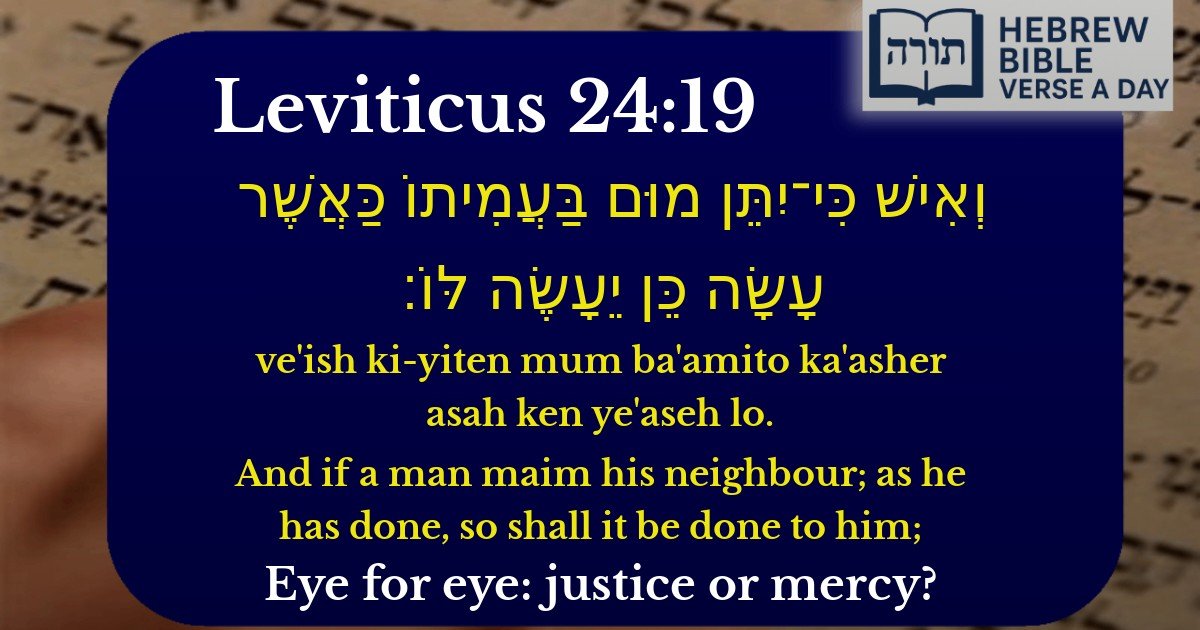

Literal Interpretation (Peshat)
The verse (Vayikra 24:19) states: "And if a man maim his neighbor; as he has done, so shall it be done to him." On a simple level, this appears to prescribe a principle of retaliation—"an eye for an eye." However, Rashi (ad loc.) clarifies that this is not to be taken literally as physical retribution, but rather as monetary compensation. This aligns with the Talmud's (Bava Kamma 83b) ruling that the Torah mandates financial restitution for bodily injuries, not actual physical retaliation.
Halachic Application
Rambam (Hilchot Chovel U'Mazik 1:3-5) elaborates that the verse establishes five categories of compensation one must pay for injuring another:
Moral and Ethical Lessons
The Midrash (Torat Kohanim 24:19) emphasizes that the principle of "as he has done, so shall it be done to him" teaches the severity of causing harm to another person. The Sages derive from this that one must recognize the gravity of their actions and take full responsibility for their consequences. The Sefer HaChinuch (Mitzvah 227) adds that this law instills a fear of wrongdoing, as one understands that they will bear the full cost of their actions.
Philosophical Insight
Rabbi Samson Raphael Hirsch (commentary on Vayikra 24:19) explains that the Torah's emphasis on monetary compensation—rather than physical retaliation—reflects the sanctity of human life and the importance of justice tempered with wisdom. The goal is not vengeance but restoration, ensuring that the injured party is made whole while the perpetrator learns the moral weight of their actions.