

Join Our Newsletter To Be Informed When New Videos Are Posted
Hebrew Text
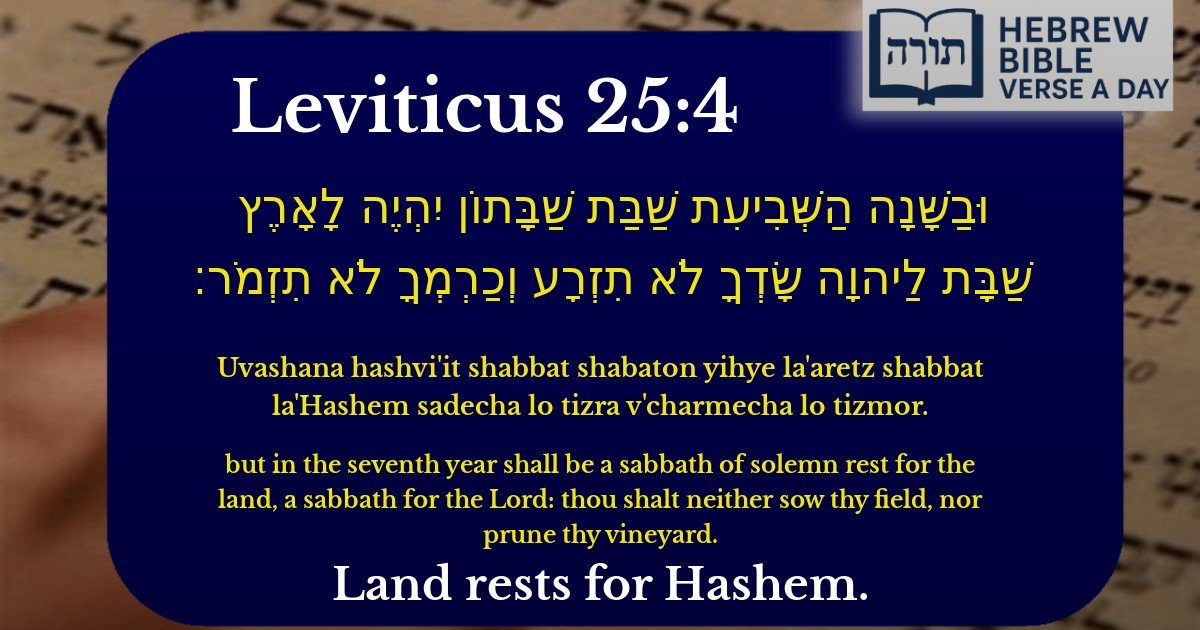
וּבַשָּׁנָה הַשְּׁבִיעִת שַׁבַּת שַׁבָּתוֹן יִהְיֶה לָאָרֶץ שַׁבָּת לַיהוָה שָׂדְךָ לֹא תִזְרָע וְכַרְמְךָ לֹא תִזְמֹר׃
English Translation
but in the seventh year shall be a sabbath of solemn rest for the land, a sabbath for the Lord: thou shalt neither sow thy field, nor prune thy vineyard.
Transliteration
Uvashana hashvi'it shabbat shabaton yihye la'aretz shabbat la'Hashem sadecha lo tizra v'charmecha lo tizmor.
Hebrew Leining Text
וּבַשָּׁנָ֣ה הַשְּׁבִיעִ֗ת שַׁבַּ֤ת שַׁבָּתוֹן֙ יִהְיֶ֣ה לָאָ֔רֶץ שַׁבָּ֖ת לַיהֹוָ֑ה שָֽׂדְךָ֙ לֹ֣א תִזְרָ֔ע וְכַרְמְךָ֖ לֹ֥א תִזְמֹֽר׃
🎵 Listen to leining
Parasha Commentary
📚 Talmud Citations
This verse is quoted in the Talmud.
📖 Moed Katan 2b
The verse is referenced in the discussion about the prohibition of agricultural work during the Sabbatical year (Shemittah).
📖 Arachin 29a
The verse is cited in the context of discussing the laws of the Sabbatical year and the sanctity of the land during that period.
📖 Sotah 48b
The verse is mentioned in relation to the blessings and curses associated with observing or neglecting the Sabbatical year.
The Sanctity of Shemitah (Sabbatical Year)
The verse (Vayikra 25:4) establishes the mitzvah of Shemitah, the Sabbatical year, during which agricultural work in Eretz Yisrael is prohibited. Rashi explains that this commandment emphasizes the land's rest as "a Sabbath for Hashem," paralleling the weekly Shabbat—just as Shabbat testifies to Hashem's creation of the world in six days, Shemitah testifies to His ownership of the land (Rashi on Vayikra 25:2).
Prohibitions During Shemitah
Spiritual and Ethical Dimensions
The Sefer HaChinuch (Mitzvah 84) highlights Shemitah's role in strengthening bitachon (trust in Hashem), as farmers must rely on divine providence for sustenance. The Midrash (Torat Kohanim 25:3) further states that violating Shemitah leads to exile, as the land "rests" without its inhabitants to compensate for missed Sabbatical years.
Halachic and Historical Context
The Talmud (Avodah Zarah 15b) notes that Shemitah applies only in Eretz Yisrael with its full biblical force, while rabbinic enactments extend certain laws to neighboring regions. Ramban (Vayikra 25:2) emphasizes that Shemitah, like Shabbat, is a covenantal sign between Hashem and Klal Yisrael, reinforcing our spiritual connection to the land.