Frequently Asked Questions
Q: Who was Nachshon ben Aminadav mentioned in Numbers 1:7?
A: Nachshon ben Aminadav was the prince (nasi) of the tribe of Yehuda during the Exodus. He is famously known in the Midrash (Shemot Rabbah 15:22) for his great faith—he was the first to jump into the Red Sea before it split, demonstrating complete trust in Hashem.
Q: Why is Nachshon ben Aminadav important in Jewish tradition?
A: Nachshon is important because his courageous act at the Red Sea set an example of unwavering faith in Hashem. The Talmud (Sotah 37a) teaches that the sea only split after Nachshon took the first step into the water, showing that miracles happen when we take initiative with trust in Hashem.
Q: What lesson can we learn from Nachshon ben Aminadav's story?
A: The lesson from Nachshon is that true faith requires action. As Rashi explains (on Shemot 14:15), Hashem told Moshe to stop praying and act—similarly, Nachshon didn’t wait passively but took the first step. This teaches us to combine prayer with effort (hishtadlut) in serving Hashem.
Q: How is Nachshon connected to King David and Mashiach?
A: Nachshon was an ancestor of King David (as seen in Ruth 4:18-22), making him part of the lineage leading to Mashiach. The Midrash (Bamidbar Rabbah 13:11) highlights that Yehuda’s tribe, represented by Nachshon, was chosen for leadership due to their righteousness.
Q: Why does the Torah list tribal leaders like Nachshon in Numbers 1?
A: Listing the leaders emphasizes the importance of each tribe’s role in forming Klal Yisrael. Ramban (on Bamidbar 1:5) explains that these princes were chosen for their integrity and ability to represent their tribes during the census and in the Mishkan’s dedication.

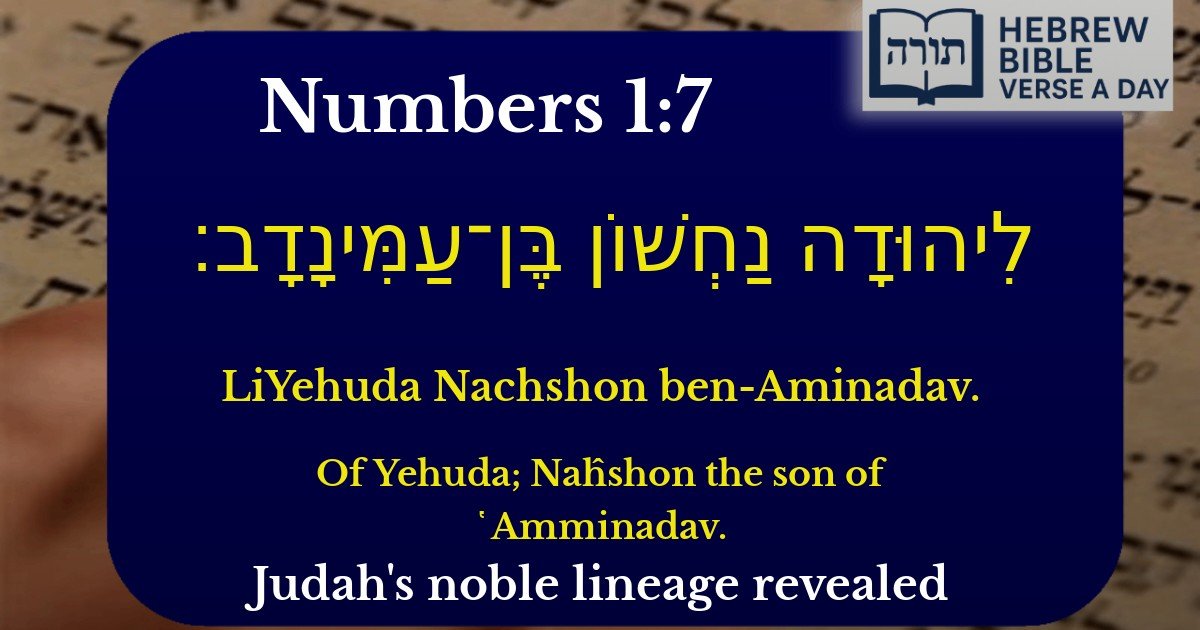

Context in the Torah
The verse "לִיהוּדָה נַחְשׁוֹן בֶּן־עַמִּינָדָב" (Of Yehuda; Nachshon the son of Amminadav) appears in Bamidbar 1:7 as part of the census of the Israelites in the wilderness. Nachshon is identified as the prince (nasi) of the tribe of Yehuda, chosen to represent his tribe during the counting.
Nachshon's Leadership and Legacy
Nachshon ben Amminadav holds a significant place in Jewish tradition. Rashi (Bamidbar 7:12) notes that he was the first to bring an offering during the dedication of the Mishkan, demonstrating his prominence among the tribal leaders. The Midrash (Shemot Rabbah 15:22) further highlights his bravery at the splitting of the Red Sea, where he was the first to step into the waters before they miraculously parted, embodying the principle of emunah (faith) in Hashem.
Genealogical Significance
Nachshon's lineage is noteworthy in Jewish tradition. The Talmud (Sotah 37a) connects him to the Davidic dynasty, as he was an ancestor of King David. Rambam (Hilchot Melachim 1:7) emphasizes that the monarchy of Israel was destined to come from Yehuda, with Nachshon representing the noble lineage that would eventually produce Mashiach.
Symbolism of His Name
Lessons in Leadership
Nachshon serves as a model of proactive leadership. The Midrash (Bamidbar Rabbah 13:7) teaches that his willingness to act with bitachon (trust in Hashem) set the standard for future leaders. His role underscores the importance of courage and initiative in fulfilling divine commandments.