Frequently Asked Questions
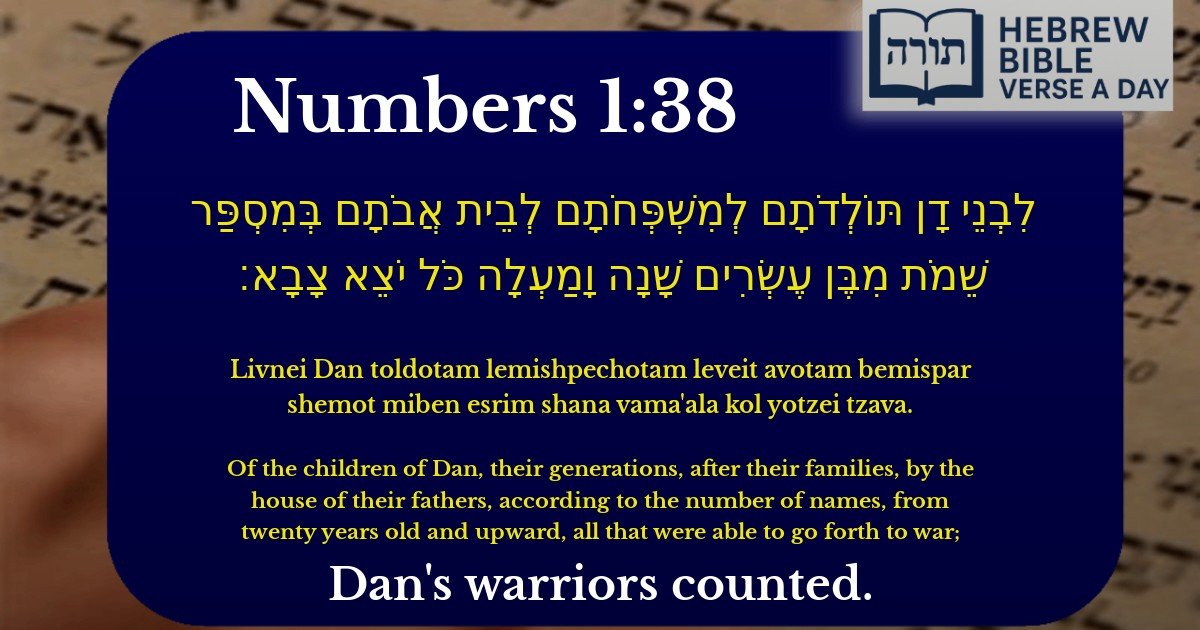
Q: What does the verse about the children of Dan counting those 'able to go forth to war' mean?
A: This verse describes the census taken of the tribe of Dan, counting men aged 20 and older who were fit for military service. According to Rashi, this was done to organize the Israelites for their journey and potential battles in the wilderness, showing the importance of unity and preparedness in fulfilling G-d's plan.
Q: Why was the census in Numbers 1:38 only for men 20 years and older?
A: The age of 20 was chosen because, as Rambam explains, this was the age when a man reached physical maturity and was capable of serving in the army. The Talmud (Bava Batra 121b) also connects this age to the concept of accountability and strength for communal responsibilities.
Q: What can we learn from the detailed counting of the tribes in this verse?
A: The detailed counting teaches us that every individual in the Jewish people is important and has a unique role. The Midrash (Bamidbar Rabbah 1:4) explains that just as a shepherd counts his flock to show care for each sheep, G-d counts the Israelites to show His love and attention to each person.
Q: How does the concept of being 'able to go forth to war' apply to us today?
A: While we are not currently engaged in physical warfare, the Sages teach that this verse also alludes to spiritual battles. The 'war' can represent the struggle against negative influences or the effort to fulfill mitzvot. Every Jew is called to be spiritually strong and committed, just as the tribe of Dan was prepared for their role.
Q: Why is the tribe of Dan mentioned separately in this census?
A: Each tribe is listed individually to emphasize their unique identity and contribution to the nation. The Midrash highlights that Dan, though descended from a handmaid (Bilhah), was given equal status in the census, showing that in G-d's eyes, all tribes are valued when they uphold their responsibilities.


Context of the Verse
The verse (Bamidbar 1:38) is part of the census taken of the Israelites in the wilderness, specifically detailing the tribe of Dan. This census was commanded by Hashem to Moshe and Aharon to count all men eligible for military service from the age of twenty and upward (Bamidbar 1:2-3). The counting was done "לְמִשְׁפְּחֹתָם לְבֵית אֲבֹתָם" (by their families, according to their fathers' households), emphasizing the importance of lineage and tribal identity.
Rashi's Commentary
Rashi explains that the phrase "תּוֹלְדֹתָם לְמִשְׁפְּחֹתָם" (their generations, after their families) refers to the genealogical records of each tribe. The counting was not merely numerical but also served to establish the purity of lineage, ensuring that each individual's tribal affiliation was verified (Rashi on Bamidbar 1:18). This was crucial for matters such as inheritance, tribal land allocation, and military organization.
Military Service at Twenty Years Old
The age of twenty is significant because, as the Rambam (Hilchot Melachim 7:4) notes, this is when a man reaches full physical strength and maturity, making him fit for military duty. The Talmud (Sotah 44a) also connects this age to the concept of accountability, as twenty is the age when one becomes fully liable for mitzvot and communal responsibilities.
The Tribe of Dan's Distinctiveness
Midrash Tanchuma (Bamidbar 12) highlights that the tribe of Dan was known for its large population, as hinted in Bereishit 46:23, where Dan's son Chushim is mentioned. Despite their numbers, the Midrash emphasizes that each tribe—including Dan—was counted individually to demonstrate their unique role in Klal Yisrael. The Sforno adds that the meticulous counting reflected Hashem's love for each Jew, as one counts precious possessions carefully.
Spiritual Lessons