Frequently Asked Questions
Q: What does the number 62,700 represent in Numbers 1:39?
A: In Numbers 1:39, the number 62,700 represents the count of men aged 20 and older from the tribe of Dan who were eligible for military service. This census was taken in the wilderness as commanded by Hashem (Rashi on Numbers 1:2-3).
Q: Why was the tribe of Dan counted separately in the census?
A: Each tribe was counted separately to show their individual strength and importance within the nation of Israel. The tribe of Dan was one of the largest tribes, demonstrating their significant role among the Jewish people (Rambam, Mishneh Torah, Hilchot Melachim 12:3).
Q: What can we learn from the census of the tribes in the wilderness?
A: The census teaches us that every individual in the Jewish people is precious and counted before Hashem. It also shows the importance of unity while recognizing each tribe's unique role (Midrash Bamidbar Rabbah 1:4).
Q: How does the large number of the tribe of Dan apply to us today?
A: The size of the tribe of Dan reminds us that every Jew, regardless of background or status, contributes to the strength of the Jewish nation. Just as each person was counted then, every Jew today has a vital role in the Jewish people (Talmud, Sanhedrin 17b).
Q: Why does the Torah give such precise numbers in the census?
A: The precise numbers emphasize that the Torah is a historical record of the Jewish people's journey. It also shows Hashem's care in counting each individual, teaching us that every person matters (Sforno on Numbers 1:2).

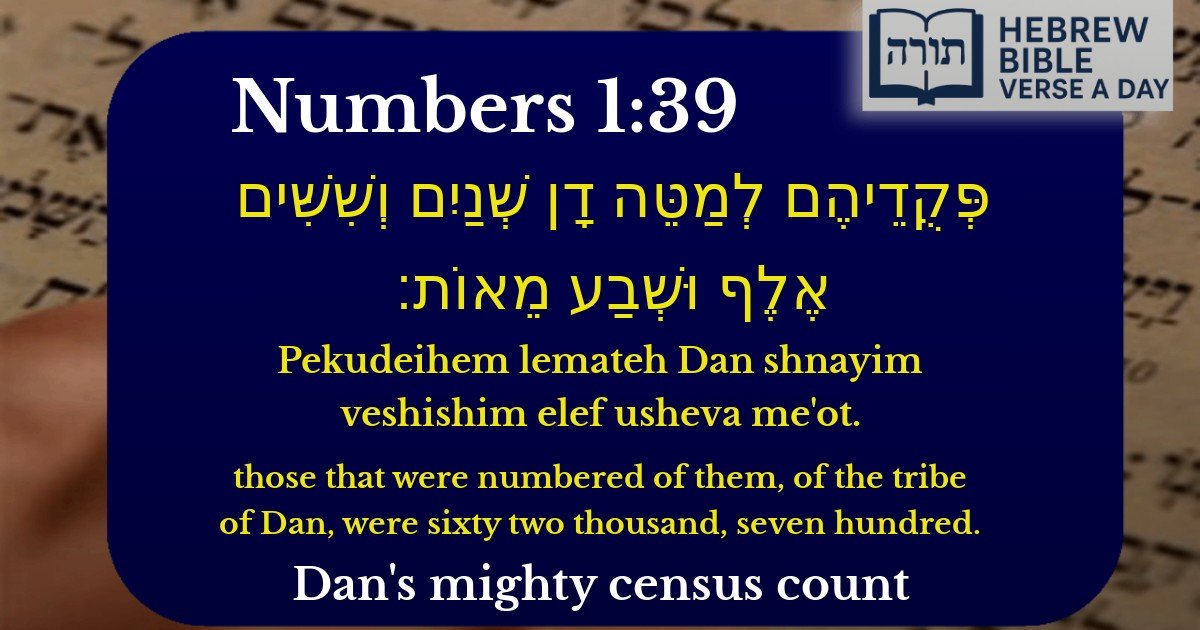

Commentary on Numbers 1:39 – The Tribe of Dan's Census
The verse states: "פְּקֻדֵיהֶם לְמַטֵּה דָן שְׁנַיִם וְשִׁשִּׁים אֶלֶף וּשְׁבַע מֵאוֹת" ("those that were numbered of them, of the tribe of Dan, were sixty-two thousand, seven hundred"). This census result for the tribe of Dan is significant in several ways, as discussed by traditional Jewish commentators.
Rashi's Explanation
Rashi (Rabbi Shlomo Yitzchaki) notes that the tribe of Dan was the second-largest tribe in the census, surpassed only by Yehudah (Judah). He points out that despite Dan being the son of Bilhah, Rachel's maidservant, the tribe grew remarkably in numbers—a fulfillment of Yaakov's blessing to Dan in Bereishit (Genesis) 49:16: "Dan shall judge his people as one of the tribes of Israel." This indicates that Dan was not to be considered inferior despite his maternal lineage.
Midrashic Insights
The Midrash (Bamidbar Rabbah 2:7) highlights that Dan's large population was a reward for the tribe's role in upholding justice. The Midrash connects this to Shimshon (Samson), a descendant of Dan, who judged Israel for twenty years (Shoftim 15:20). Additionally, the Midrash teaches that Dan's numbers were a result of their unity—they camped together under one banner (as per Bamidbar 2:25), fostering harmony and growth.
Numerical Significance
Spiritual Lessons
The Sforno (Rabbi Ovadia Sforno) emphasizes that Dan's growth teaches that success comes from dedication to Torah and mitzvot, not just ancestry. Furthermore, the Kli Yakar (Rabbi Shlomo Ephraim Luntschitz) suggests that Dan's large numbers reflect their role as "rear guards" (Bamidbar 10:25), protecting the nation—a merit that brought them abundance.