Frequently Asked Questions
Q: Why weren't the Levites counted with the other tribes in Numbers 1:47?
A: The Levites were not counted in the general census because they had a special role dedicated to serving in the Mishkan (Tabernacle) and later the Beit HaMikdash (Temple). Rashi explains that since they were set apart for holy service, they were counted separately (Rashi on Numbers 1:49).
Q: What was the role of the Levites that made them different from other tribes?
A: The Levites were chosen by Hashem to assist the Kohanim (priests) in the Mishkan and Temple service. Their duties included transporting the Mishkan, singing during offerings, and guarding the sacred area. The Rambam (Hilchot Klei HaMikdash 3) details their unique responsibilities.
Q: Does the special status of the Levites still apply today?
A: While we don't have the Temple today, Levites still maintain certain honors in Jewish life, such as being called second to the Torah after a Kohen. The Shulchan Aruch (Orach Chaim 135) preserves these customs, showing the lasting distinction of the Levites.
Q: How were the Levites counted if not in the general census?
A: The Torah later describes a separate counting of Levite males from one month old (Numbers 3:15). Unlike the other tribes who were counted from age 20 for military service, the Levites' count emphasized their spiritual role from infancy, as the Midrash Tanchuma (Bamidbar 3) explains.
Q: What lesson can we learn from the Levites being set apart?
A: This teaches that serving Hashem requires dedication and sometimes separation from regular societal roles. The Sforno notes that the Levites' exclusion from the census highlights how spiritual service is its own 'nation' with different priorities (Sforno on Numbers 1:47).

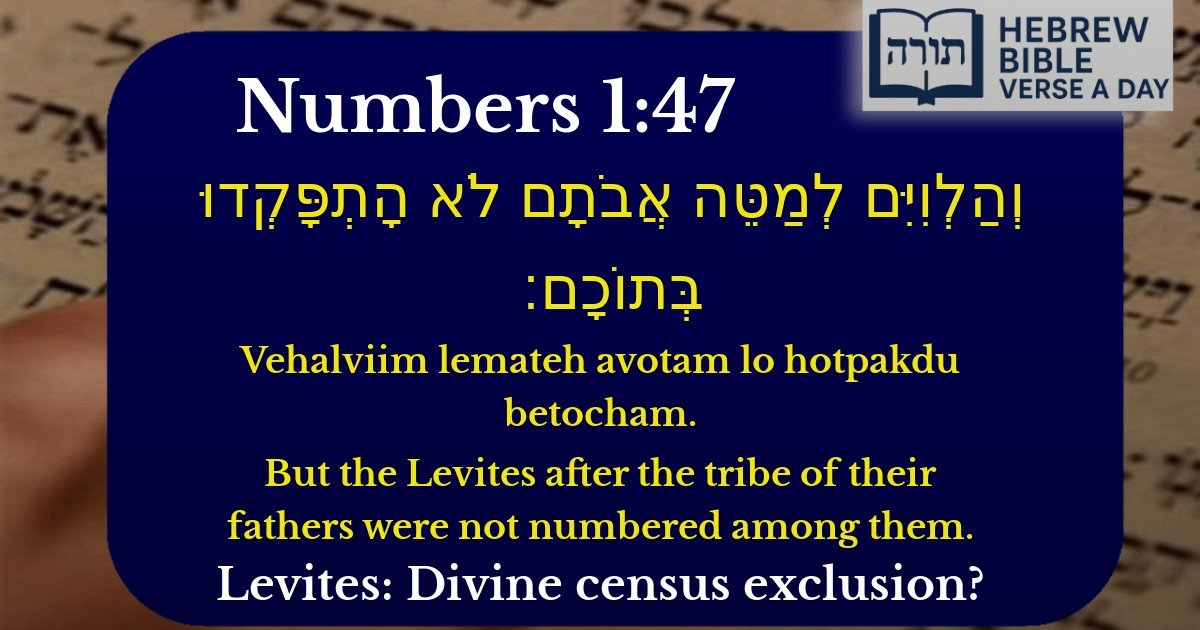

Context of the Verse
The verse (Numbers 1:47) states that the Levites were not counted among the rest of the tribes of Israel during the census in the wilderness. This exclusion is significant and requires explanation based on traditional Orthodox Jewish sources.
Rashi's Explanation
Rashi (Rabbi Shlomo Yitzchaki) comments on this verse that the Levites were not included in the general census because they were designated for a special role—serving in the Mishkan (Tabernacle) and later the Beit HaMikdash (Temple). Their unique status exempted them from being counted among the other tribes for military or general purposes.
Rambam's Perspective
Rambam (Maimonides) elaborates in Hilchot Shemita v'Yovel (13:12) that the Levites were set apart for divine service, and their exclusion from the census reflects their distinct spiritual mission. Unlike the other tribes, who were given portions in the Land of Israel, the Levites were to be supported by the tithes (Ma'aser) and dedicated entirely to Torah study and service to Hashem.
Midrashic Insights
Halachic Implications
The Sefer HaChinuch (Mitzvah 360) connects this verse to the broader principle that the Levites were not to receive a territorial inheritance in Eretz Yisrael (Deuteronomy 18:1-2). Their role as spiritual leaders necessitated their dependence on the community, reinforcing their focus on Torah and Avodah (service).
Symbolic Meaning
The Kli Yakar (Rabbi Shlomo Ephraim Luntschitz) suggests that the Levites' exclusion symbolizes their transcendence of physical enumeration, representing their higher spiritual purpose. While the other tribes were counted for earthly matters (e.g., military, land allocation), the Levites were "counted" only in terms of their sacred duties (Numbers 3:15).