Frequently Asked Questions
Q: What does Numbers 2:8 mean when it mentions 'his host'?
A: In Numbers 2:8, 'his host' refers to the tribal army of the tribe of Ephraim, one of the twelve tribes of Israel. According to Rashi, this verse is part of the census taken in the wilderness, counting the men eligible for military service from each tribe. The number given (57,400) represents the strength of Ephraim's fighting force at that time.
Q: Why is the number 57,400 significant in Numbers 2:8?
A: The number 57,400 in Numbers 2:8 shows the size of the tribe of Ephraim's military contingent during the wilderness journey. According to the Rambam, these censuses were important for organizing the camp and understanding each tribe's contribution to the collective defense and structure of the Israelite nation.
Q: How does the counting of tribes in Numbers 2 apply to us today?
A: While we no longer count tribes for military purposes, the principle of organization and each individual's role in the community remains relevant. The Midrash teaches that just as each tribe had its place and purpose in the camp, every Jew today has a unique role in serving Hashem and strengthening the Jewish people.
Q: Why does the Torah give such specific numbers for each tribe's count?
A: The Torah provides exact numbers to emphasize the importance of every individual. As the Talmud (Sanhedrin 37a) teaches, each person is an entire world. The precise counting shows that every member of the tribe mattered in the collective mission of the Jewish people.
Q: What can we learn from the placement of Ephraim's tribe in the camp?
A: Ephraim was positioned to the west of the Tabernacle (Numbers 2:18), showing their specific role in the camp's structure. Rashi explains that each tribe's placement reflected their spiritual qualities and relationship to the Mishkan. This teaches us about the importance of proper spiritual positioning and order in serving Hashem.

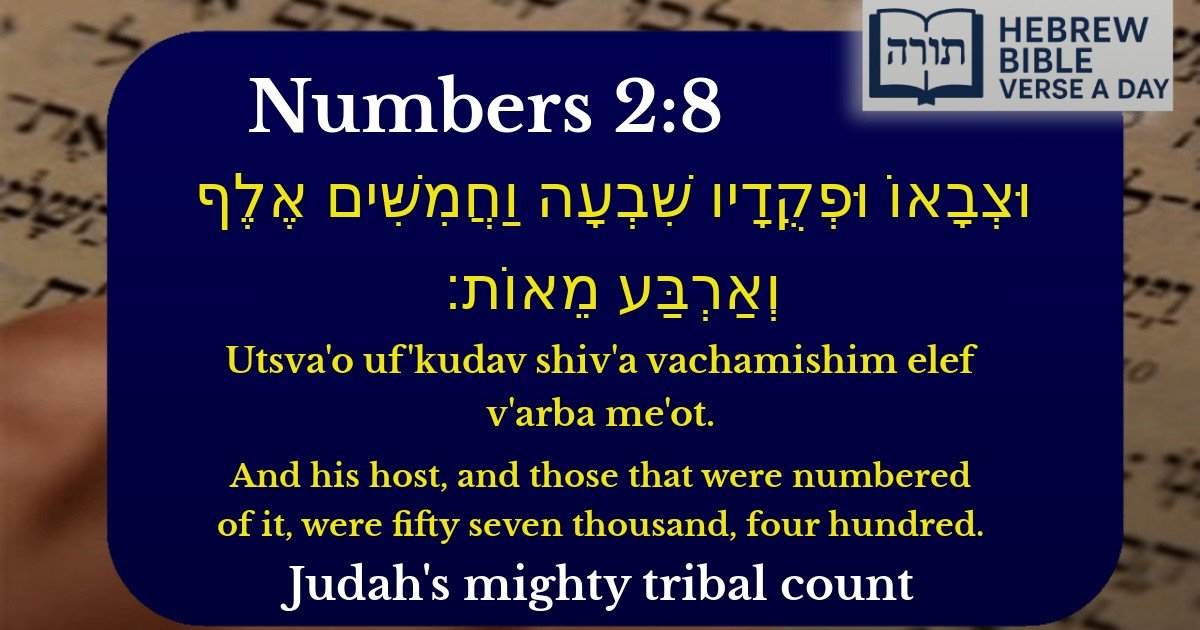

Context of the Verse
This verse appears in Bamidbar (Numbers) 2:16, describing the census count of the tribe of Reuven during the Israelites' journey in the wilderness. The verse specifies the number of men fit for military service from the tribe of Reuven as 57,400.
Rashi's Commentary
Rashi (Bamidbar 2:16) explains that the phrase "וּצְבָאוֹ וּפְקֻדָיו" ("his host and those that were numbered of it") refers to the military divisions of the tribe of Reuven. The term "צבא" (host) denotes their readiness for battle, while "פקודים" (those that were numbered) emphasizes their organized count under the leadership of Elitzur ben Shedeur (as mentioned in Bamidbar 1:5).
Symbolism of the Number
The Midrash Rabbah (Bamidbar Rabbah 2:10) notes that the number 57,400 reflects the strength and unity of the tribe of Reuven. Despite being descendants of Yaakov's eldest son, Reuven, they accepted their position in the camp (south of the Mishkan) without dispute, demonstrating humility.
Military Significance
Rambam (Hilchot Melachim 7:1) discusses the importance of a census for military readiness in Jewish tradition. The counting of Reuven's troops underscores the principle that Israel's wars are fought with divine oversight, as the numbers were recorded under Moshe and Aharon's leadership (Bamidbar 1:3).
Comparison with Other Tribes