Frequently Asked Questions
Q: What does Numbers 2:12 teach us about the tribe of Shimon?
A: Numbers 2:12 tells us that the tribe of Shimon camped next to the tribe of Yehuda (Judah) in the wilderness, with their leader being Shelumiel ben Tzurishaddai. This arrangement was part of the divinely ordained formation of the Israelite camp around the Mishkan (Tabernacle), as described in the Torah (Bamidbar 2:1-34). Rashi explains that each tribe had a specific place to emphasize unity and order.
Q: Who was Shelumiel ben Tzurishaddai?
A: Shelumiel ben Tzurishaddai was the nasi (prince/leader) of the tribe of Shimon during the Israelites' journey in the wilderness. The Midrash (Bamidbar Rabbah 2:7) notes that his name reflects his character—'Shelumiel' means 'my peace is from G-d,' indicating his role in maintaining harmony. His father's name, 'Tzurishaddai,' highlights G-d's protection ('Tzur' means 'rock,' and 'Shaddai' is one of G-d's names).
Q: Why is the tribal camping arrangement important in the Torah?
A: The precise camping arrangement around the Mishkan (Numbers 2) teaches the importance of structure, unity, and reverence for the Divine presence. The Ramban (Nachmanides) explains that each tribe's position reflected their spiritual role and relationship with the Mishkan. The tribe of Shimon camped next to Yehuda, symbolizing their connection in leadership and destiny (as seen later in the blessings of Yaakov in Bereishit 49).
Q: How does the concept of tribal leaders apply to Jewish leadership today?
A: Just as Shelumiel ben Tzurishaddai led the tribe of Shimon with dedication, Jewish leadership today—whether rabbinic or communal—must prioritize integrity, humility, and service to the community. The Talmud (Horayot 10a) teaches that leaders are responsible for guiding others in Torah values. The names of the tribal leaders (like Shelumiel, meaning 'my peace is from G-d') remind us that true leadership comes from aligning with G-d's will.

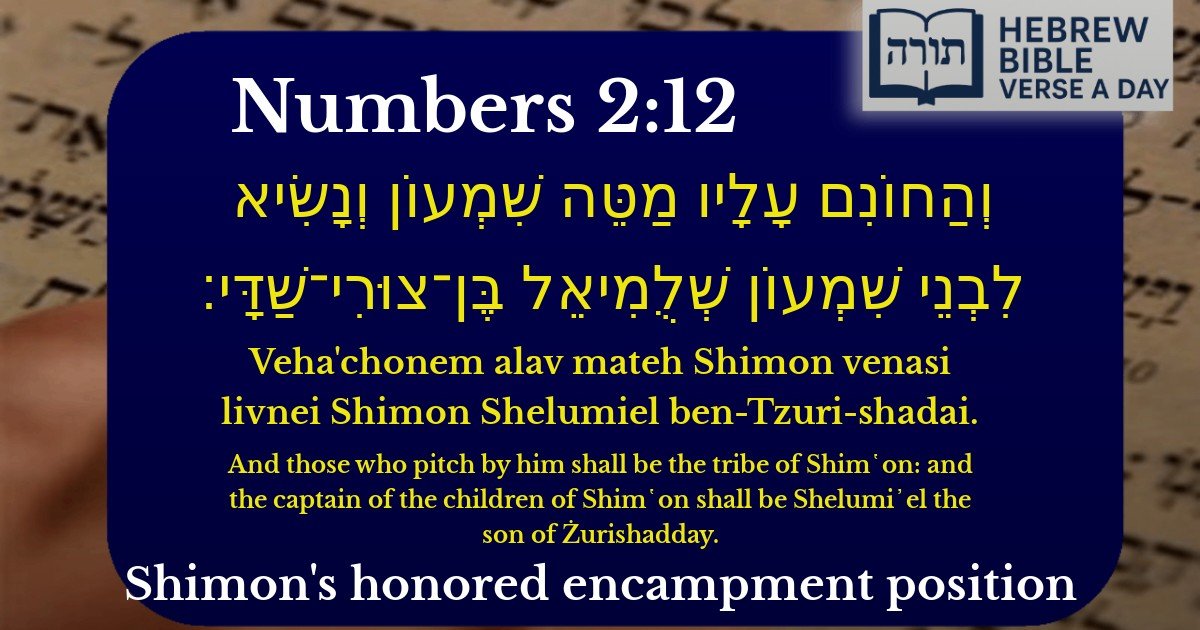

Positioning of the Tribe of Shimon
The verse (Bamidbar 2:12) places the tribe of Shimon adjacent to the tribe of Yehuda in the encampment of Israel. Rashi explains that this positioning reflects the close relationship between these tribes, as Yaakov Avinu had linked them in his blessings (Bereishit 49:5-7). The Midrash Tanchuma (Bamidbar 12) further notes that despite Shimon's past transgressions (as in the incident with Dinah), they were granted honor through this placement near Yehuda, the royal tribe.
The Nasi Shelumiel ben Tzurishaddai
The Torah specifies Shelumiel ben Tzurishaddai as the leader of Shimon. The name "Shelumiel" (שְׁלֻמִיאֵל) contains the root "shalom" (peace), which the Midrash (Bamidbar Rabbah 2:7) interprets as symbolic of his role in maintaining peace within the tribe. His father's name, "Tzurishaddai," combines "Tzur" (Rock) and "Shaddai" (Almighty), indicating his lineage's strength and connection to Hashem.
Spiritual Significance of the Encampment
The Ramban explains that each tribe's position around the Mishkan corresponded to their spiritual character. Shimon's placement to the south, alongside Reuven and Gad, reflects their shared quality of gevurah (strength), as the south is associated with this divine attribute (Zohar, Bamidbar). The Sforno adds that Shimon's proximity to Yehuda served to elevate their spiritual standing through Yehuda's influence.