Frequently Asked Questions
Q: What does Numbers 2:32 mean?
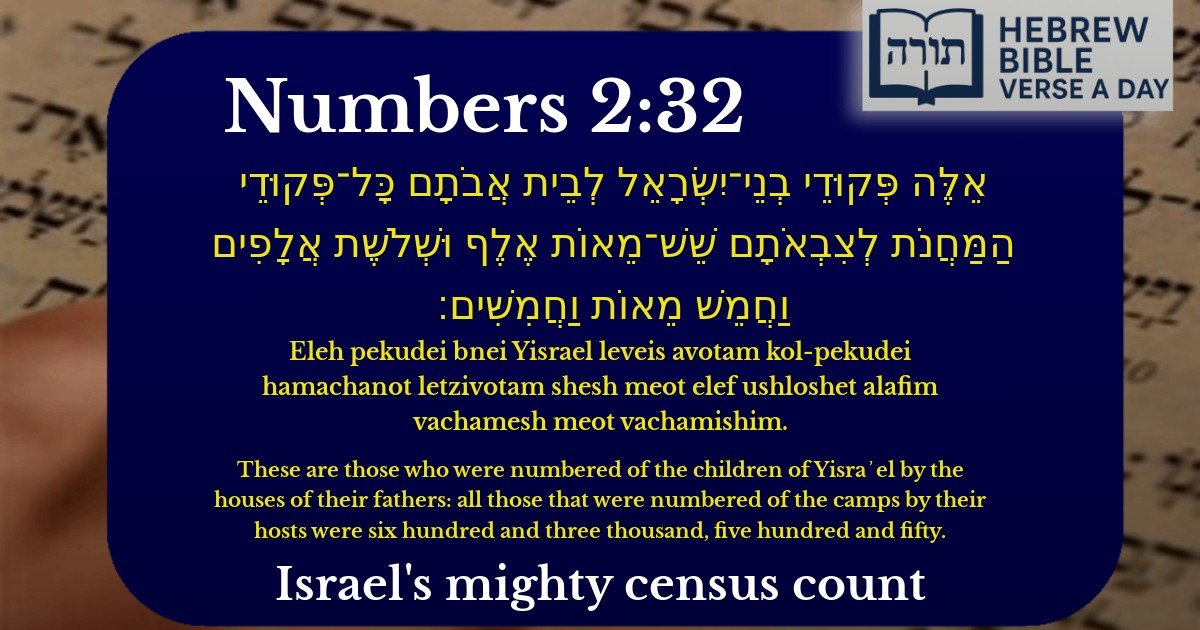
A: Numbers 2:32 records the total count of the Israelite men eligible for military service when they were organized into camps in the wilderness. The verse states there were 603,550 men, counted according to their tribes and families. This census reflects the fulfillment of G-d's promise to make the Israelites as numerous as the stars (Genesis 15:5). Rashi explains that this counting showed G-d's love for Israel, as He frequently counted them.
Q: Why was it important to count the Israelites in the wilderness?
A: The counting in the wilderness served several purposes: 1) It organized the nation for their journey and encampments (each tribe had its designated place around the Mishkan). 2) It prepared them militarily when needed. 3) As Ramban explains, it demonstrated that despite their slavery in Egypt, the Israelites grew into a great nation - a fulfillment of divine promise. The counting also showed each individual's importance in the collective nation.
Q: How does the number 603,550 relate to the Exodus story?
A: The number 603,550 represents only adult males aged 20-60 (Numbers 1:3). When including women, children and the elderly, traditional sources estimate the total Israelite population at the Exodus was between 2-3 million people. The Midrash (Tanchuma Ki Tisa 9) notes this massive growth from just 70 people who descended to Egypt (Exodus 1:5) demonstrates G-d's blessing, despite the harsh slavery.
Q: What can we learn from how the Israelites were organized in camps?
A: The organized camps teach us about: 1) Unity with structure - each tribe had its place while surrounding the Mishkan (Tabernacle) at the center. 2) The importance of order in spiritual life. 3) As the Talmud (Shabbat 92a) derives, the arrangement showed reverence for the Divine Presence. Today, this reminds us that while we have different roles, we all surround and support Torah as our central focus.
Q: Why does the Torah give such exact numbers in the census?
A: The precise numbers: 1) Show the Torah's historical accuracy. 2) Demonstrate that every individual counts in the Jewish people (no one is just part of a crowd). 3) As Rashi explains on Numbers 1:1, G-d frequently counts His people out of love, like a person who constantly checks their precious possessions. The exact figures also allow for later calculations about the nation's size and organization.


Overview of the Verse
The verse (Bamidbar 2:32) concludes the census of the tribes of Israel in the wilderness, providing the total count of the Israelite men eligible for military service. The number—603,550—reflects the strength and organization of Bnei Yisrael as they prepared for their journey toward Eretz Yisrael.
Rashi's Commentary
Rashi explains that the phrase "אֵלֶּה פְּקוּדֵי בְנֵי־יִשְׂרָאֵל" ("These are those who were numbered of the children of Israel") emphasizes that each individual was counted with dignity and importance, as if personally presented before Hashem. The counting was not merely for logistical purposes but to demonstrate the love and care Hashem has for each Jew.
Significance of the Number 603,550
The Organization by Camps
The verse mentions "הַמַּחֲנֹת לְצִבְאֹתָם" ("the camps by their hosts"), referring to the four directional camps surrounding the Mishkan. The Talmud (Shabbat 92a) derives from this arrangement that the Shechinah dwells among Israel when they are united and organized according to Hashem’s command.
Spiritual Lessons