

Join Our Newsletter To Be Informed When New Videos Are Posted
Hebrew Text
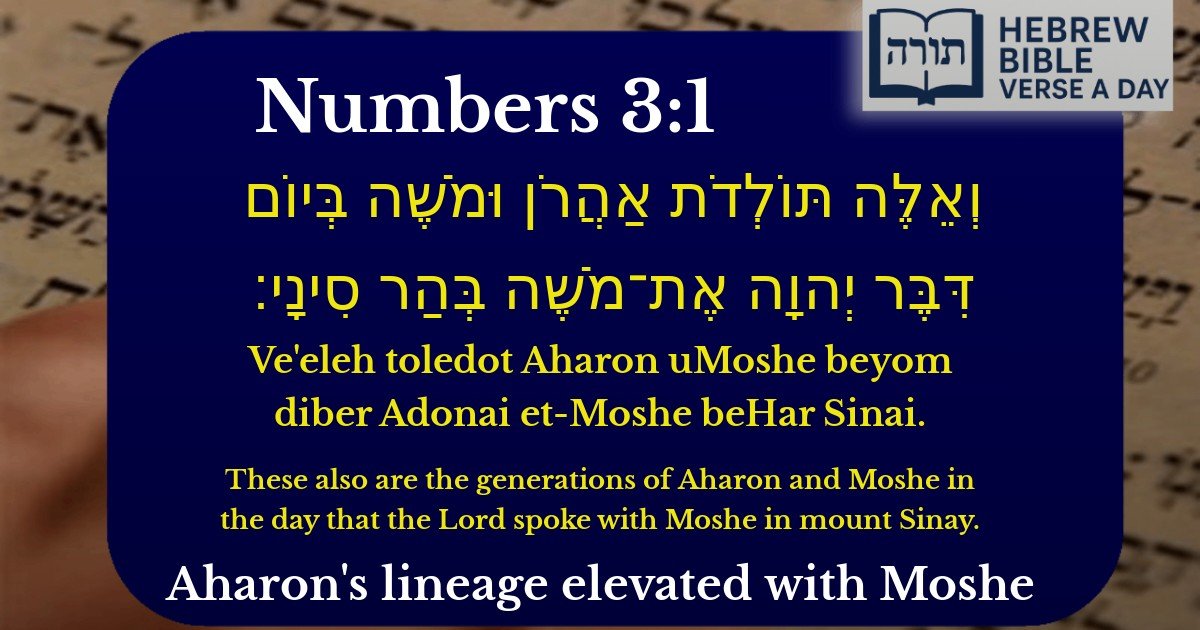
וְאֵלֶּה תּוֹלְדֹת אַהֲרֹן וּמֹשֶׁה בְּיוֹם דִּבֶּר יְהוָה אֶת־מֹשֶׁה בְּהַר סִינָי׃
English Translation
These also are the generations of Aharon and Moshe in the day that the Lord spoke with Moshe in mount Sinay.
Transliteration
Ve'eleh toledot Aharon uMoshe beyom diber Adonai et-Moshe beHar Sinai.
Hebrew Leining Text
וְאֵ֛לֶּה תּוֹלְדֹ֥ת אַהֲרֹ֖ן וּמֹשֶׁ֑ה בְּי֗וֹם דִּבֶּ֧ר יְהֹוָ֛ה אֶת־מֹשֶׁ֖ה בְּהַ֥ר סִינָֽי׃
🎵 Listen to leining
Parasha Commentary
📚 Talmud Citations
This verse is quoted in the Talmud.
📖 Sanhedrin 19b
The verse is cited in a discussion about the lineage and status of Aharon and Moshe, emphasizing their roles and the divine communication at Mount Sinai.
📖 Zevachim 102a
Referenced in the context of discussing the priestly lineage and the significance of Aharon's descendants in the priestly service.
Introduction to the Verse
The verse begins with the phrase "וְאֵלֶּה תּוֹלְדֹת אַהֲרֹן וּמֹשֶׁה" ("These are the generations of Aharon and Moshe"), which appears to introduce a genealogy. However, the Torah immediately shifts to discussing the day Hashem spoke to Moshe at Har Sinai, rather than listing descendants. This unusual structure invites deeper analysis from our commentators.
Rashi's Explanation
Rashi (Bamidbar 3:1) addresses this seeming discrepancy by noting that while the verse mentions both Aharon and Moshe, it proceeds to list only Aharon's children. He explains that this teaches us that one who teaches Torah to another's children is considered as if he had fathered them (based on Sanhedrin 19b). Since Moshe taught Aharon's children Torah, they are attributed to him as well.
The Ramban's Perspective
The Ramban (Nachmanides) offers additional insight, suggesting that the verse connects Aharon and Moshe's "generations" to the revelation at Sinai because their true spiritual legacy stems from that foundational moment. Their descendants are considered significant not merely through biological lineage, but through their connection to Torah given at Sinai.
Midrashic Interpretation
The Sifrei (a halachic midrash on Bamidbar) explains that the verse emphasizes "בְּיוֹם דִּבֶּר יְהוָה" ("on the day that Hashem spoke") to teach that even as Moshe and Aharon were occupied with receiving the Torah, they did not neglect their obligation to have children. This reflects the Jewish ideal of balancing Torah study with building a family.
Themes and Lessons
Connection to Har Sinai
The mention of Har Sinai in this context reminds us that the authority of Moshe and Aharon, and by extension their descendants, derives from their role in the Sinai revelation. Their leadership was not based on personal qualities alone, but on their faithful transmission of divine communication.