Frequently Asked Questions
Q: What does Numbers 3:33 mean?
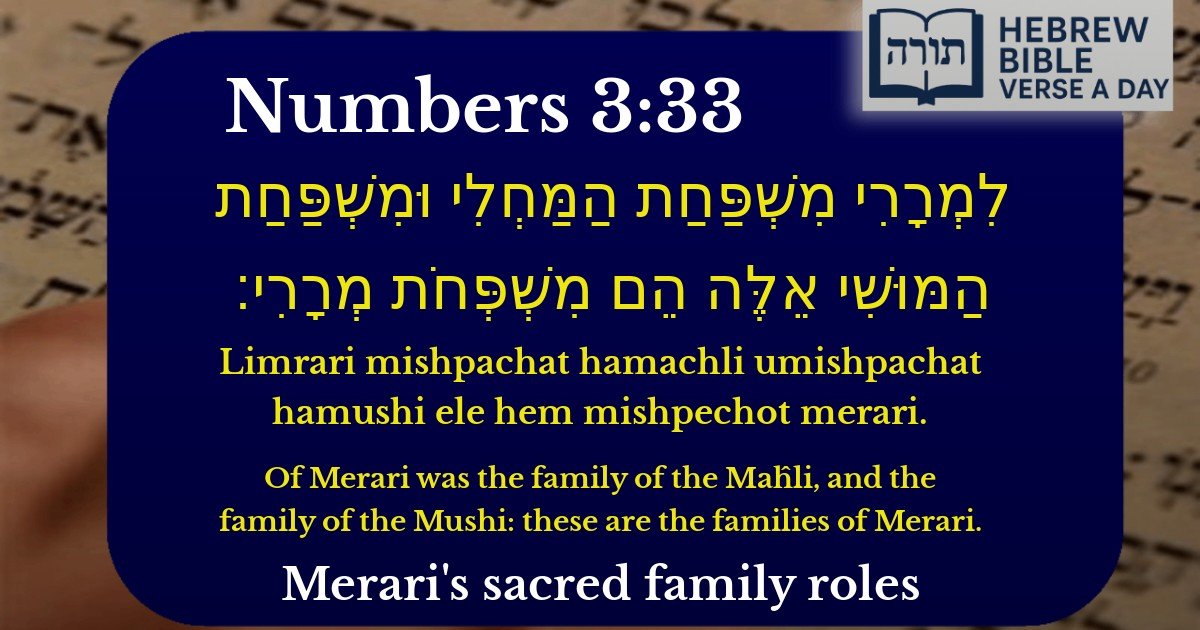
A: Numbers 3:33 lists the two families descended from Merari, one of Levi's sons: the Machli family and the Mushi family. This verse is part of the Torah's detailed account of the Levite families and their roles in the Mishkan (Tabernacle).
Q: Why is the family of Merari important?
A: The family of Merari was important because they had specific duties in transporting parts of the Mishkan (Tabernacle) during the Israelites' travels in the wilderness. According to Rashi and the Talmud (Bamidbar Rabbah), they were responsible for carrying the beams, sockets, and other structural components.
Q: What can we learn from the listing of families in Numbers 3:33?
A: We learn that every family and individual in the tribe of Levi had a unique role in serving Hashem. The Torah emphasizes that each person's contribution is valuable, as seen in the detailed listing of families like Merari's descendants (Machli and Mushi). This teaches us the importance of recognizing everyone's role in communal service.
Q: How does this verse apply to us today?
A: Just as the families of Merari had specific responsibilities in the Mishkan, today we each have unique roles in serving Hashem and contributing to the Jewish community. The Rambam (Hilchot Klei HaMikdash) explains that this teaches us the value of assigned roles in spiritual service, whether in Torah study, prayer, or acts of kindness.
Q: Why does the Torah mention the names Machli and Mushi?
A: The Torah mentions these names to highlight the individual families within Merari's lineage. According to Midrashic sources (Sifrei Bamidbar), recording their names shows that every family's service was significant. It also helps trace the lineage of the Levites, who were dedicated to holy work in the Mishkan and later the Beit HaMikdash (Temple).


Context in the Torah
This verse appears in Bamidbar (Numbers) 3:33, as part of the census and organization of the Levites. The tribe of Levi was divided into three main families: Gershon, Kehat, and Merari. This verse specifies the subdivisions within the family of Merari.
Rashi's Explanation
Rashi (Rabbi Shlomo Yitzchaki) notes that the families of Machli and Mushi are the two branches descending from Merari. He emphasizes that the Torah lists them to clarify the lineage and roles of the Levites in the Mishkan (Tabernacle). The Merari family was responsible for transporting the structural components of the Mishkan, such as the beams and sockets (see Bamidbar 3:36-37).
Rambam's Perspective
Rambam (Maimonides), in Hilchot Klei HaMikdash (Laws of the Temple Vessels), discusses the hereditary roles of the Levites. He explains that the division into families ensured an orderly system of service, with each family assigned specific duties. The families of Machli and Mushi maintained their ancestral responsibilities in the Mishkan and later in the Beit HaMikdash (Temple).
Midrashic Insights
Halachic Significance
The Sefer HaChinuch (Mitzvah 394) explains that the detailed listing of Levite families teaches the importance of assigning roles based on lineage and expertise. This principle applies to communal leadership and service, ensuring continuity and efficiency in sacred tasks.