Frequently Asked Questions
Q: What does Numbers 4:4 mean by 'the most holy things'?
A: In Numbers 4:4, 'the most holy things' (קֹדֶשׁ הַקֳּדָשִׁים) refers to the sacred objects in the Mishkan (Tabernacle) that only the Kohanim (priests) and the sons of Kehat (a Levite family) were permitted to handle. These included the Ark of the Covenant, the Menorah, the Golden Altar, and other holy vessels. Rashi explains that these items required extra care and sanctity because of their supreme holiness.
Q: Why were the sons of Kehat given special duties in the Mishkan?
A: The sons of Kehat, a family within the tribe of Levi, were entrusted with transporting the holiest vessels of the Mishkan because of their unique spiritual status. The Midrash (Bamidbar Rabbah) teaches that they were chosen due to their righteousness and dedication. Unlike other Levites who carried less sacred items, the sons of Kehat had to carry the most sacred objects on their shoulders, as they were not permitted to use wagons for these items (Numbers 7:9).
Q: How does the concept of 'most holy things' apply today without the Mishkan?
A: Although we no longer have the Mishkan or Temple, the concept of treating sacred objects with reverence still applies today. For example, Torah scrolls, tefillin, and mezuzot are considered holy and must be handled with respect. The Rambam (Hilchot Sefer Torah) outlines laws for proper care of Torah scrolls, reflecting the same reverence the sons of Kehat had for the holy vessels.
Q: What can we learn from the sons of Kehat's service in the Mishkan?
A: The dedication of the sons of Kehat teaches us the importance of serving Hashem with humility and responsibility. They carried the holiest items without personal gain, showing that true service is about devotion, not recognition. The Talmud (Yoma 23a) emphasizes that those who perform mitzvot with sincerity, like the sons of Kehat, merit great spiritual reward.

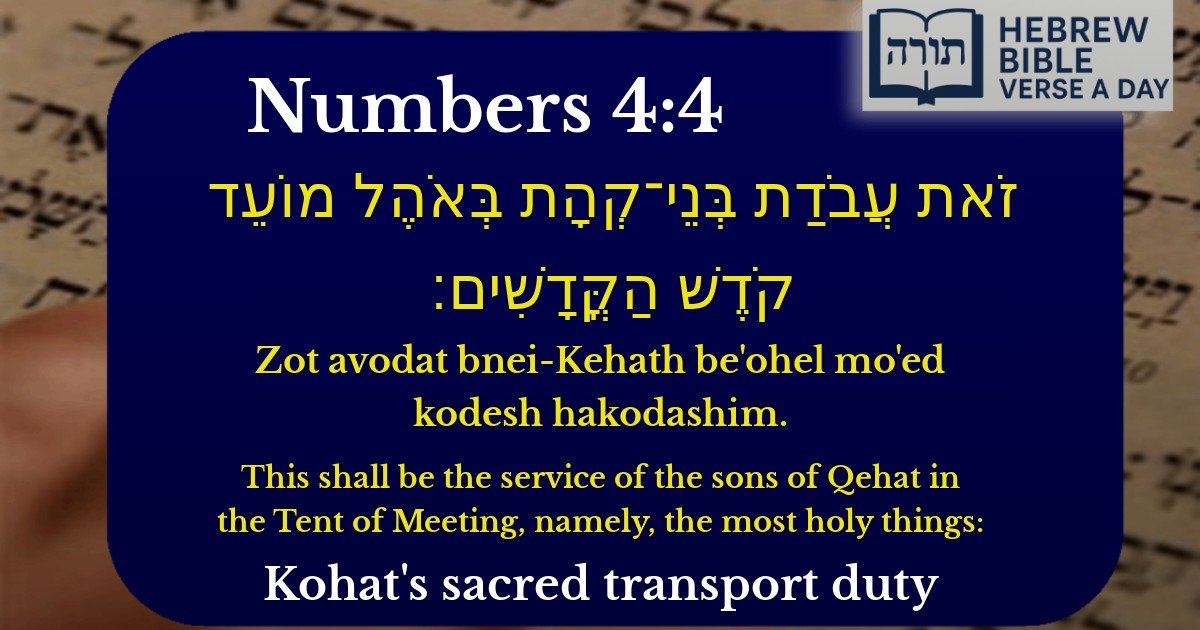

Overview of the Verse
The verse (Bamidbar 4:4) describes the sacred duties assigned to the sons of Kehat, one of the families of the tribe of Levi, regarding the transport and handling of the most holy vessels in the Mishkan (Tabernacle). Their service involved the Aron (Ark), Shulchan (Table), Menorah, and other sacred items from the Kodesh HaKodashim (Holy of Holies) and the Mishkan.
Rashi's Explanation
Rashi clarifies that the term "זאת עבודת בני קהת" ("This shall be the service of the sons of Kehat") refers specifically to the carrying of the holy vessels, as they were not permitted to perform the actual sacrificial services (like the Kohanim). Their role was strictly limited to transporting these items when the Mishkan was dismantled during the travels of Bnei Yisrael.
Rambam's Perspective
In Hilchot Klei HaMikdash (Laws of the Temple Vessels), Rambam elaborates on the precautions the Kehatites had to take, emphasizing that they were only permitted to carry the vessels after the Kohanim had properly covered them (as described in the preceding verses). This ensured that they would not directly see or touch the sacred objects, preventing any potential desecration.
Midrashic Insights
Halachic Implications
The Talmud (Yoma 54a) derives from this verse that the Kehatites carried the Ark on their shoulders, not on wagons, as a sign of utmost reverence. This principle influenced later Halacha regarding the treatment of sacred objects—teaching that honor for kedusha (holiness) requires personal effort and cannot be delegated to mechanical means.
Symbolic Meaning
The Sforno suggests that the Kehatites' role symbolizes the idea that those who bear the "holy of holies"—Torah and Divine service—must do so with complete devotion and physical commitment, not treating it as a burden but as a privilege.