Frequently Asked Questions
Q: What does Numbers 4:31 mean?
A: Numbers 4:31 describes the specific responsibilities of the Levite family of Gershon in transporting parts of the Mishkan (Tabernacle) during the Israelites' travels in the wilderness. They were entrusted with carrying the boards, bars, pillars, and sockets of the Mishkan, which were essential for its structure.
Q: Why is the detailed list of items in Numbers 4:31 important?
A: The detailed list in Numbers 4:31 is important because it shows the precise organization and division of labor among the Levites. Each family had specific sacred duties, ensuring the Mishkan was handled with care and reverence. This teaches us the value of order and responsibility in holy work.
Q: What can we learn from the Levites' duties in Numbers 4:31?
A: From the Levites' duties in Numbers 4:31, we learn that every role in serving Hashem is significant. Even transporting the physical parts of the Mishkan was a sacred task. This teaches us that all contributions to communal holiness, no matter how seemingly small, are valuable.
Q: How does Numbers 4:31 apply to us today?
A: Numbers 4:31 applies today by reminding us that every individual has a unique role in serving Hashem and contributing to the community. Just as the Levites had specific tasks, we too should identify and fulfill our responsibilities with dedication and care.
Q: What is the significance of the Mishkan's structure mentioned in Numbers 4:31?
A: The Mishkan's structure, mentioned in Numbers 4:31, symbolizes stability and holiness. The boards, bars, pillars, and sockets formed the foundation of the Mishkan, representing the importance of a strong spiritual foundation in our relationship with Hashem and in maintaining a sacred space.

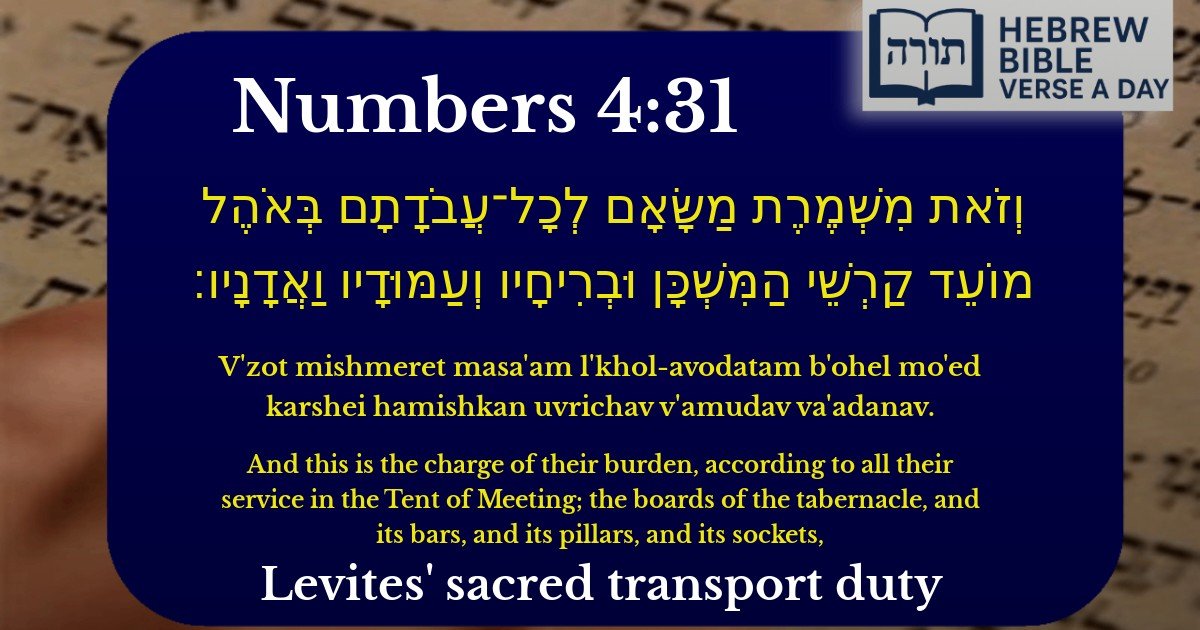

Overview of the Verse
The verse (Bamidbar 4:31) describes the responsibilities of the Merari family among the Levites regarding the transportation of the Mishkan (Tabernacle) during the Israelites' travels in the wilderness. Their duty included carrying the structural components—boards, bars, pillars, and sockets—which formed the framework of the Mishkan.
Rashi's Commentary
Rashi explains that the phrase "וְזֹאת מִשְׁמֶרֶת מַשָּׂאָם" ("this is the charge of their burden") refers to the specific items assigned to the Merari family to carry. He emphasizes that each Levite family had distinct responsibilities, and the Merari family was entrusted with the heavy structural elements. Rashi notes that the sockets ("אֲדָנָיו") were particularly weighty, as they were made of silver and formed the foundation of the Mishkan.
Rambam's Perspective
In Hilchot Klei HaMikdash (Laws of the Temple Vessels), Rambam discusses the division of labor among the Levites. He highlights that the Merari family's role was crucial because the stability of the Mishkan depended on their proper handling of the boards and sockets. Their service ensured that the Mishkan could be reassembled correctly at each encampment.
Midrashic Insights
The Midrash Tanchuma (Bamidbar 12) elaborates on the symbolism of the Mishkan's components. The boards ("קַרְשֵׁי הַמִּשְׁכָּן") represent the unity of the Jewish people, as they were joined together to form a single structure. The bars ("וּבְרִיחָיו") signify the Torah, which binds the nation together, while the sockets ("אֲדָנָיו") symbolize the foundation of faith and commitment to Hashem.
Talmudic Discussion
The Talmud (Zevachim 54b) discusses the practical aspects of transporting the Mishkan. It notes that the Merari family used wagons (as described in Bamidbar 7:8) to carry the heavy boards and sockets, while the other Levite families carried lighter items by hand. This division of labor ensured efficiency and prevented damage to the sacred vessels.
Key Lessons