
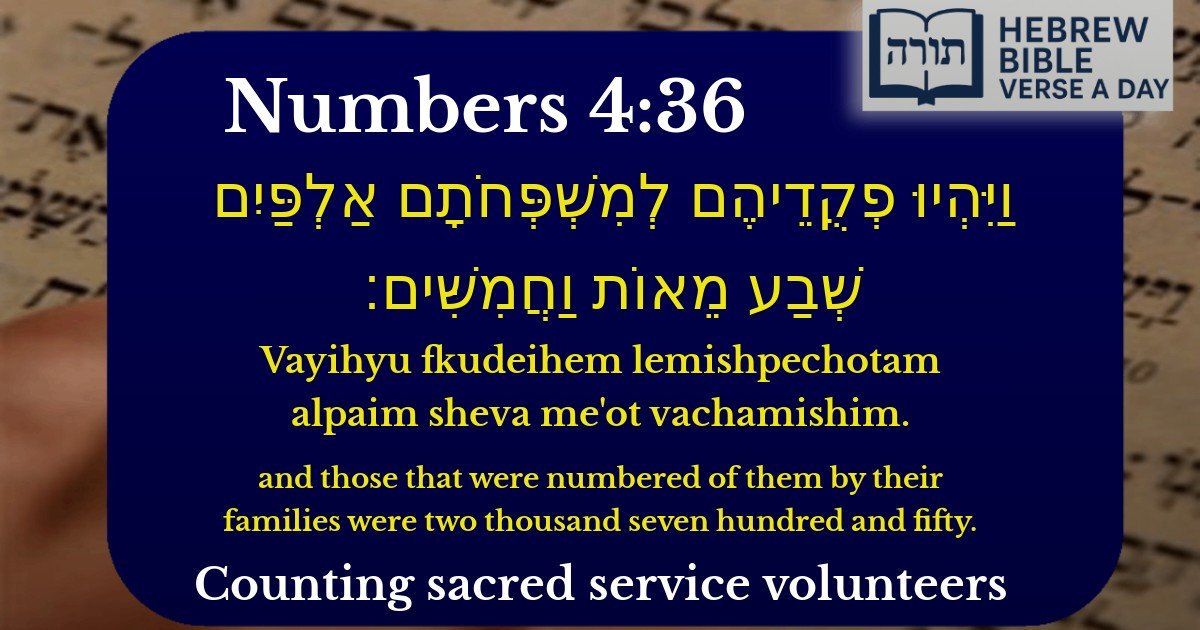

Numbers 4:36 - Counting sacred service volunteers

Numbers 4:36 - במדבר 4:36

Hebrew Text

וַיִּהְיוּ פְקֻדֵיהֶם לְמִשְׁפְּחֹתָם אַלְפַּיִם שְׁבַע מֵאוֹת וַחֲמִשִּׁים׃

English Translation

and those that were numbered of them by their families were two thousand seven hundred and fifty.

Transliteration

Vayihyu fkudeihem lemishpechotam alpaim sheva me'ot vachamishim.

Hebrew Leining Text

וַיִּהְי֥וּ פְקֻדֵיהֶ֖ם לְמִשְׁפְּחֹתָ֑ם אַלְפַּ֕יִם שְׁבַ֥ע מֵא֖וֹת וַחֲמִשִּֽׁים׃

🎵 Listen to leining

Parasha Commentary

Context of the Verse

The verse (Bamidbar 3:22) is part of the census of the tribe of Levi, specifically the Gershonite family, who were tasked with transporting the Mishkan (Tabernacle) and its coverings during the Israelites' travels in the wilderness. The count of 2,750 males aged one month and older reflects their role in the sacred service.

Rashi's Commentary

Rashi explains that the counting of the Levites was distinct from the general census of Israel. While the rest of the tribes were counted from age 20 and up (for military purposes), the Levites were counted from one month old because their sanctity began at birth. The number 2,750 represents only the Gershonites, one of the three Levite families.

Significance of the Number

  • The Baal HaTurim notes that the numerical value (gematria) of "וַחֲמִשִּׁים" (and fifty) hints at the 50 levels of wisdom, suggesting the spiritual elevation of the Levites.
  • Sforno emphasizes that this count demonstrates the fulfillment of the promise to make the Levites numerous despite their late start (as Levi was Yaakov's third son).

Role of the Gershonites

According to the Midrash Tanchuma, the Gershonites' responsibility for the Mishkan's coverings and curtains symbolized their role in protecting the spiritual "covering" of Klal Yisrael. Their large number (compared to the other Levite families) may reflect the extensive labor required for transporting these heavy materials.

Halachic Insight from Rambam

In Hilchot Klei HaMikdash (3:2), Rambam derives from this verse that even infants could be included in the count of those dedicated to Divine service, establishing the principle that kedusha (sanctity) applies from the earliest age.

📚 Talmud Citations

This verse is not quoted in the Talmud.

Frequently Asked Questions

Q: What does Numbers 4:36 mean when it lists the count of the Kohathites?
A: Numbers 4:36 records the census count of the Kohathite family of Levi, who were responsible for transporting the sacred vessels of the Mishkan (Tabernacle). The verse specifies there were 2,750 eligible men (ages 30-50) for this holy service. Rashi explains this count ensured proper organization for their duties.
Q: Why is the counting of the Kohathites important in the Torah?
A: The counting emphasizes the importance of structure and responsibility in sacred work. The Midrash (Bamidbar Rabbah) teaches that each individual had a unique role in serving the Mishkan. The precise count reflects Hashem's care for every contributor to the community's spiritual needs.
Q: What can we learn from the detailed numbers in the census of the Levites?
A: The Rambam teaches that the detailed counts remind us that every person matters in fulfilling mitzvot. Just as each Kohathite was essential for transporting the Mishkan, every Jew today has a unique role in building spiritual holiness in the world.
Q: How does the age range (30-50) for Levite service apply to us today?
A: The Talmud (Chullin 24a) derives from this that spiritual leadership requires maturity and strength. While we no longer transport the Mishkan, the principle remains that one should use their peak years (both physically and spiritually) for avodat Hashem (service of G-d) and community responsibility.
Q: Why does the Torah specify counting by families?
A: Rashi explains that family units create natural structures for transmitting tradition and dividing labor. The Sforno adds that this prevented chaos in the sacred work - teaching us that spiritual endeavors require both individual commitment and organized communal structures.