Frequently Asked Questions
Q: What does Numbers 6:9 mean in simple terms?
A: Numbers 6:9 discusses a situation where a Nazirite (someone who took a special vow of holiness) accidentally becomes impure by coming into sudden contact with a dead body. The verse explains that the Nazirite must shave their head on the seventh day of their purification process to restore their sanctity.
Q: Why is the Nazirite required to shave their head after impurity?
A: According to Rashi and Talmudic sources (Nazir 44b), shaving the head symbolizes a fresh start after impurity. Since the Nazirite’s hair represents their vow (as it grows untouched during their Nazirite period), shaving it signifies the need for renewal and atonement after accidental defilement.
Q: What is the significance of the seventh day in Numbers 6:9?
A: The seventh day marks the completion of the purification process, as taught in Jewish law (Rambam, Hilchot Nezirut 7:8). Just as impurity from contact with the dead typically lasts seven days (Numbers 19:11), the Nazirite’s shaving on the seventh day signifies their return to purity and readiness to restart their vow.
Q: Does this law about the Nazirite apply today?
A: While the laws of Nazirite vows are still valid, today—without the Temple—fulfilling all aspects (like bringing sacrifices) is impossible. However, the principles of repentance, renewal, and commitment to holiness remain timeless lessons (see Mishneh Torah, Hilchot Nezirut 10:1).
Q: What can we learn from the Nazirite’s purification process?
A: The Midrash (Bamidbar Rabbah 10:10) teaches that this law emphasizes accountability: even accidental impurity requires correction. It reminds us that spiritual growth involves overcoming setbacks with sincere effort, as holiness demands conscious dedication.

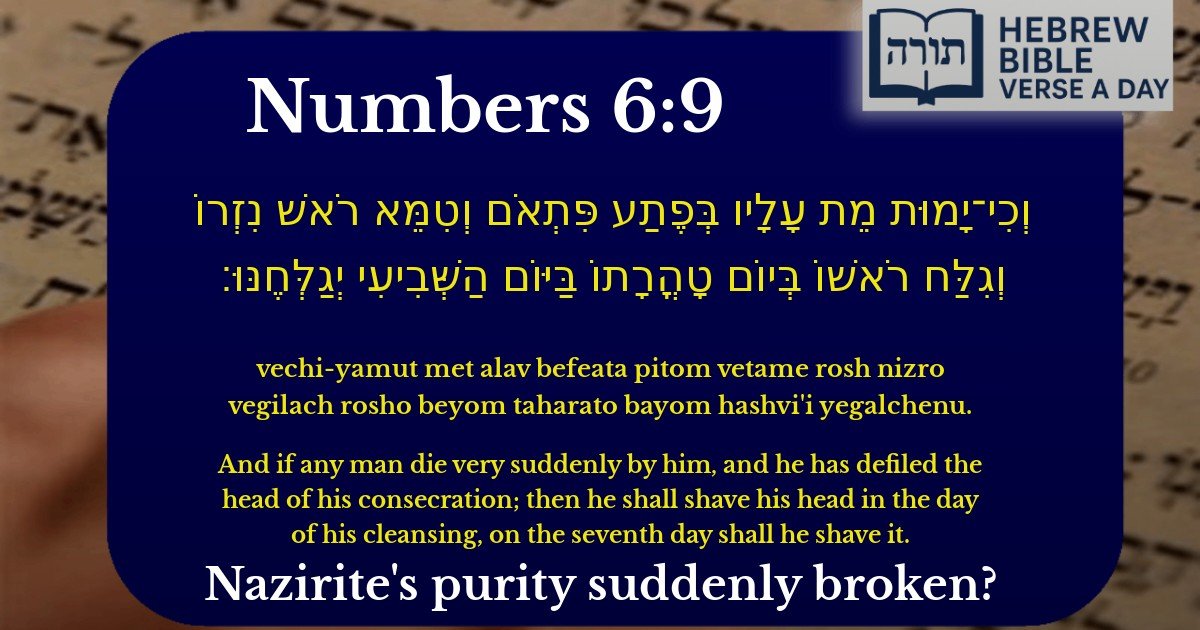

Context in the Torah
This verse appears in Bamidbar (Numbers) 6:9 and deals with the laws of a Nazir (Nazirite), an individual who takes a vow of abstinence for a set period. The verse addresses an unexpected situation where a Nazir becomes ritually impure (tamei) due to sudden contact with a corpse.
Rashi's Explanation
Rashi explains that the phrase "וְכִי־יָמוּת מֵת עָלָיו בְּפֶתַע פִּתְאֹם" ("if any man die very suddenly by him") refers to an unavoidable and accidental encounter with a dead body, such as finding an unburied corpse (met mitzvah). The Nazir becomes impure despite not intending to violate his vow. Rashi emphasizes that the Torah uses the doubled term "פֶּתַע פִּתְאֹם" ("very suddenly") to highlight the unexpected nature of the event.
Impurity and the Nazir's Response
The verse states that the Nazir must shave his head on the seventh day of his purification process. The Rambam (Hilchot Nezirut 7:9) clarifies that this shaving is part of the atonement process, as the Nazir must bring sacrifices and restart his vow from the beginning. The shaving symbolizes the nullification of his previous period of nezirut due to the impurity.
Halachic Implications
Midrashic Insight
The Midrash Tanchuma (Naso 14) connects this law to the broader theme of human mortality and the need for repentance. Even a Nazir, who dedicates himself to holiness, is reminded of life's fragility through sudden encounters with death. The purification process serves as a spiritual reset, reinforcing the idea that one must continually strive for sanctity despite unforeseen challenges.
Symbolism of the Seventh Day
The Kli Yakar notes that the seventh day represents completion and renewal, paralleling the seven-day mourning period (shiva). Just as mourners transition back to normal life after seven days, the Nazir symbolically "reboots" his vow, demonstrating that setbacks do not negate one's spiritual aspirations.