

Join Our Newsletter To Be Informed When New Videos Are Posted
Hebrew Text
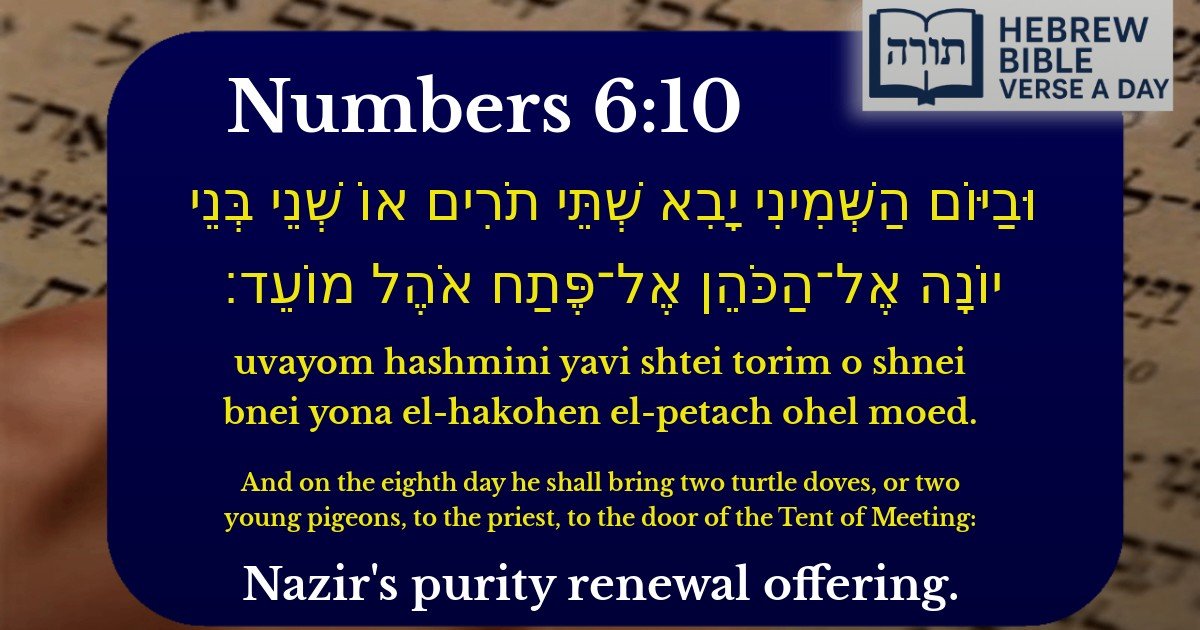
וּבַיּוֹם הַשְּׁמִינִי יָבִא שְׁתֵּי תֹרִים אוֹ שְׁנֵי בְּנֵי יוֹנָה אֶל־הַכֹּהֵן אֶל־פֶּתַח אֹהֶל מוֹעֵד׃
English Translation
And on the eighth day he shall bring two turtle doves, or two young pigeons, to the priest, to the door of the Tent of Meeting:
Transliteration
Uvayom hashmini yavi shtei torim o shnei bnei yona el-hakohen el-petach ohel moed.
Hebrew Leining Text
וּבַיּ֣וֹם הַשְּׁמִינִ֗י יָבִא֙ שְׁתֵּ֣י תֹרִ֔ים א֥וֹ שְׁנֵ֖י בְּנֵ֣י יוֹנָ֑ה אֶ֨ל־הַכֹּהֵ֔ן אֶל־פֶּ֖תַח אֹ֥הֶל מוֹעֵֽד׃
🎵 Listen to leining
Parasha Commentary
📚 Talmud Citations
This verse is quoted in the Talmud.
📖 Keritot 8a
The verse is cited in the discussion about the offerings brought by a poor person for purification, particularly comparing the requirements for different types of offerings.
📖 Niddah 31a
Referenced in the context of discussing the laws of purification and the specific offerings required after childbirth.
📖 Arakhin 21a
Mentioned in the discussion about the valuation of offerings and the types of birds that can be brought as sacrifices.
Context in Leviticus
The verse (Vayikra 15:29) appears in the context of the purification process for a zavah (a woman with an abnormal uterine discharge) after her seven-day period of impurity. On the eighth day, she is required to bring two turtle doves or two young pigeons as a korban oleh v'yored (a sliding-scale offering), depending on her financial means (Rashi, Vayikra 15:29).
Significance of the Eighth Day
The eighth day symbolizes a transition from impurity to purity, representing renewal and a return to holiness. The number seven often denotes natural cycles (e.g., Shabbat, the seven days of creation), while eight signifies transcending nature—entering a state of spiritual elevation (Ramban, Vayikra 15:29).
Choice of Birds
Location of the Offering
The offering is brought to the door of the Tent of Meeting, underscoring that purity is a prerequisite for entering sacred spaces. The Kohen facilitates this process, acting as an intermediary between the individual and Hashem (Sforno, Vayikra 15:29).
Midrashic Insight
The Midrash (Vayikra Rabbah 15:2) compares the zavah's purification to the Jewish people's repentance: just as she returns to purity through sacrifice, so too does Klal Yisrael return to Hashem through sincere teshuvah.