

Join Our Newsletter To Be Informed When New Videos Are Posted
Hebrew Text
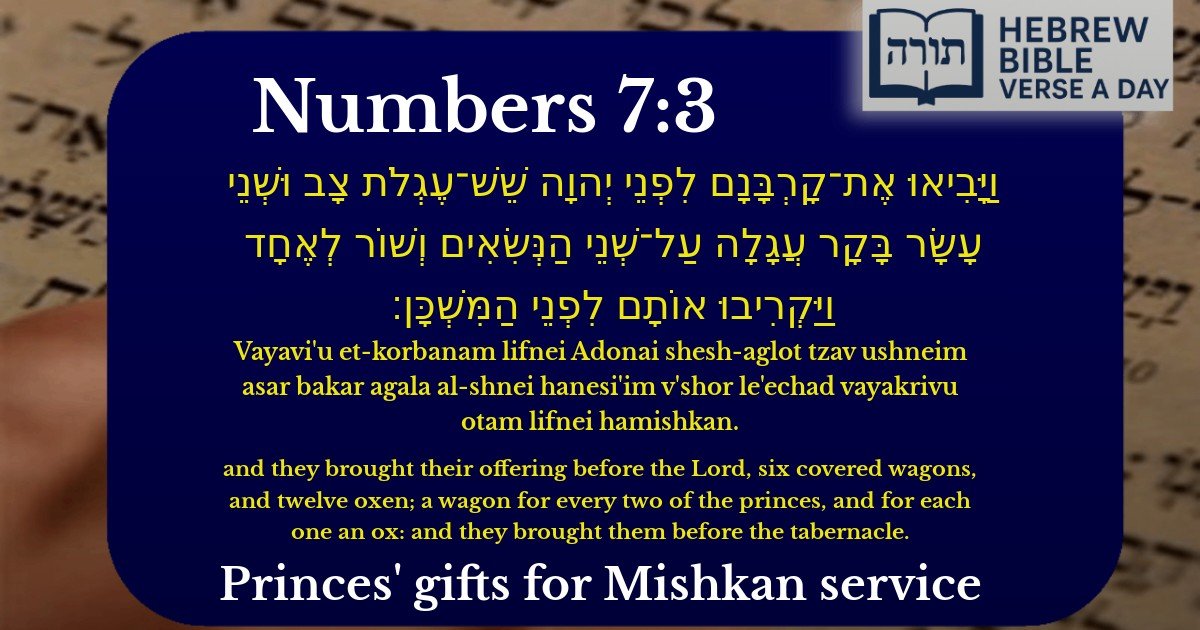
וַיָּבִיאוּ אֶת־קָרְבָּנָם לִפְנֵי יְהוָה שֵׁשׁ־עֶגְלֹת צָב וּשְׁנֵי עָשָׂר בָּקָר עֲגָלָה עַל־שְׁנֵי הַנְּשִׂאִים וְשׁוֹר לְאֶחָד וַיַּקְרִיבוּ אוֹתָם לִפְנֵי הַמִּשְׁכָּן׃
English Translation
and they brought their offering before the Lord, six covered wagons, and twelve oxen; a wagon for every two of the princes, and for each one an ox: and they brought them before the tabernacle.
Transliteration
Vayavi'u et-korbanam lifnei Adonai shesh-aglot tzav ushneim asar bakar agala al-shnei hanesi'im v'shor le'echad vayakrivu otam lifnei hamishkan.
Hebrew Leining Text
וַיָּבִ֨יאוּ אֶת־קׇרְבָּנָ֜ם לִפְנֵ֣י יְהֹוָ֗ה שֵׁשׁ־עֶגְלֹ֥ת צָב֙ וּשְׁנֵ֣י עָשָׂ֣ר בָּקָ֔ר עֲגָלָ֛ה עַל־שְׁנֵ֥י הַנְּשִׂאִ֖ים וְשׁ֣וֹר לְאֶחָ֑ד וַיַּקְרִ֥יבוּ אוֹתָ֖ם לִפְנֵ֥י הַמִּשְׁכָּֽן׃
🎵 Listen to leining
Parasha Commentary
📚 Talmud Citations
This verse is quoted in the Talmud.
📖 Sotah 13a
The verse is referenced in a discussion about the offerings brought by the princes of Israel for the dedication of the altar, highlighting the communal and individual contributions to the Tabernacle.
📖 Yoma 72b
The verse is cited in a broader discussion about the sanctity and the proper handling of sacred objects, including the wagons and oxen used in the service of the Tabernacle.
The Offering of the Wagons and Oxen
The verse describes the generous offering brought by the Nesi'im (princes of the tribes) for the service of the Mishkan (Tabernacle). According to Rashi (Bamidbar 7:3), these wagons and oxen were designated to assist the Levites in transporting the Mishkan during the Israelites' travels in the wilderness. The division—six wagons and twelve oxen—reflects a carefully calculated contribution, as each pair of Nesi'im donated one wagon, and each Nasi gave one ox.
Symbolism of the Numbers
The Midrash Tanchuma (Naso 12) notes that the number six corresponds to the six days of Creation, while twelve represents the twelve tribes of Israel. This teaches that the service of the Mishkan is intertwined with the order of the universe and the unity of the Jewish people. The Kli Yakar (Bamidbar 7:3) adds that the wagons symbolize the physical vessels needed for divine service, while the oxen represent the strength and diligence required to fulfill it.
The Role of the Nesi'im
The Ramban (Bamidbar 7:3) emphasizes that the Nesi'im acted with humility and unity by contributing jointly rather than individually. This demonstrates the principle of shalom (peace) and collective responsibility in serving Hashem. The Sforno further explains that their offering was particularly praiseworthy because it addressed a practical need for the Mishkan's transport, showing foresight and dedication to the communal mission.
Halachic Implications