Frequently Asked Questions
Q: What is the meaning of the 'sacrifice of peace offerings' mentioned in Numbers 7:23?
A: The 'sacrifice of peace offerings' (זֶבַח הַשְּׁלָמִים) refers to a voluntary offering brought to express gratitude, fulfill a vow, or as a freewill donation to Hashem. Unlike other sacrifices, parts of it were eaten by the person bringing it and the kohanim (priests), symbolizing peace and closeness between man and Hashem (Rashi on Leviticus 3:1, Rambam Hilchot Korbanot 3:1).
Q: Why does the verse specify the exact number of animals (2 oxen, 5 rams, etc.)?
A: The Torah specifies the exact number to show the generosity and dedication of Netan'el ben Tzu'ar, who brought this offering when the Mishkan (Tabernacle) was dedicated. Each tribal leader brought identical offerings to emphasize unity among the tribes (Rashi on Numbers 7:19-23, Midrash Bamidbar Rabbah 13:15).
Q: What can we learn from Netan'el ben Tzu'ar bringing this offering?
A: We learn the importance of willingly contributing to holy causes with joy and precision. Netan'el's offering teaches that giving should be done wholeheartedly and according to the proper guidelines (Malbim on Numbers 7:23). Additionally, his act highlights the value of communal unity, as all tribal leaders brought the same offering (Talmud, Sotah 13b).
Q: Do we still bring peace offerings today?
A: Since the destruction of the Beit HaMikdash (Holy Temple), animal sacrifices, including peace offerings, are not brought. However, our prayers (תְּפִלָּה) and acts of kindness (גְּמִילוּת חֲסָדִים) serve as substitutes for sacrifices (Hoshea 14:3, Rambam Hilchot Ma'aseh HaKorbanot 3:15). Many also study the laws of sacrifices in anticipation of their future restoration.
Q: Why are lambs 'of the first year' specified for the offering?
A: Lambs in their first year (כְּבָשִׂים בְּנֵי־שָׁנָה) are chosen because they represent purity and freshness, symbolizing a new and sincere dedication to Hashem. This age is also halachically ideal for certain korbanot (offerings) as prescribed in the Torah (Rashi on Exodus 12:5, Rambam Hilchot Issurei Mizbe'ach 1:14).


Context of the Verse
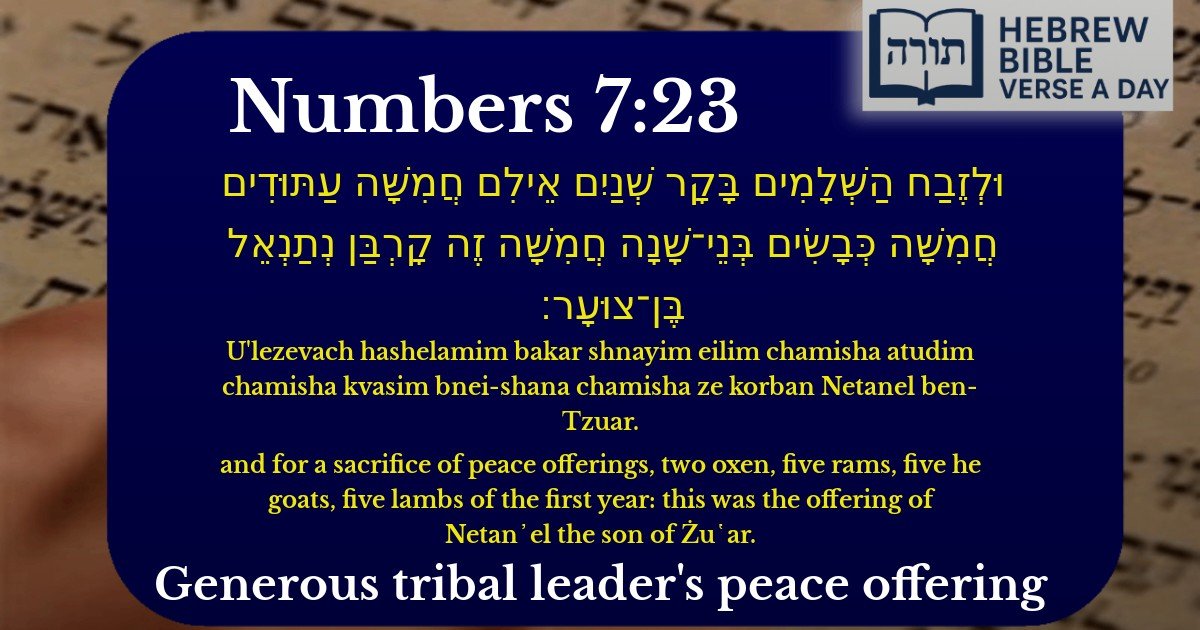
This verse (Bamidbar 7:17) describes the korban shelamim (peace offering) brought by Netan'el ben Tzu'ar, the prince of the tribe of Yissachar, during the inauguration of the Mishkan. The shelamim offering symbolizes harmony and gratitude, as it is shared between the altar, the kohanim, and the one bringing the offering (Vayikra 3:1-17).
Significance of the Numbers
The offering consists of:
Netan'el ben Tzu'ar's Unique Offering
The Midrash (Bamidbar Rabbah 13:16) teaches that Netan'el's name means "gift of G-d," reflecting his tribe's dedication to Torah. The shelamim offering, which fosters unity, aligns with Yissachar's role in promoting peace through Torah study. Ramban (Bamidbar 7:18) adds that the symmetry in numbers (five of each type) signifies completeness in avodah (divine service).
Symbolism of the Shelamim
The shelamim represents: