Frequently Asked Questions
Q: What is the meaning of the 'sacrifice of peace offerings' in Numbers 7:65?
A: The 'sacrifice of peace offerings' (זֶבַח הַשְּׁלָמִים) refers to the Korban Shelamim, a voluntary offering brought to express gratitude, fulfill a vow, or as a freewill donation to Hashem. Unlike other sacrifices, parts of it were eaten by the person bringing it, symbolizing peace and closeness between the individual and Hashem (Rashi on Leviticus 3:1).
Q: Why did Avidan bring specific numbers of animals (2 oxen, 5 rams, etc.)?
A: Each tribal leader (Nasi) brought identical offerings during the dedication of the Mishkan (Tabernacle) to show unity and equal dedication to Hashem. The specific numbers (2 oxen, 5 rams, etc.) were part of a standardized offering, emphasizing that no tribe was superior to another (Midrash Bamidbar Rabbah 13:15).
Q: What is the significance of the 'lambs of the first year' in this verse?
A: Lambs in their first year (כְּבָשִׂים בְּנֵי־שָׁנָה) were commonly used in sacrifices because they represent purity and innocence. The Torah often requires young animals for korbanot to symbolize sincerity and wholehearted devotion (Rambam, Guide for the Perplexed 3:46).
Q: How does this verse relate to the dedication of the Mishkan?
A: This verse is part of a 12-day ceremony where each tribal leader brought identical offerings to inaugurate the Mishkan. Avidan ben Gidoni represented the tribe of Dan. The repetition of similar offerings teaches that every tribe’s contribution was equally valued in serving Hashem (Talmud, Sotah 13b).
Q: Can we learn anything from Avidan's offering for today?
A: Yes! Though we no longer bring korbanot, the lesson of unity and equal dedication to Hashem remains. Just as all tribes brought the same offering, we should strive for collective responsibility in serving Hashem through Torah study, prayer, and acts of kindness (based on Malbim on Numbers 7:65).

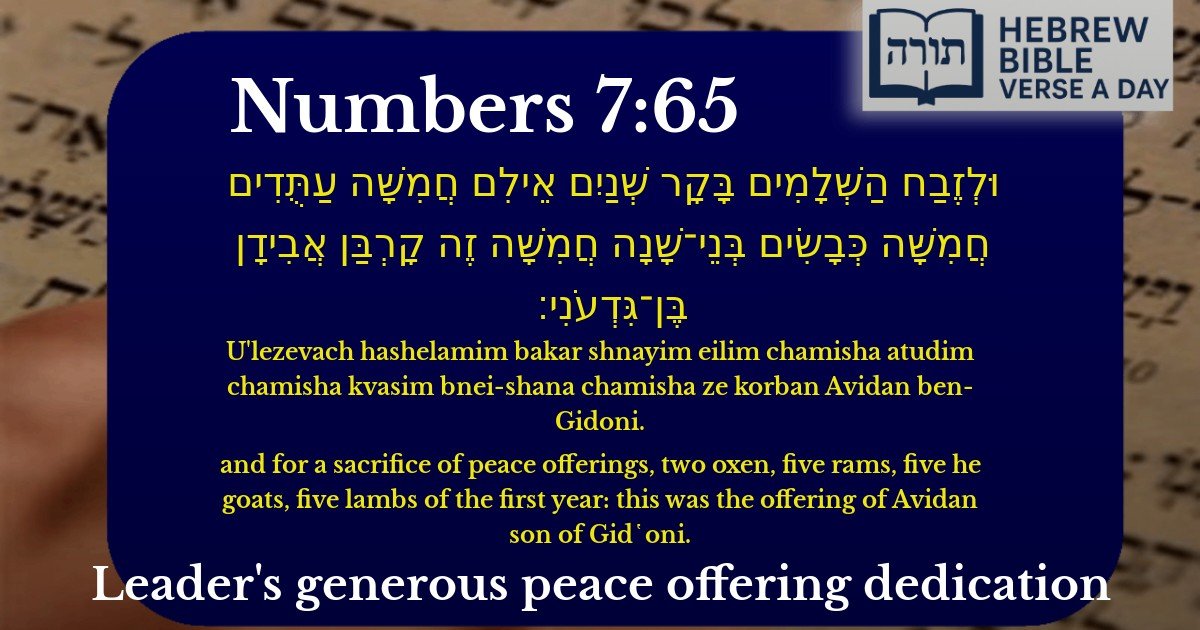

The Offering of Avidan ben Gid'oni
The verse describes the peace offering (zevach shelamim) brought by Avidan ben Gid'oni, one of the leaders of the tribes of Israel during the dedication of the Mishkan (Tabernacle). The peace offering is unique in that it is shared between the altar, the Kohanim, and the owner, symbolizing peace and harmony between man and Hashem.
Details of the Sacrifice
Symbolism of the Peace Offering
The shelamim offering signifies completeness (shleimus)—between man and Hashem, and among the Jewish people. The Talmud (Chullin 84a) teaches that the peace offering was unique because portions were given to the Kohanim, burned on the altar, and eaten by the owner, fostering unity and gratitude.
Avidan ben Gid'oni's Role
Avidan, representing the tribe of Binyamin, brought this offering as part of the collective dedication of the Mishkan. The Midrash (Tanchuma Naso 14) highlights that each leader’s offering was identical, demonstrating unity among the tribes despite their individual distinctions.