Frequently Asked Questions
Q: What is the significance of the tribal offerings in Numbers 7?
A: In Numbers 7, each of the 12 tribal leaders (nasi) brought identical offerings for the dedication of the Mishkan (Tabernacle). The Torah lists each one individually to show that every tribe's contribution was equally valued before Hashem, even though they were identical. Rashi explains that this teaches us that each tribe's unique intention and devotion mattered.
Q: Why does the Torah repeat the same offering 12 times?
A: Although each tribal leader brought the same offering, the Torah repeats it 12 times to honor each tribe individually. The Midrash (Bamidbar Rabbah 13:14) teaches that this repetition emphasizes that every tribe's act of giving was cherished separately by Hashem, showing that sincerity in mitzvot is more important than the quantity.
Q: Who was Pagiel ben Ochran?
A: Pagiel ben Ochran was the nasi (prince) of the tribe of Asher during the wilderness journey. Rashi notes that his name, Pagiel, means 'encounter with G-d,' symbolizing his role in leading his tribe in divine service. The Talmud (Sotah 11b) also connects the tribe of Asher with blessings of prosperity.
Q: Why did the tribe of Asher bring their offering on the 11th day?
A: The order of the offerings followed the arrangement of the tribes in the camp (see Numbers 2). Asher was part of the camp of Dan, which traveled last, so their leader brought his offering on the 11th day. The Rambam teaches that this structured approach reflects the importance of unity and order in serving Hashem.
Q: What lesson can we learn from the tribal offerings today?
A: The repeated yet individualized offerings teach us that in serving Hashem, sincerity and personal effort matter more than outward comparisons. The Chofetz Chaim explains that just as each tribe's identical offering was precious, every Jew's mitzvot—no matter how small they seem—are infinitely valuable when done with a pure heart.


Context in the Torah
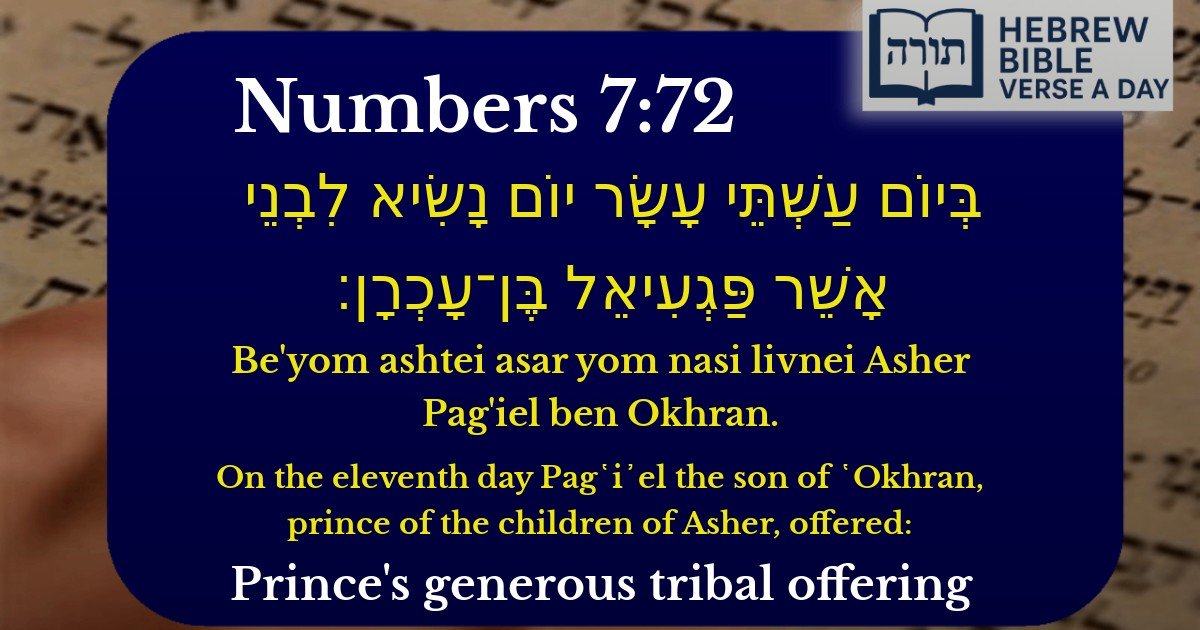
This verse (Bamidbar 7:72) appears in the section describing the offerings brought by the tribal leaders (nesi'im) during the dedication of the Mishkan. Each leader brought identical offerings on successive days, with Pagiel ben Ochran representing the tribe of Asher on the eleventh day.
Meaning of the Names
Asher's Tribal Significance
The Midrash Tanchuma (Naso 14) notes that Asher's offering came after most other tribes, yet their dedication was equally cherished. This reflects the principle that in divine service, timing does not diminish the value of one's contribution—whether in Torah study, prayer, or acts of kindness.
Structural Parallels
The Sforno observes that the repetitive listing of each tribe's identical offerings teaches that although the gifts were materially the same, each leader's kavanah (intent) was unique. Pagiel's offering thus represented Asher's distinct spiritual character—associated with joy and abundance (Devarim 33:24).
Halachic Insight
Rambam (Hilchot Klei HaMikdash 3:4) derives from this section that communal offerings retain individual significance. Though Pagiel brought his gift as a representative, it was recorded separately to honor both him and his tribe.