
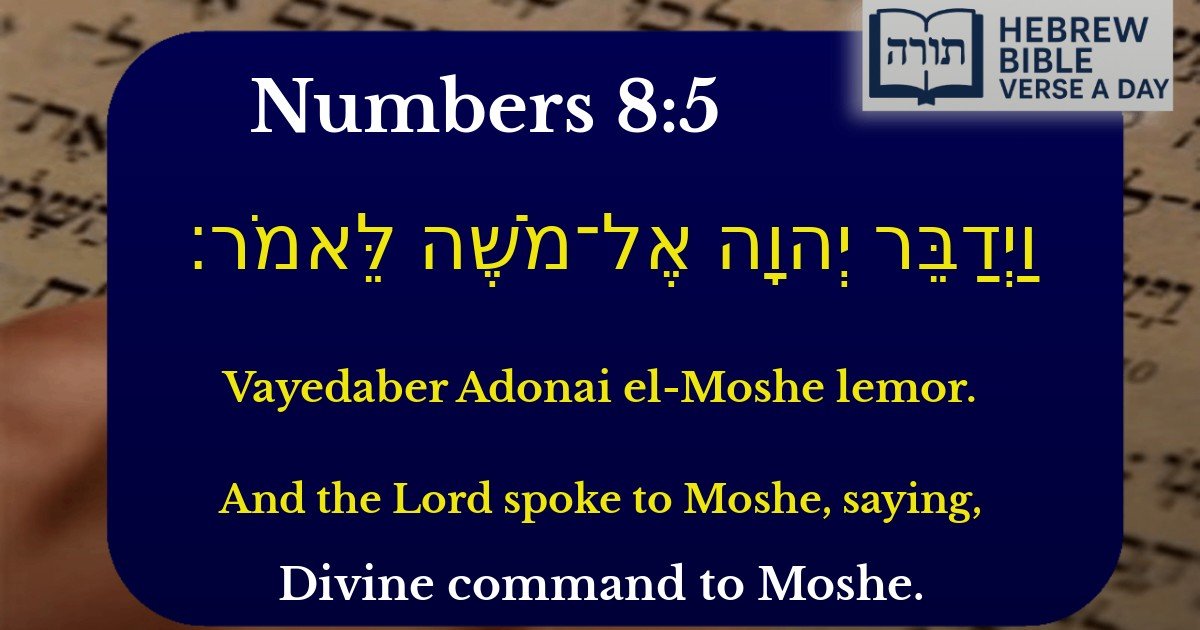

Numbers 8:5 - Divine command to Moshe.

Numbers 8:5 - במדבר 8:5

Hebrew Text

וַיְדַבֵּר יְהוָה אֶל־מֹשֶׁה לֵּאמֹר׃

English Translation

And the Lord spoke to Moshe, saying,

Transliteration

Vayedaber Adonai el-Moshe lemor.

Hebrew Leining Text

וַיְדַבֵּ֥ר יְהֹוָ֖ה אֶל־מֹשֶׁ֥ה לֵּאמֹֽר׃

🎵 Listen to leining

Parasha Commentary

The Divine Communication to Moshe

The phrase "וַיְדַבֵּר יְהוָה אֶל־מֹשֶׁה לֵּאמֹר" ("And the Lord spoke to Moshe, saying") appears frequently in the Torah, introducing direct communication from Hashem to Moshe Rabbeinu. Rashi (Shemot 6:2) notes that this expression signifies a clear and direct prophetic revelation, distinguishing Moshe's unique level of prophecy from that of other prophets. The term "וַיְדַבֵּר" implies a forceful and authoritative transmission of divine will, as opposed to softer forms of communication like "וַיֹּאמֶר" ("and He said").

The Significance of "לֵּאמֹר"

The word "לֵּאמֹר" ("saying") is interpreted by the Midrash (Sifrei Bamidbar 7:89) to indicate that Moshe was commanded to relay the divine message to Bnei Yisrael. Rambam (Hilchos Yesodei HaTorah 7:6) elaborates that Moshe's role as the intermediary was essential for transmitting Torah with precision, ensuring no distortion of Hashem's word.

  • Rashi's View: The term emphasizes Moshe's obligation to teach the words exactly as received (Shemot 19:7).
  • Ramban's Insight: It underscores the perpetual nature of Torah commandments, applicable to all generations (Ramban on Vayikra 1:1).

The Unique Relationship Between Hashem and Moshe

The Talmud (Yevamos 49b) teaches that Moshe was the only prophet to experience prophecy "פֶּה אֶל פֶּה" ("mouth to mouth"), a level of clarity unmatched by other nevi'im. The Ohr HaChaim (Shemot 25:1) adds that this phrase highlights Moshe's readiness to receive divine instruction at all times, reflecting his complete bitul (self-nullification) to Hashem's will.

📚 Talmud Citations

This verse is not quoted in the Talmud.

Frequently Asked Questions

Q: What does it mean when the Torah says 'And the Lord spoke to Moshe, saying'?
A: This phrase is a common introduction in the Torah indicating that Hashem is giving a direct commandment or instruction to Moshe Rabbeinu (Moses our teacher). Rashi explains that this wording emphasizes the precision with which Moshe transmitted Hashem's words to Bnei Yisrael (the Children of Israel).
Q: Why does the Torah repeat 'saying' after 'spoke'?
A: The double language of 'spoke... saying' teaches that Moshe was commanded to repeat these words to others (either to Aharon or to all of Israel). This is based on Talmudic interpretation (Yoma 4a) which learns from such phrasing that prophets must accurately transmit Divine messages.
Q: How many times does this phrase appear in the Torah?
A: The exact phrase 'Vayedaber Hashem el Moshe lemor' appears over 80 times in the Torah, showing the constant communication between Hashem and Moshe. The Rambam (Hilchos Yesodei HaTorah 7:6) explains this demonstrates Moshe's unique level of prophecy.
Q: What can we learn from this verse about prophecy?
A: This teaches us about the clarity of Moshe's prophecy. Unlike other prophets who received messages through dreams or visions (as explained in Bamidbar 12:6-8), Moshe heard Hashem's words directly and clearly, like a person speaking to a friend.
Q: Why is Moshe referred to by name here instead of as 'Moshe Rabbeinu'?
A: The Torah generally refers to Moshe simply by his name to show his humility (as explained in Midrash Tanchuma). Even when receiving prophecy, he remained the most humble of men (Bamidbar 12:3), serving as a model for how to receive Divine communication with proper awe and respect.